

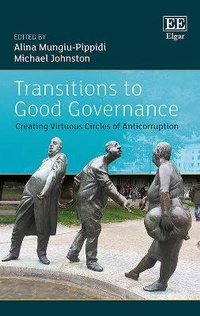
Transitions to Good Governance
Creating Virtuous Circles of Anti-corruption
Published on 29. September 2017
Book
Hardback
320 pages
978-1-78643-914-7 (ISBN)
Description
Why have so few countries managed to leave systematic corruption behind, while in many others modernization is still a mere facade? How do we escape the trap of corruption, to reach a governance system based on ethical universalism? In this unique book, Alina Mungiu-Pippidi and Michael Johnston lead a team of eminent researchers on an illuminating path towards deconstructing the few virtuous circles in contemporary governance. The book combines a solid theoretical framework with quantitative evidence and case studies from around the world. While extracting lessons to be learned from the success cases covered, Transitions to Good Governance avoids being prescriptive and successfully contributes to the understanding of virtuous circles in contemporary good governance.
Offering a balanced but always grounded perspective, this collection combines analytic narratives of existing virtuous circles and how they were established, with an analysis of the global evidence. In doing so the authors explain why governance is so resistant to change, and describe the lessons to be remembered for international anti-corruption efforts. Exploring the primacy of politics over economic development, and in order to understand how vicious circles can be broken, the expert contributions trace the progress of countries that have successfully transitioned. Unprecedentedly, this book goes beyond the tests of different variables to showcase human agency on every continent, and reveals why some nations make the best and others the worst of the same development legacies.
This comprehensive examination of virtuous circles of governance will appeal to all scholars with an interest in transitions, democratization, anti-corruption and good governance. Policy-makers and practitioners in the fields of international development, good governance and democracy support will find it an invaluable resource.
Contributors include: A. Bozzini, D. Bupuet Corleto, C. Goebel, M. Johnston, V. Kalnins, L. Khatib, A. Kupatadze, M. Martini, A. Mungiu-Pippidi, P. Navia, R. Pineiro, D. Sebudubudu, E. Villarreal, B.W. Wilson, J.-S. You
Offering a balanced but always grounded perspective, this collection combines analytic narratives of existing virtuous circles and how they were established, with an analysis of the global evidence. In doing so the authors explain why governance is so resistant to change, and describe the lessons to be remembered for international anti-corruption efforts. Exploring the primacy of politics over economic development, and in order to understand how vicious circles can be broken, the expert contributions trace the progress of countries that have successfully transitioned. Unprecedentedly, this book goes beyond the tests of different variables to showcase human agency on every continent, and reveals why some nations make the best and others the worst of the same development legacies.
This comprehensive examination of virtuous circles of governance will appeal to all scholars with an interest in transitions, democratization, anti-corruption and good governance. Policy-makers and practitioners in the fields of international development, good governance and democracy support will find it an invaluable resource.
Contributors include: A. Bozzini, D. Bupuet Corleto, C. Goebel, M. Johnston, V. Kalnins, L. Khatib, A. Kupatadze, M. Martini, A. Mungiu-Pippidi, P. Navia, R. Pineiro, D. Sebudubudu, E. Villarreal, B.W. Wilson, J.-S. You
Reviews / Votes
'Vicious cycles, where corruption breeds corruption, present special challenges. Nevertheless, some success stories exist. The case studies in this edited volume highlight reforms that created virtuous cycles, where honesty breeds honesty. Nevertheless, the authors caution that reforms may be fragile and incomplete if policies do not shift expectations and behavior sufficiently enough toward a new, less-corrupt status quo.'--Susan Rose-Ackerman, Yale University, US
More details
Language
English
Place of publication
Cheltenham
United Kingdom
Target group
Professional and scholarly
Dimensions
Height: 234 mm
Width: 156 mm
ISBN-13
978-1-78643-914-7 (9781786439147)
Copyright in bibliographic data and cover images is held by Nielsen Book Services Limited or by the publishers or by their respective licensors: all rights reserved.
Schweitzer Classification
Persons
Edited by Alina Mungiu-Pippidi, Professor of Comparative Public Policy, LUISS Guido Carli, Rome, Italy and Michael Johnston, Charles A. Dana Professor of Political Science Emeritus, Colgate University, US
Content
Contents:
1. Introduction: Identifying and explaining governance virtuous circles
Alina Mungiu-Pippidi
2. The atypical achievers: Botswana, Qatar and Rwanda
David Sebudubudu, Lina Khatib and Alessandro Bozzini
3. The Uruguayan path from particularism to universalism
Daniel Buquet Corleto and Rafael Pineiro
4. Georgia: Breaking out of a vicious circle
Alexander Kupatadze
5. The world's smallest virtuous circle: Estonia
Valts Kalnins
6. South Korea: The odyssey to corruption control
Jong-sung You
7. Tracing Taiwan's road to good governance
Christian Goebel
8. Costa Rica: Tipping points and an incomplete journey
Bruce M. Wilson and Evelyn Villarreal
9. Chile: Human agency against the odds
Patricio Navia, Alina Mungiu-Pippidi and Maira Martini
10. Conclusions and lessons learned
Alina Mungiu-Pippidi and Michael Johnston
Index
1. Introduction: Identifying and explaining governance virtuous circles
Alina Mungiu-Pippidi
2. The atypical achievers: Botswana, Qatar and Rwanda
David Sebudubudu, Lina Khatib and Alessandro Bozzini
3. The Uruguayan path from particularism to universalism
Daniel Buquet Corleto and Rafael Pineiro
4. Georgia: Breaking out of a vicious circle
Alexander Kupatadze
5. The world's smallest virtuous circle: Estonia
Valts Kalnins
6. South Korea: The odyssey to corruption control
Jong-sung You
7. Tracing Taiwan's road to good governance
Christian Goebel
8. Costa Rica: Tipping points and an incomplete journey
Bruce M. Wilson and Evelyn Villarreal
9. Chile: Human agency against the odds
Patricio Navia, Alina Mungiu-Pippidi and Maira Martini
10. Conclusions and lessons learned
Alina Mungiu-Pippidi and Michael Johnston
Index