

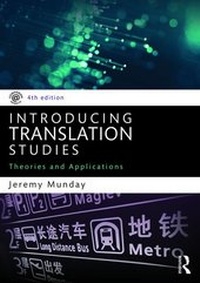
Introducing Translation Studies
Theories and Applications
4th Edition
Published on 1. February 2016
Book
Paperback/Softback
376 pages
978-1-138-91255-7 (ISBN)
Description
Introducing Translation Studies remains the definitive guide to the theories and concepts that make up the field of translation studies. Providing an accessible and up-to-date overview, it has long been the essential textbook on courses worldwide.
This fourth edition has been fully revised and continues to provide a balanced and detailed guide to the theoretical landscape. Each theory is applied to a wide range of languages, including Bengali, Chinese, English, French, German, Italian, Punjabi, Portuguese and Spanish. A broad spectrum of texts is analysed, including the Bible, Buddhist sutras, Beowulf, the fiction of Garcia Marquez and Proust, European Union and UNESCO documents, a range of contemporary films, a travel brochure, a children's cookery book and the translations of Harry Potter.
Each chapter comprises an introduction outlining the translation theory or theories, illustrative texts with translations, case studies, a chapter summary and discussion points and exercises.
NEW FEATURES IN THIS FOURTH EDITION INCLUDE:
new material to keep up with developments in research and practice, including the sociology of translation, multilingual cities, translation in the digital age and specialized, audiovisual and machine translation
revised discussion points and updated figures and tables
new, in-chapter activities with links to online materials and articles to encourage independent research
an extensive updated companion website with video introductions and journal articles to accompany each chapter, online exercises, an interactive timeline, weblinks, and powerpoint slides for teacher support
This is a practical, user-friendly textbook ideal for students and researchers on courses in Translation and Translation Studies.
This fourth edition has been fully revised and continues to provide a balanced and detailed guide to the theoretical landscape. Each theory is applied to a wide range of languages, including Bengali, Chinese, English, French, German, Italian, Punjabi, Portuguese and Spanish. A broad spectrum of texts is analysed, including the Bible, Buddhist sutras, Beowulf, the fiction of Garcia Marquez and Proust, European Union and UNESCO documents, a range of contemporary films, a travel brochure, a children's cookery book and the translations of Harry Potter.
Each chapter comprises an introduction outlining the translation theory or theories, illustrative texts with translations, case studies, a chapter summary and discussion points and exercises.
NEW FEATURES IN THIS FOURTH EDITION INCLUDE:
new material to keep up with developments in research and practice, including the sociology of translation, multilingual cities, translation in the digital age and specialized, audiovisual and machine translation
revised discussion points and updated figures and tables
new, in-chapter activities with links to online materials and articles to encourage independent research
an extensive updated companion website with video introductions and journal articles to accompany each chapter, online exercises, an interactive timeline, weblinks, and powerpoint slides for teacher support
This is a practical, user-friendly textbook ideal for students and researchers on courses in Translation and Translation Studies.
Reviews / Votes
"Jeremy Munday's Introducing Translation Studies has long been admired for its combination of theoretical rigour and down-to-earth explanation, and this new edition will further confirm its place as the go-to introduction for students and teachers alike. Its further incorporation of ideas from the Chinese context is particularly welcome." Robert Neather, Hong Kong Baptist University, China"An even better fourth edition of a widely popular and commonly used book in Translation Studies (TS). Like former editions, Munday's volume is a sound and accessible introduction to TS that will appeal not only to readers with a professional interest in TS but also to scholars and students in related fields. In Introducing Translation Studies, Munday combines scholarly rigor with reader-friendly style and an excellent didactic orientation, which will continue to make this book highly attractive to students, teachers and newcomers." Sonia Colina, University of Arizona, USA
More details
Edition
4th edition
Language
English
Place of publication
London
United Kingdom
Publishing group
Taylor & Francis Ltd
Target group
College/higher education
Illustrations
6 b/w images and 30 tables
Dimensions
Height: 246 mm
Width: 174 mm
Weight
756 gr
ISBN-13
978-1-138-91255-7 (9781138912557)
Copyright in bibliographic data and cover images is held by Nielsen Book Services Limited or by the publishers or by their respective licensors: all rights reserved.
Schweitzer Classification
Other editions
New editions
Jeremy Munday | Sara Ramos Pinto | Jacob Blakesley
Introducing Translation Studies
Theories and Applications
Book
03/2026
6th Edition
Routledge
€52.00
Available immediately
Jeremy Munday | Sara Ramos Pinto | Jacob Blakesley
Introducing Translation Studies
Theories and Applications
Book
04/2022
5th Edition
Routledge
€88.00
Available immediately
Additional editions
Book
02/2016
4th Edition
Routledge
€207.98
Article exhausted; check for reprint
Previous edition
Book
02/2012
3rd Edition
Routledge
€55.89
Article exhausted; check for reprint
Person
Content
A visual tour of Introducing Translation Studies
List of figures and tables
Acknowledgements
List of abbreviations
Introduction
Chapter 1 Main issues of translation studies
Chapter 2 Translation theory before the twentieth century
Chapter 3 Equivalence and equivalent effect
Chapter 4 Studying translation product and process
Chapter 5 Functional theories of translation
Chapter 6 Discourse and Register analysis approaches
Chapter 7 Systems theories
Chapter 8 Cultural and ideological turns
Chapter 9 The role of the translator: visibility, ethics and sociology
Chapter 10 Philosophical approaches to translation
Chapter 11 New directions from the new media
Chapter 12 Research and commentary projects
Notes
Bibliography
Index
List of figures and tables
Acknowledgements
List of abbreviations
Introduction
Chapter 1 Main issues of translation studies
Chapter 2 Translation theory before the twentieth century
Chapter 3 Equivalence and equivalent effect
Chapter 4 Studying translation product and process
Chapter 5 Functional theories of translation
Chapter 6 Discourse and Register analysis approaches
Chapter 7 Systems theories
Chapter 8 Cultural and ideological turns
Chapter 9 The role of the translator: visibility, ethics and sociology
Chapter 10 Philosophical approaches to translation
Chapter 11 New directions from the new media
Chapter 12 Research and commentary projects
Notes
Bibliography
Index