

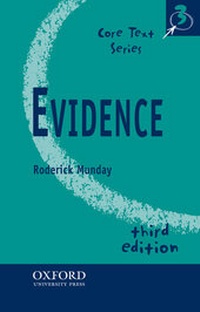
Evidence
3rd Edition
Published on 1. July 2005
Book
Paperback/Softback
644 pages
978-0-19-928510-5 (ISBN)
Description
Like its predecessors, the third edition of "Evidence" sets out in a readable style the leading rules of the Law of Evidence. This new edition takes full account of the profound changes that have occurred within this fast-evolving area of law since the previous edition. Indeed, much of the book has been completely re-written in order to accommodate both the major reforms affected by the Criminal Justice Act 2003 and the not insignificant developments that have taken place within the relevant case law. The book covers all the major topics of the Law of Evidence. Although essentially designed as an introduction to the subject, it does not shy from subjecting some issues to a more searching and critical treatment, if they happen to present particular interest. Students sometimes find the Law of Evidence an intimidating subject. This lively, and in places entertaining, text, in the words of the song, may offer that spoonful of sugar to help the medicine go down. In any event, this work provides all the basic information the student is likely to need when studying on LLB, LPC, and Bar Vocational courses.
More details
Edition
3rd Revised edition
Language
English
Place of publication
Oxford
United Kingdom
Target group
College/higher education
Edition type
Revised edition
Dimensions
Height: 216 mm
Width: 138 mm
ISBN-13
978-0-19-928510-5 (9780199285105)
Copyright in bibliographic data and cover images is held by Nielsen Book Services Limited or by the publishers or by their respective licensors: all rights reserved.
Schweitzer Classification
Other editions
Content
INTRODUCTION; 1. Relevance and admissibility of evidence; 2. Presumptions and the burden of proof; 3. Witnesses: competence, compellability and various privileges; 4. The course of the trial; 5. Witnesses' previous consistent statements and remnants of the rule against narrative; 6. Character and credibility; 7. Evidence of the defendant's bad character; 8. The opinion rule and the presentation of expert evidence; 9. The rule against hearsay; 10. Confessions; 11. Drawing adverse inferences from a defendant's omissions, lies or false alibis; 12. Identification evidence; 13. Documents; INDEX