

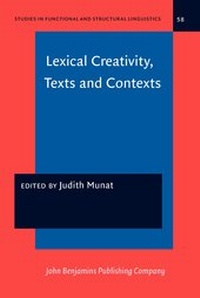
Lexical Creativity, Texts and Contexts
Published on 6. November 2007
Book
Hardback
294 pages
978-90-272-1567-3 (ISBN)
Description
The coining of novel lexical items and the creative manipulation of existing words and expressions is heavily dependent on contextual factors, including the semantic, stylistic, textual and social environments in which they occur. The twelve specialists contributing to this collection aim to illuminate creativity in word formation with respect to functional discourse roles, but also examine 'critical creativity' determined by language policy, as well as diachronic phonetic variation in creatively-coined words.
The data, based either on large corpora or smaller hand-collected samples, is drawn from advertising, the daily press, electronic communication, literature, spoken interaction, cartoons, lexical ontologies and style guides.
The coining of novel lexical items and the creative manipulation of existing words and expressions is heavily dependent on contextual factors, including the semantic, stylistic, textual and social environments in which they occur. The twelve specialists contributing to this collection aim to illuminate creativity in word formation with respect to functional discourse roles, but also examine 'critical creativity' determined by language policy, as well as diachronic phonetic variation in creatively-coined words. The data, based either on large corpora or smaller hand-collected samples, is drawn from advertising, the daily press, electronic communication, literature, spoken interaction, cartoons, lexical ontologies and style guides. Each study analyses novel formations in relation to their contexts of use and inevitably leads to the crucial question of creativity vs. productivity. By focussing on creative lexical formations at the level of parole, these studies provide insights into morphological theory at the level of langue, and ultimately seek to explain lexical creativity as a function of language use.
The data, based either on large corpora or smaller hand-collected samples, is drawn from advertising, the daily press, electronic communication, literature, spoken interaction, cartoons, lexical ontologies and style guides.
The coining of novel lexical items and the creative manipulation of existing words and expressions is heavily dependent on contextual factors, including the semantic, stylistic, textual and social environments in which they occur. The twelve specialists contributing to this collection aim to illuminate creativity in word formation with respect to functional discourse roles, but also examine 'critical creativity' determined by language policy, as well as diachronic phonetic variation in creatively-coined words. The data, based either on large corpora or smaller hand-collected samples, is drawn from advertising, the daily press, electronic communication, literature, spoken interaction, cartoons, lexical ontologies and style guides. Each study analyses novel formations in relation to their contexts of use and inevitably leads to the crucial question of creativity vs. productivity. By focussing on creative lexical formations at the level of parole, these studies provide insights into morphological theory at the level of langue, and ultimately seek to explain lexical creativity as a function of language use.
More details
Series
Language
English
Place of publication
Amsterdam
Netherlands
Target group
Professional and scholarly
Dimensions
Height: 245 mm
Width: 164 mm
Weight
710 gr
ISBN-13
978-90-272-1567-3 (9789027215673)
Copyright in bibliographic data and cover images is held by Nielsen Book Services Limited or by the publishers or by their respective licensors: all rights reserved.
Schweitzer Classification
Other editions
Additional editions
Judith Munat
Lexical Creativity, Texts and Contexts
E-Book
11/2007
1st Edition
John Benjamins Publishing Company
€136.99
Available for download
Person
Content
1. List of tables; 2. List of figures; 3. List of contributors; 4. Editor's Preface; 5. Introduction; 6. Lexical creativity, textuality and problems of metalanguage (by Lipka, Leonhard); 7. Lexical Creativity in Disourse; 8. How to do (even more) things with nonce words (other than naming) (by Hohenhaus, Peter); 9. The phonetics of 'un' (by Hay, Jennifer); 10. Lexical creativity in texts; 11. The press ; 12. Tracing lexical productivity and creativity in the British media: The Chavs and the Chav-Nots (by Renouf, Antoinette); 13. Cartoon art; 14. Cathy Wilcox meets the phrasal lexicon: Creative deformation of phrasal lexical items for humorous effect (by Kuiper, Koenraad); 15. Advertising and the media; 16. Blendalicious (by Lehrer, Adrienne); 17. Electronic communication; 18. Keeping up with the times: Lexical creativity in electronic communication (by Lopez Rua, Paula); 19. Fictional genres; 20. Lexical creativity as a marker of style in science fiction and children's literature (by Munat, Judith); 21. Creative concept formation; 22. Dynamic creation of analogically-motivated terms and categories in lexical ontologies (by Veale, Tony); 23. Creative lexical categorization in a narrative fiction (by Porto, M. Dolores); 24. Sociopolitical effects on creativity; 25. Occasional and systematic shifts in word-formation and idiom use in Latvian as a result of translation (by Veisbergs, Andrejs); 26. Critical creativity: A study of 'politically correct' terms in style guides for different types of discourse (by Fischer, Roswitha); 27. Name index; 28. Subject index