

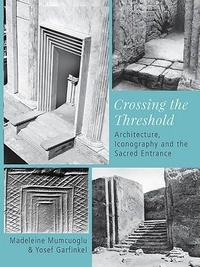
Crossing the Threshold
Architecture, Iconography and the Sacred Entrance
Published on 12. July 2018
Book
Hardback
208 pages
978-1-78925-076-3 (ISBN)
Description
Every day millions of people enter public buildings of many forms and functions: Notre-Dame in Paris, Central Station in New York; the British Museum in London, that are decorated with recessed doorways. None of them is likely to be aware that this style of decoration has been continuously employed for 6500 years in temples, royal palaces, tombs, churches, synagogues and modern public buildings, becoming a symbol of the divine and of a place of worship. During this very long period, from the ancient Near East until today, the world has undergone immense changes, but the concept of the recessed opening was never forgotten or abandoned. What is the secret of its longevity? This unique cultural edifice is not only about architecture, but is a language that defines social order and relations with the ruling power and authorities. These, sometimes highly decorated and elaborate, sometimes simple and understated, thresholds in fact functioned on two communicative levels: first, as a liminal marker demarcating a sacred area and second, to emphasize the social order, as few were permitted to pass through. In this book the history of this eternal symbol is presented for the first time through text, figures and photographs. The authors consider historical, anthropological, sociological, religious and economic factors that reflect the significance of crossing these iconic thresholds according to the concept of the longue duree.
More details
Language
English
Place of publication
Oxford
United Kingdom
Target group
Professional and scholarly
Product notice
sewn/stitched
Cloth over boards
Illustrations
b/w
Dimensions
Height: 282 mm
Width: 221 mm
Thickness: 20 mm
Weight
975 gr
ISBN-13
978-1-78925-076-3 (9781789250763)
Copyright in bibliographic data and cover images is held by Nielsen Book Services Limited or by the publishers or by their respective licensors: all rights reserved.
Schweitzer Classification
Other editions
Additional editions
Mumcuoglu Madeleine Mumcuoglu | Garfinkel Yosef Garfinkel
Crossing the Threshold
Architecture, Iconography and the Sacred Entrance
E-Book
09/2018
Oxbow Books
€36.99
Available for download
Mumcuoglu Madeleine Mumcuoglu | Garfinkel Yosef Garfinkel
Crossing the Threshold
Architecture, Iconography and the Sacred Entrance
E-Book
09/2018
OXBOW BOOKS
€36.99
Available for download
Persons
Yosef Garfinkel is Yigael Yadin Chair in the Archaeology of Israel at the Hebrew University of Jerusalem. He has wide ranging research interests focused on the Levant region, mainly in the Neolithic period but also on Biblical archaeology and urban development.
Content
Foreword
Acknowledgements
List of Figures and Tables
Part I. Introduction, Methodology, Summarizing the Data, Discussion
Chapter 1: Introduction
Chapter 2: Methodology
Chapter 3: Summarizing the Data
Chapter 4: Discussion
Part II. The Data: Recessed Openings in Architecture, Iconography and Text
Chapter 5: Recessed Openings from Late Prehistoric Mesopotamia (fifth and fourth millennia BCE)
Chapter 6: Recessed Openings of the World's Earliest Cities (late fourth and third millennia BCE Mesopotamia)
Chapter 7: Recessed Openings in Second Millennium BCE Mesopotamia and Adjacent Regions
Chapter 8: Recessed Openings in First Millennium BCE Mesopotamia
Chapter 9: Recessed Openings in the Iron Age and Persian Period in the Levant, Sardinia and Carthage (10th to 4th centuries BCE)
Chapter 10: Recessed Openings in Late Antiquity Judaism
Chapter 11: Recessed Openings in the Greek, Hellenistic and Roman Worlds (sixth century BCE to third century CE)
Chapter 12: Recessed Openings in Early Christian Architecture: Byzantine, Romanesque and Gothic (fourth century to 13th century CE)
Chapter 13: Recessed Openings in later Periods
References
Acknowledgements
List of Figures and Tables
Part I. Introduction, Methodology, Summarizing the Data, Discussion
Chapter 1: Introduction
Chapter 2: Methodology
Chapter 3: Summarizing the Data
Chapter 4: Discussion
Part II. The Data: Recessed Openings in Architecture, Iconography and Text
Chapter 5: Recessed Openings from Late Prehistoric Mesopotamia (fifth and fourth millennia BCE)
Chapter 6: Recessed Openings of the World's Earliest Cities (late fourth and third millennia BCE Mesopotamia)
Chapter 7: Recessed Openings in Second Millennium BCE Mesopotamia and Adjacent Regions
Chapter 8: Recessed Openings in First Millennium BCE Mesopotamia
Chapter 9: Recessed Openings in the Iron Age and Persian Period in the Levant, Sardinia and Carthage (10th to 4th centuries BCE)
Chapter 10: Recessed Openings in Late Antiquity Judaism
Chapter 11: Recessed Openings in the Greek, Hellenistic and Roman Worlds (sixth century BCE to third century CE)
Chapter 12: Recessed Openings in Early Christian Architecture: Byzantine, Romanesque and Gothic (fourth century to 13th century CE)
Chapter 13: Recessed Openings in later Periods
References