

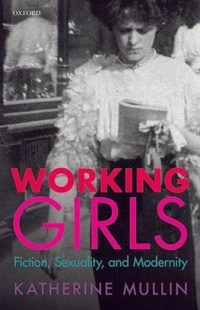
Working Girls
Fiction, Sexuality, and Modernity
Published on 5. May 2016
Book
Hardback
288 pages
978-0-19-872484-1 (ISBN)
Description
Working Girls: Fiction, Sexuality, and Modernity investigates the significance of a new form of sexual identity at the end of the nineteenth and beginning of the twentieth century. Young women of the lower-middle and working classes were increasingly abandoning domestic service in favour of occupations of contested propriety. They inspired both moral unease and erotic fascination. Working Girls considers representations of four highly glamorised yet controversial types of women worker: telegraphists and typists (in newly-feminised offices), shop assistants (in the new department stores), and barmaids (in the new 'gin palaces' of major British cities).
Economically emancipated (more or less) and liberated (more or less) from the protection and constraints of home and family, shop-girls, barmaids, typists, and telegraphists became mass media sensations. They energised a wide range of late-Victorian and Modernist fiction. This study will bring late-Victorian and Modernist British writers into intimate conversation with a substantial new archive of ephemeral sources often regarded as remote from high art and its concerns: popular fiction; music hall and musical comedy; beauty pageants and fairground exhibitions; visual art and early film; careers manuals; magazine and periodical journalism; moral reform crusades, Royal Commissions, and attempts at protective legislation.
Working Girls argues that these seductive yet perilous young women helped writers negotiate anxieties about the state of literary culture in the United Kingdom. Crucially, they preoccupy novelists who were themselves beleaguered by anxieties over cultural capital, the shifting pressures of the literary marketplace, or controversies about the morality of fiction (often leading to the threat of censorship). In articulating questions about sexual integrity, Working Girls articulate often submerged questions about textual integrity and the role of the modern novel.
Economically emancipated (more or less) and liberated (more or less) from the protection and constraints of home and family, shop-girls, barmaids, typists, and telegraphists became mass media sensations. They energised a wide range of late-Victorian and Modernist fiction. This study will bring late-Victorian and Modernist British writers into intimate conversation with a substantial new archive of ephemeral sources often regarded as remote from high art and its concerns: popular fiction; music hall and musical comedy; beauty pageants and fairground exhibitions; visual art and early film; careers manuals; magazine and periodical journalism; moral reform crusades, Royal Commissions, and attempts at protective legislation.
Working Girls argues that these seductive yet perilous young women helped writers negotiate anxieties about the state of literary culture in the United Kingdom. Crucially, they preoccupy novelists who were themselves beleaguered by anxieties over cultural capital, the shifting pressures of the literary marketplace, or controversies about the morality of fiction (often leading to the threat of censorship). In articulating questions about sexual integrity, Working Girls articulate often submerged questions about textual integrity and the role of the modern novel.
Reviews / Votes
In exploring the diverse tensions surrounding an emergent female work force, Working Girls ultimately provides a fascinating cultural genealogy of modern postfeminism. * David M Earle, James Joyce Literary Supplement * the coverage of Working Girls is extensive and Mullins book is both erudite and enjoyable to read. * Deborah Wynne, Review of English Studies *More details
Product info
Print PDF
Language
English
Place of publication
Oxford
United Kingdom
Target group
College/higher education
Product notice
sewn/stitched
Cloth over boards
Illustrations
17 black-and-white halftones
Dimensions
Height: 234 mm
Width: 160 mm
Thickness: 23 mm
Weight
544 gr
ISBN-13
978-0-19-872484-1 (9780198724841)
Schweitzer Classification
Other editions
Additional editions
E-Book
05/2016
1st Edition
OUP eBook
€54.49
Available for download
Person
Katherine Mullin lectures in Victorian and Modern Literature at the University of Leeds. She is the author of James Joyce, Sexuality and Social Purity (Cambridge University Press, 2003), and articles on Modernism, late-Victorian fiction, and censorship. She is currently working on an edition of George Gissing's New Grub Street for Oxford World's Classics.
Content
PART I: TYPISTS AND TELEGRAPHISTS; PART II: SHOP-GIRLS; PART III: BARMAIDS