

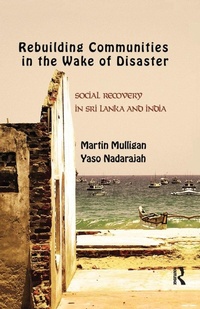
Rebuilding Local Communities in the Wake of Disaster
Social Recovery in Sri Lanka and India
1st Edition
Published on 21. January 2016
Book
Paperback/Softback
252 pages
978-1-138-66242-1 (ISBN)
Description
This book examines the sociological consequences of disaster relief and recovery, and uncovers its impact on the communities that were affected by the Indian Ocean tsunami in 2004. It is the most extensive and intensive study of post-disaster community rebuilding yet reported in the literature on the subject. The authors draw on this research to develop a three-phase strategy for moving from quick and effective relief to long-term social recovery work.
While there have been many big natural disasters since then, none have affected so many local communities spread over so many nations and none have evoked the same kind of global response. A great deal of post-tsunami recovery work was done in India and Sri Lanka, with more than 500 international aid and humanitarian agencies involved in Sri Lanka alone - many with little experience in long-term community development. This book argues that international aid agencies must work patiently to put in place meaningful partnerships with local, community-based organisations as soon as long-term physical and social planning becomes possible.
The authors explain that such an approach could help address some pre-existing vulnerabilities in disaster-affected communities. They argue that it is much easier to rebuild damaged infrastructure than to rebuild shattered lives, and to ensure that traumatised communities are not put under new stresses and strains, the 'fault-lines' within these communities need to be lessened.
While there have been many big natural disasters since then, none have affected so many local communities spread over so many nations and none have evoked the same kind of global response. A great deal of post-tsunami recovery work was done in India and Sri Lanka, with more than 500 international aid and humanitarian agencies involved in Sri Lanka alone - many with little experience in long-term community development. This book argues that international aid agencies must work patiently to put in place meaningful partnerships with local, community-based organisations as soon as long-term physical and social planning becomes possible.
The authors explain that such an approach could help address some pre-existing vulnerabilities in disaster-affected communities. They argue that it is much easier to rebuild damaged infrastructure than to rebuild shattered lives, and to ensure that traumatised communities are not put under new stresses and strains, the 'fault-lines' within these communities need to be lessened.
More details
Language
English
Place of publication
London
United Kingdom
Publishing group
Taylor & Francis Ltd
Target group
College/higher education
Dimensions
Height: 216 mm
Width: 140 mm
Thickness: 14 mm
Weight
322 gr
ISBN-13
978-1-138-66242-1 (9781138662421)
Copyright in bibliographic data and cover images is held by Nielsen Book Services Limited or by the publishers or by their respective licensors: all rights reserved.
Schweitzer Classification
Other editions
Additional editions
Martin Mulligan | Yaso Nadarajah
Rebuilding Local Communities in the Wake of Disaster
Social Recovery in Sri Lanka and India
E-Book
11/2020
1st Edition
Routledge India
€64.49
Available for download
Martin Mulligan | Yaso Nadarajah
Rebuilding Local Communities in the Wake of Disaster
Social Recovery in Sri Lanka and India
E-Book
11/2020
1st Edition
Routledge India
€64.49
Available for download
Martin Mulligan | Yaso Nadarajah
Rebuilding Local Communities in the Wake of Disaster
Social Recovery in Sri Lanka and India
Book
12/2011
1st Edition
Routledge India
€206.10
Shipment within 15-20 days
Persons
Martin Mulligan is Director, Globalism Research Centre, School of Global Studies, Social Science and Planning, RMIT University, Melbourne, Australia.
Yaso Nadarajah is Senior Research Fellow, Globalism Research Centre and Senior Research Manager, Global Cities Research Institute, RMIT University, Melbourne, Australia.
Yaso Nadarajah is Senior Research Fellow, Globalism Research Centre and Senior Research Manager, Global Cities Research Institute, RMIT University, Melbourne, Australia.
Content
Acknowledgements. Glossary 1. Introduction 2. Setting the Research Questions 3. How and Where the Study was Conducted 4. Thematic Analysis of Research Outcomes 5. A Summary of Research Findings 6. Towards a Community Development Approach to Disaster Recovery. Bibliography. About the Authors. Index