

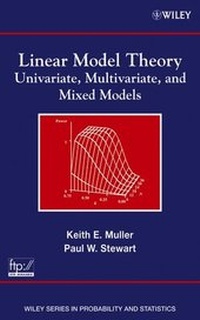
Linear Model Theory
Univariate, Multivariate, and Mixed Models
Published on 22. August 2006
Book
Hardback
410 pages
978-0-471-21488-5 (ISBN)
Description
A precise and accessible presentation of linear model theory, illustrated with data examples
Statisticians often use linear models for data analysis and for developing new statistical methods. Most books on the subject have historically discussed univariate, multivariate, and mixed linear models separately, whereas Linear Model Theory: Univariate, Multivariate, and Mixed Models presents a unified treatment in order to make clear the distinctions among the three classes of models.
Linear Model Theory: Univariate, Multivariate, and Mixed Models begins with six chapters devoted to providing brief and clear mathematical statements of models, procedures, and notation. Data examples motivate and illustrate the models. Chapters 7-10 address distribution theory of multivariate Gaussian variables and quadratic forms. Chapters 11-19 detail methods for estimation, hypothesis testing, and confidence intervals. The final chapters, 20-23, concentrate on choosing a sample size. Substantial sets of excercises of varying difficulty serve instructors for their classes, as well as help students to test their own knowledge.
The reader needs a basic knowledge of statistics, probability, and inference, as well as a solid background in matrix theory and applied univariate linear models from a matrix perspective. Topics covered include:
* A review of matrix algebra for linear models
* The general linear univariate model
* The general linear multivariate model
* Generalizations of the multivariate linear model
* The linear mixed model
* Multivariate distribution theory
* Estimation in linear models
* Tests in Gaussian linear models
* Choosing a sample size in Gaussian linear models
Filling the need for a text that provides the necessary theoretical foundations for applying a wide range of methods in real situations, Linear Model Theory: Univariate, Multivariate, and Mixed Models centers on linear models of interval scale responses with finite second moments. Models with complex predictors, complex responses, or both, motivate the presentation.
Reviews / Votes
"This text successfully offers a unified context for the theory of univariate, multivariate, and mixed modeling settings and may be useful supplemental text for individuals interested in multivariate modeling." (Journal of the American Statistician, December 2008) "I believe that this text provides an important contribution to the long-memory time series literature. I feel that it largely achieves its aims and could be useful for those instructors wishing to teach a semester-long special topics course ... .I strongly recommend this book to anyone interested in long-memory time series. Both researchers and beginners alike will find this text extremely useful." (Journal of the American Statistician, December 2008)"The book will certainly be useful for Ph.D. students and researchers in biostatistics who want to learn a little bit of theory of linear models." (Mathematical Reviews, 2007)
"...stands out from the others...will certainly have its enthusiastic supporters." (Biometrics, March 2007)
"...an excellent book for graduate students and professional researchers." (MAA Reviews, February 2007)
"The focus of this book is on linear models with correlated observations and Gaussian errors." (Zentralblatt MATH, April 2007)
More details
Product info
gebunden
Edition
1. Auflage
Language
English
Place of publication
United States
Publishing group
John Wiley & Sons Inc
Target group
Professional and scholarly
Dimensions
Height: 23.6 cm
Width: 16.1 cm
Thickness: 2.5 cm
Weight
698 gr
ISBN-13
978-0-471-21488-5 (9780471214885)
Schweitzer Classification
Other editions
Additional editions
E-Book
08/2006
Wiley
€136.99
Available for download
Persons
KEITH E. MULLER, PhD, is Professor and Director of the Division of Biostatistics in the Department of Epidemiology and Health Policy Research in the College of Medicine at the University of Florida in Gainesville, as well as Professor Emeritus of Biostatistics at The University of North Carolina at Chapel Hill where the book was written.
PAUL W. STEWART, PhD, is Research Associate Professor of Biostatistics at The University of North Carolina at Chapel Hill.
Content
Preface.
PART I: MODELS AND EXAMPLES.
1. Matrix Algebra for Linear Models.
2. The General Linear Univariate Model.
3. The General Linear Multivariate Model.
4. Generalizations of the Multivariate Linear Model.
5. The Linear Mixed Model.
6. Choosing the Form of a Linear Model for Analysis.
PART II: MULTIVARIATE DISTRIBUTION THEORY.
7. General Theory of Multivariate Distributions.
8. Scalar, vector, and Matrix Gaussian Distributions.
9. Univariate Quadratic Forms.
10. Multivariate Quadratic Forms.
PART III: ESTIMATION IN LINEAR MODELS.
11. Estimation for Univariate and Weighted Linear Models.
12. Estimation for Multivariate Linear Models.
13. Estimation for Generalizations of Multivariate Models.
14. Estimation for Linear Mixed Models.
PART IV: TESTS IN GAUSSIAN LINEAR MODELS.
15. Tests for Univariate Linear Models.
16. Tests for Multivariate Linear Models.
17. Tests for Generalizations of Multivariate Linear Models.
18. Tests for Linear Mixed Models.
19. A Review of Multivariate and Univariate Linear Models.
PART V: CHOOSING A SIMPLE SIZE IN GAUSSIAN LINEAR MODELS.
20. Sample Size for Univariate Linear Model.
21. Sample Size for Multivariate Linear Model.
22. Sample Size for Generalizations of Multivariate Models.
23. Sample Size for Linear Mixed Models.
Appendix: Computing Resources.
References.
Index.