

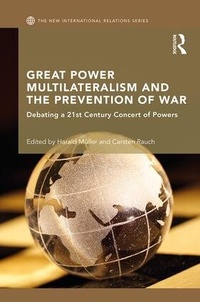
Great Power Multilateralism and the Prevention of War
Debating a 21st Century Concert of Powers
1st Edition
Published on 2. October 2017
Book
Hardback
268 pages
978-1-138-63443-5 (ISBN)
Description
Great-power conflict and great-power war are still the most dangerous risks the international community is facing today. This edited volume investigates the feasibility of a modern day concert of powers as a way for managing the risk of great power conflicts in the 21st century. The volume takes its inspiration from history.
The 19th century European Concert was not only able to ensure a period of exceptional peacefulness among the European great powers, it also limited the scope and duration of the few wars that did break out. The chapter authors discuss the achievements and limits of the historical concert, define the requirements that a new concert would have to meet, critically evaluate obstacles and risks of the approach and indicate how a 21st century concert of powers could complement, and fit into, the present legal and institutional setting of global politics.
This volume offers a systematic examination of the norms and tools of the historical template and scrutinizes these tools for their utility in our time. It will be of great interest to a wide range of scholars and students in areas such as International Relations, History and International Law.
The 19th century European Concert was not only able to ensure a period of exceptional peacefulness among the European great powers, it also limited the scope and duration of the few wars that did break out. The chapter authors discuss the achievements and limits of the historical concert, define the requirements that a new concert would have to meet, critically evaluate obstacles and risks of the approach and indicate how a 21st century concert of powers could complement, and fit into, the present legal and institutional setting of global politics.
This volume offers a systematic examination of the norms and tools of the historical template and scrutinizes these tools for their utility in our time. It will be of great interest to a wide range of scholars and students in areas such as International Relations, History and International Law.
More details
Series
Language
English
Place of publication
London
United Kingdom
Publishing group
Taylor & Francis Ltd
Target group
College/higher education
Postgraduate and Undergraduate
Illustrations
7 s/w Tabellen, 5 s/w Zeichnungen, 5 s/w Abbildungen
7 Tables, black and white; 5 Line drawings, black and white; 5 Illustrations, black and white
Dimensions
Height: 234 mm
Width: 156 mm
Weight
690 gr
ISBN-13
978-1-138-63443-5 (9781138634435)
Copyright in bibliographic data and cover images is held by Nielsen Book Services Limited or by the publishers or by their respective licensors: all rights reserved.
Schweitzer Classification
Other editions
Additional editions
Harald Muller | Carsten Rauch
Great Power Multilateralism and the Prevention of War
Debating a 21st Century Concert of Powers
Book
08/2020
1st Edition
Routledge
€65.60
Shipment within 15-20 days
Harald Muller | Carsten Rauch
Great Power Multilateralism and the Prevention of War
Debating a 21st Century Concert of Powers
E-Book
09/2017
Routledge
€58.99
Available for download
Harald Muller | Carsten Rauch
Great Power Multilateralism and the Prevention of War
Debating a 21st Century Concert of Powers
E-Book
09/2017
Routledge
€59.49
Available for download
Persons
Harald Mueller has been Executive Director of the Peace Research Institute Frankfurt (PRIF) for twenty years and Professor of International Relations at Goethe University, Frankfurt, Germany. He retired in 2016.
Carsten Rauch is a Research Fellow at the Peace Research Institute Frankfurt, Germany. He received his PhD from Goethe University in 2013.
Carsten Rauch is a Research Fellow at the Peace Research Institute Frankfurt, Germany. He received his PhD from Goethe University in 2013.
Content
Preface
Part I: Laying the Groundwork
Chapter 1: Introduction: Risks of Great Power Conflict in the 21st Century
Harald Mueller, Carsten Rauch and Iris Wurm
Chapter 2: The Concert of Europe and International Security Governance: How did it Operate, What did it Accomplish, What were its Shortcomings, What can we Learn?
Matthias Schulz
Chapter 3: Concerts as a Mode of Ordering in World Politics: An Ideal Type Approach
Adam Humphreys
Part II: Marking the Challenges
Chapter 4: The Dark Side of the European Concert of Powers: Caveats to be Taken into Account for Successfully Managing Peace
Andreas Fahrmeir
Chapter 5: The Dangers of Great Power Connivance
Bertrand Badie
Chapter 6: The Club Practices of Concert Diplomacy. The Paradox and Effects of Selective Cooperation with Global Objectives
Melanie Albaret and Delphine Lagrange
Chapter 7: The Concert and Existing Organizations and Legal Structures at the Global Level
Stefan Kadelbach
Part III: Tackling Diversity and Exclusion: Common Norms, Justice and Legitimacy
Chapter 8: The Normative Foundations for a New Global Concert in an Age of Western Retrenchment
Kyle Lascurettes and Sara B. Moller
Chapter 9: The Concert of Powers and Competing Government Models
Hans-Joachim Spanger
Chapter 10: Just a Concert or a Just Concert: The Role of Justice and Fairness Considerations
Harald Mueller, Daniel Mueller and Carsten Rauch
Chapter 11: The Exclusion Problem and the Need for Legitimacy
Konstanze Juengling and Siddharth Mallavarapu
Chapter 12: Ownership Matters in a 21st Century Concert of Powers
Pang Zhongying and Mao Weizhun
Part IV: Accounting for the Differences: Adapting to 21st Century Circumstances
Chapter 13: Between Informality and Formality: Concert Operations in a Densely Institutionalized World
Kanti Bajpai and Harald Mueller
Chapter 14: Concert of Concerts: The Geopolitical Role of Regional Inter-State Organizations
Alexander Nikitin and Oleg Demidov
Chapter 15: Great Power Accommodation, Nuclear Weapons and Concerts of Power
Nicola Leveringhaus and Andrew Hurrell
Conclusion
Chapter 16: Managing Power Transitions with a Concert of Powers
Harald Mueller and Carsten Rauch
Part I: Laying the Groundwork
Chapter 1: Introduction: Risks of Great Power Conflict in the 21st Century
Harald Mueller, Carsten Rauch and Iris Wurm
Chapter 2: The Concert of Europe and International Security Governance: How did it Operate, What did it Accomplish, What were its Shortcomings, What can we Learn?
Matthias Schulz
Chapter 3: Concerts as a Mode of Ordering in World Politics: An Ideal Type Approach
Adam Humphreys
Part II: Marking the Challenges
Chapter 4: The Dark Side of the European Concert of Powers: Caveats to be Taken into Account for Successfully Managing Peace
Andreas Fahrmeir
Chapter 5: The Dangers of Great Power Connivance
Bertrand Badie
Chapter 6: The Club Practices of Concert Diplomacy. The Paradox and Effects of Selective Cooperation with Global Objectives
Melanie Albaret and Delphine Lagrange
Chapter 7: The Concert and Existing Organizations and Legal Structures at the Global Level
Stefan Kadelbach
Part III: Tackling Diversity and Exclusion: Common Norms, Justice and Legitimacy
Chapter 8: The Normative Foundations for a New Global Concert in an Age of Western Retrenchment
Kyle Lascurettes and Sara B. Moller
Chapter 9: The Concert of Powers and Competing Government Models
Hans-Joachim Spanger
Chapter 10: Just a Concert or a Just Concert: The Role of Justice and Fairness Considerations
Harald Mueller, Daniel Mueller and Carsten Rauch
Chapter 11: The Exclusion Problem and the Need for Legitimacy
Konstanze Juengling and Siddharth Mallavarapu
Chapter 12: Ownership Matters in a 21st Century Concert of Powers
Pang Zhongying and Mao Weizhun
Part IV: Accounting for the Differences: Adapting to 21st Century Circumstances
Chapter 13: Between Informality and Formality: Concert Operations in a Densely Institutionalized World
Kanti Bajpai and Harald Mueller
Chapter 14: Concert of Concerts: The Geopolitical Role of Regional Inter-State Organizations
Alexander Nikitin and Oleg Demidov
Chapter 15: Great Power Accommodation, Nuclear Weapons and Concerts of Power
Nicola Leveringhaus and Andrew Hurrell
Conclusion
Chapter 16: Managing Power Transitions with a Concert of Powers
Harald Mueller and Carsten Rauch