

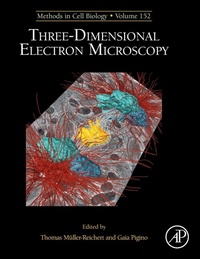
Three-Dimensional Electron Microscopy: Volume 152
Published on 18. July 2019
Book
Hardback
303 pages
978-0-12-817018-2 (ISBN)
Description
Three-Dimensional Electron Microscopy, Volume 152 in the Methods in Cell Biology series, highlights new advances in the field, with this new volume presenting interesting chapters focusing on FIB-SEM of mouse nervous tissue: fast and slow sample preparation, Serial-section electron microscopy using ATUM - Automated Tape collecting Ultra-Microtome, Software for automated acquisition of electron tomography tilt series, Scanning electron tomography of biological samples embedded in plastic, Cryo-STEM tomography for Biology, CryoCARE: Content-aware denoising of cryo-EM images and tomograms using artificial neural networks, Expedited large-volume 3-D SEM workflows for comparative vertebrate microanatomical imaging, and many other interesting topics.
More details
Language
English
Place of publication
San Diego
United States
Publishing group
Elsevier Science Publishing Co Inc
Target group
Professional and scholarly
Postgraduates and researchers in the area of molecular and cellular biology and other scientific areas.
Product notice
Laminated cover
Dimensions
Height: 235 mm
Width: 191 mm
Thickness: 18 mm
Weight
738 gr
ISBN-13
978-0-12-817018-2 (9780128170182)
Copyright in bibliographic data and cover images is held by Nielsen Book Services Limited or by the publishers or by their respective licensors: all rights reserved.
Schweitzer Classification
Other editions
Additional editions
Persons
Thomas Mueller-Reichert is a Professor of Structural Cell Biology at the Technische Universitaet Dresden (TU Dresden, Germany). He is interested in how the microtubule cytoskeleton is modulated within cells to fulfill functions in mitosis, meiosis and abscission. The Mueller-Reichert lab is mainly applying correlative light microscopy and electron tomography to study the 3D organization of microtubules in early embryos and meiocytes of the nematode Caenorhabditis elegans, and also in mammalian cells in culture. He has published over 75 papers and edited several volumes of the Methods in Cell Biology series on electron microscopy and CLEM.
TMR obtained his PhD at the Swiss Federal Institute of Technology (ETH) in Zurich and moved afterwards for a post-doc to the EMBL in Heidelberg (Germany). He was a visiting scientist with Dr. Kent McDonald (UC Berkeley, USA). Together with Paul Verkade, he set up the electron microscope facility at the newly founded Max Planck Institute of Molecular Cell Biology and Genetics (MPI-CBG). Since 2010 he is a scientific group leader and head of the Core Facility Cellular Imaging (CFCI) of the Faculty of Medicine Carl Gustav Carus of the TU Dresden. He acted as president of the German Society for Electron Microscopy (Deutsche Gesellschaft fuer Elektronenmikroskopie, DGE) from 2018 to 2019.
He taught numerous courses and workshops on high-pressure freezing and Correlative Light and Electron Microscopy. Dr. Pigino works at Max Planck Institute of Molecular Cell Biology and Genetics, Dresden, Germany
TMR obtained his PhD at the Swiss Federal Institute of Technology (ETH) in Zurich and moved afterwards for a post-doc to the EMBL in Heidelberg (Germany). He was a visiting scientist with Dr. Kent McDonald (UC Berkeley, USA). Together with Paul Verkade, he set up the electron microscope facility at the newly founded Max Planck Institute of Molecular Cell Biology and Genetics (MPI-CBG). Since 2010 he is a scientific group leader and head of the Core Facility Cellular Imaging (CFCI) of the Faculty of Medicine Carl Gustav Carus of the TU Dresden. He acted as president of the German Society for Electron Microscopy (Deutsche Gesellschaft fuer Elektronenmikroskopie, DGE) from 2018 to 2019.
He taught numerous courses and workshops on high-pressure freezing and Correlative Light and Electron Microscopy. Dr. Pigino works at Max Planck Institute of Molecular Cell Biology and Genetics, Dresden, Germany
Content
1. FIB-SEM of mouse nervous tissue: Fast and slow sample preparation
Anna M. Steyer, Andreas Schertel, Christos Nardis and Wiebke Moebius
2. Expedited large-volume 3-D SEM workflows for comparative microanatomical imaging
Gerald John Shami, Delfine Cheng and Filip Braet
3. Serial-section electron microscopy using automated tape-collecting ultramicrotome (ATUM)
Valentina Baena, Richard Lee Schalek, Jeff William Lichtman and Mark Terasaki
4. Serial block face-scanning electron microscopy for volume electron microscopy
Saskia Lippens, Anna Kremer, Peter Borghgraef and Chris Guerin
5. Combining serial block face and focused ion beam scanning electron microscopy for 3D studies of rare events
Christopher J. Guerin, Anna Kremer, Peter Borghgraef, Andy Y. Shih and Saskia Lippens
6. Yeast membraneless compartments revealed by correlative light microscopy and electron tomography
Guendalina Marini and Gaia Pigino
7. In situ analysis of male meiosis in C. elegans
Gunar Fabig, Anna Schwarz, Cynthia Striese, Michael Laue and Thomas Mueller-Reichert
8. Software for automated acquisition of electron tomography tilt series
Guenter P. Resch
9. In situ cryo-electron tomography and subtomogram averaging of intraflagellar transport trains
Mareike Jordan and Gaia Pigino
10. CryoSTEM tomography in biology
Sharon G. Wolf and Michael Elbaum
11. Subtomogram averaging from cryo-electron tomograms
Kendra E. Leigh, Paula P. Navarro, Stefano Scaramuzza, Wenbo Chen, Yingyi Zhang, Daniel Castano-Diez and Misha Kudryashev
12. Computational methods for stitching, alignment, and artifact correction of serial section data
Stephan Saalfeld
13. Content-aware image restoration for electron microscopy
Tim-Oliver Buchholz, Alexander Krull, Reza Shahidi, Gaia Pigino, Gaspar Jekely and Florian Jug
Anna M. Steyer, Andreas Schertel, Christos Nardis and Wiebke Moebius
2. Expedited large-volume 3-D SEM workflows for comparative microanatomical imaging
Gerald John Shami, Delfine Cheng and Filip Braet
3. Serial-section electron microscopy using automated tape-collecting ultramicrotome (ATUM)
Valentina Baena, Richard Lee Schalek, Jeff William Lichtman and Mark Terasaki
4. Serial block face-scanning electron microscopy for volume electron microscopy
Saskia Lippens, Anna Kremer, Peter Borghgraef and Chris Guerin
5. Combining serial block face and focused ion beam scanning electron microscopy for 3D studies of rare events
Christopher J. Guerin, Anna Kremer, Peter Borghgraef, Andy Y. Shih and Saskia Lippens
6. Yeast membraneless compartments revealed by correlative light microscopy and electron tomography
Guendalina Marini and Gaia Pigino
7. In situ analysis of male meiosis in C. elegans
Gunar Fabig, Anna Schwarz, Cynthia Striese, Michael Laue and Thomas Mueller-Reichert
8. Software for automated acquisition of electron tomography tilt series
Guenter P. Resch
9. In situ cryo-electron tomography and subtomogram averaging of intraflagellar transport trains
Mareike Jordan and Gaia Pigino
10. CryoSTEM tomography in biology
Sharon G. Wolf and Michael Elbaum
11. Subtomogram averaging from cryo-electron tomograms
Kendra E. Leigh, Paula P. Navarro, Stefano Scaramuzza, Wenbo Chen, Yingyi Zhang, Daniel Castano-Diez and Misha Kudryashev
12. Computational methods for stitching, alignment, and artifact correction of serial section data
Stephan Saalfeld
13. Content-aware image restoration for electron microscopy
Tim-Oliver Buchholz, Alexander Krull, Reza Shahidi, Gaia Pigino, Gaspar Jekely and Florian Jug