

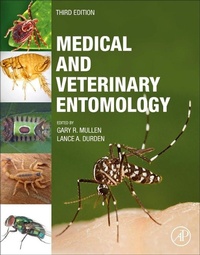
Medical and Veterinary Entomology
3rd Edition
Published on 2. October 2018
Book
Paperback/Softback
792 pages
978-0-12-814043-7 (ISBN)
Description
The first and second editions of Medical and Veterinary Entomology, edited by Gary R. Mullen and Lance A. Durden, published in 2002 and 2009, respectively, have been highly praised and become widely used as a textbook for classroom instruction. This fully revised third edition continues the focus on the diversity of arthropods affecting human and animal health, with separate chapters devoted to each of the taxonomic groups of insects and arachnids of medical or veterinary concern, including spiders, scorpions, mites, and ticks. Each chapter includes sections on taxonomy, morphology, life history, and behavior and ecology, with separate sections on those species of public-health and veterinary importance. Each concludes with approaches to management of pest species and prevention of arthropod-borne diseases. The third edition provides a comprehensive source for teaching medical and/or veterinary entomology at the college and university level, targeted particularly at upper-level undergraduate and graduate/postgraduate programs. In addition to its value as a student textbook, the volume has appeal to a much broader audience, specialists and non-specialists alike. It provides a key reference for biologists in general, entomologists, zoologists, parasitologists, physicians, public-health personnel, veterinarians, wildlife biologists, vector biologists, military entomologists, the general public and others seeking a readable, authoritative account on this important topic.
Reviews / Votes
"In my opinion, the third edition of Medical and Veterinary Entomology is the most comprehensive textbook on the topic. ...I suspect that this edition will become one of the most used references for nonentomological readers such as veterinarians, physicians, and epidemiologists who need information about arthropod-borne diseases. The editors assembled an impressive list of authors who are subject-matter experts, and each chapter was written by authoritative experts on the taxa being presented." --Journal of the American Veterinary Medical AssocationMore details
Edition
3rd edition
Language
English
Place of publication
San Diego
United States
Publishing group
Elsevier Science Publishing Co Inc
Target group
Professional and scholarly
Upper-level undergraduate and graduate/postgraduate students are the primary audience for this textbook in association with accompanying courses in Medical Entomology, Veterinary Entomology, Medical and Veterinary Entomology, Public Health Entomology, Wildlife Entomology, Vector-Borne Diseases and Emerging Diseases. These courses are taught in various (mainly University) departments including those that specialize in Biology, Zoology, Entomology, Parasitology and Public Health. Students in Colleges of Medicine and Veterinary Medicine are another target audience as are practicing physicians, veterinarians, general entomologists, parasitologists, epidemiologists, and wildlife biologists.
Product notice
Paperback (trade)
Unsewn / adhesive bound
Dimensions
Height: 274 mm
Width: 214 mm
Thickness: 45 mm
Weight
2173 gr
ISBN-13
978-0-12-814043-7 (9780128140437)
Copyright in bibliographic data and cover images is held by Nielsen Book Services Limited or by the publishers or by their respective licensors: all rights reserved.
Schweitzer Classification
Other editions
Additional editions
Gary R. Mullen | Lance A. Durden
Medical and Veterinary Entomology
E-Book
10/2018
3rd Edition
Academic Press
€95.95
Available for download
Previous edition
Gary R. Mullen | Lance A. Durden
Medical and Veterinary Entomology
Book
04/2009
2nd Edition
Academic Press
€91.60
Article exhausted; check for reprint
Persons
Gary Mullen is Professor of Entomology emeritus in the Department of Entomology and Plant Pathology at Auburn University, AL, USA. He earned his M.S. and Ph.D. degrees in entomology at Cornell University before serving as medical entomologist and administrator of the Pennsylvania Vector Control Program, Allegheny County Health Department, Pittsburgh, PA. He joined the faculty of Auburn University in 1975 as a medical-veterinary entomologist, acarologist, and aquatic ecologist, teaching courses and conducting research at Auburn for 34 years. His major areas of research have focused on biting flies, notably mosquitoes and biting midges, and ticks as vectors of animal pathogens Lance Durden is Professor of Vector Ecology and Curator of the Insect Collection in the Department of Biology at Georgia Southern University, Statesboro, USA. He earned a Ph.D. in Zoology from the University of London, UK and has worked at Vanderbilt School of Medicine in Nashville, Tennessee, the Smithsonian Institution in Washington DC, Auburn University in Alabama, and the U.S. Army Medical Research Institute of Infectious Diseases (USAMRIID) in Frederick, Maryland. He is the author or co-author of approximately 300 peer-reviewed publications including 24 book chapters and 7 books or monographs. His research focuses on ectoparasitic arthropods and vector-borne diseases.
Content
1. Introduction
2. Morphological Adaptations of Parasitic Arthropods
3. Arthropod Toxins and Venoms
4. Epidemiology of Vector-Borne Diseases
5. Forensic Entomology
6. Cockroaches (Blattaria)
7. Lice (Phthiraptera)
8. True Bugs (Hemiptera)
9. Beetles (Coleoptera)
10. Fleas (Siphonaptera)
11. Flies (Diptera)
12. Phlebotomine Sand Flies and Moth Flies (Psychodidae)
13. Biting Midges (Ceratopogonidae)
14. Black Flies (Simuliidae)
15. Mosquitoes (Culicidae)
16. Horse Flies and Deer Flies (Tabanidae)
17. Muscid Flies (Muscidae)
18. Tsetse Flies (Glossinidae)
19. Myiasis (Muscoidea, Oestroidea)
20. Louse Flies, Keds, and Bat Flies (Hippoboscoidea)
21. Moths and Butterflies (Lepidoptera)
22. Ants, Wasps, and Bees (Hymenoptera)
23. Scorpions (Scorpiones)
24. Solpugids (Solifugae)
25. Spiders (Araneae)
26. Mites (Acari)
27. Ticks (Ixodida)
28. Molecular Tools Used in Medical and Veterinary Entomology
Appendix: Arthropod-Related Viruses of Medical and Veterinary Importance
2. Morphological Adaptations of Parasitic Arthropods
3. Arthropod Toxins and Venoms
4. Epidemiology of Vector-Borne Diseases
5. Forensic Entomology
6. Cockroaches (Blattaria)
7. Lice (Phthiraptera)
8. True Bugs (Hemiptera)
9. Beetles (Coleoptera)
10. Fleas (Siphonaptera)
11. Flies (Diptera)
12. Phlebotomine Sand Flies and Moth Flies (Psychodidae)
13. Biting Midges (Ceratopogonidae)
14. Black Flies (Simuliidae)
15. Mosquitoes (Culicidae)
16. Horse Flies and Deer Flies (Tabanidae)
17. Muscid Flies (Muscidae)
18. Tsetse Flies (Glossinidae)
19. Myiasis (Muscoidea, Oestroidea)
20. Louse Flies, Keds, and Bat Flies (Hippoboscoidea)
21. Moths and Butterflies (Lepidoptera)
22. Ants, Wasps, and Bees (Hymenoptera)
23. Scorpions (Scorpiones)
24. Solpugids (Solifugae)
25. Spiders (Araneae)
26. Mites (Acari)
27. Ticks (Ixodida)
28. Molecular Tools Used in Medical and Veterinary Entomology
Appendix: Arthropod-Related Viruses of Medical and Veterinary Importance