


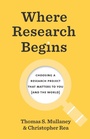
Where Research Begins
Choosing a Research Project That Matters to You (and the World)
Published on 12. April 2022
Book
Hardback
216 pages
978-0-226-80111-7 (ISBN)
Description
Plenty of books tell you how to do research. This book helps you figure out WHAT to research in the first place, and why it matters.
The hardest part of research isn't answering a question. It's knowing what to do before you know what your question is. Where Research Begins tackles the two challenges every researcher faces with every new project: How do I find a compelling problem to investigate-one that truly matters to me, deeply and personally? How do I then design my research project so that the results will matter to anyone else?
This book will help you start your new research project the right way for you with a series of simple yet ingenious exercises. Written in a conversational style and packed with real-world examples, this easy-to-follow workbook offers an engaging guide to finding research inspiration within yourself, and in the broader world of ideas.
Read this book if you (or your students):
have difficulty choosing a research topic
know your topic, but are unsure how to turn it into a research project
feel intimidated by or unqualified to do research
worry that you're asking the wrong questions about your research topic
have plenty of good ideas, but aren't sure which one to commit to
feel like your research topic was imposed by someone else
want to learn new ways to think about how to do research.
Under the expert guidance of award-winning researchers Thomas S. Mullaney and Christopher Rea, you will find yourself on the path to a compelling and meaningful research project, one that matters to you-and the world.
The hardest part of research isn't answering a question. It's knowing what to do before you know what your question is. Where Research Begins tackles the two challenges every researcher faces with every new project: How do I find a compelling problem to investigate-one that truly matters to me, deeply and personally? How do I then design my research project so that the results will matter to anyone else?
This book will help you start your new research project the right way for you with a series of simple yet ingenious exercises. Written in a conversational style and packed with real-world examples, this easy-to-follow workbook offers an engaging guide to finding research inspiration within yourself, and in the broader world of ideas.
Read this book if you (or your students):
have difficulty choosing a research topic
know your topic, but are unsure how to turn it into a research project
feel intimidated by or unqualified to do research
worry that you're asking the wrong questions about your research topic
have plenty of good ideas, but aren't sure which one to commit to
feel like your research topic was imposed by someone else
want to learn new ways to think about how to do research.
Under the expert guidance of award-winning researchers Thomas S. Mullaney and Christopher Rea, you will find yourself on the path to a compelling and meaningful research project, one that matters to you-and the world.
Reviews / Votes
"Mullaney and Rea have given us a little gem of a book, packed with smart, readable, compassionate guidance on the biggest question: how to start and what to do next. Read it, use it, read it again." -- William Germano, author of On Revision, Getting It Published, From Dissertation to Book, and (with Kit Nicholls) Syllabus "This is a book we have all needed for a long time: a practical, helpful and reassuring guide for those facing the scary task of defining a research topic. With clarity, humor, and compassion, Mullaney and Rea provide a step by step guide to figuring out what interests you, why, and how to tackle the problem you have defined. Where Research Begins will prove an invaluable addition to research-centered courses as well as a guide for individual readers seeking to define their intellectual agenda."-- Sarah Maza, Northwestern University "High-achieving students-those who undertake mentored or independent research, write undergraduate theses, apply for prestigious fellowships and awards, and complete graduate degrees-are often high achievers because they are good at following directions and pleasing others. But when does simply following the instructions result in transformative research? To be effective scholars, students need genuine curiosity and relevant research skills coupled with commitment to a problem. Compelling research becomes possible only once the problem in all its glorious complexities, implications, and associations has been identified.
In this engaging workbook, Mullaney and Rea guide their readers through a sequence of reflective exercises with the goal of defining a compelling and meaningful research problem. Equally valuable to students and to those who teach, advise, and mentor them, Where Research Begins isn't a book you read and then return to the shelf. Instead, it's a workbook that requires you to reflect and to document what you discover along the way. Engage with this book, and you will learn to assess your interests critically, differentiate between topics and questions wisely, understand sources dynamically, tap into networks productively, relate to your field astutely, and-ultimately-share your understandings of the process generously. We need more books of this sort: those that pull back the curtain on the intensely cerebral and iterative practice behind all research worth pursuing."
-- Steven E. Gump, Associate Director of Fellowship Advising, Princeton University
More details
Series
Language
English
Place of publication
Chicago
United States
Publishing group
The University of Chicago Press
Target group
Professional and scholarly
Illustrations
4 halftones, 9 tables
Dimensions
Height: 229 mm
Width: 152 mm
ISBN-13
978-0-226-80111-7 (9780226801117)
Copyright in bibliographic data and cover images is held by Nielsen Book Services Limited or by the publishers or by their respective licensors: all rights reserved.
Schweitzer Classification
Other editions
Additional editions
Mullaney Thomas S. Mullaney | Rea Christopher Rea
Where Research Begins
Choosing a Research Project That Matters to You (and the World)
E-Book
04/2022
University of Chicago Press
€21.99
Available for download
Persons
Thomas S. Mullaney is professor of history at Stanford University and a Guggenheim fellow. His books include The Chinese Typewriter: A History and Your Computer is on Fire. Christopher Rea is professor of Asian studies at the University of British Columbia. His books include Chinese Film Classics, 1922-1949 and The Age of Irreverence: A New History of Laughter in China
Content
Introduction
Self-Centered Research: A Manifesto
Centered Research Is the Best Research
How to Use This Book
Introversion, First. Extroversion, Second.
TRY THIS NOW: Write Here, Right Now
Part 1: Become a Self-Centered Researcher
Chapter 1: Questions
A Topic Is Not a Question
TRY THIS NOW: Search Yourself
TRY THIS NOW: Let Boredom Be Your Guide
TRY THIS NOW: Go Small or Go Home
SOUNDING BOARD: Start Building Your Research Network?
You Have Questions
Chapter 2: What's Your Problem?
Don't Jump to a Question (or You'll Miss Your Problem)
Stress-Testing Your Questions
TRY THIS NOW: Run a Diagnostic Test on Your Questions
TRY THIS NOW: Use Primary Sources to Educate Your Questions
TRY THIS NOW: Make Your Assumptions Visible
TRY THIS NOW: Identify the Problem That Connects Your Questions
SOUNDING BOARD: Get Leads on Primary Sources?
You Have a Problem (in a Good Way)
?
Chapter 3: Designing a Project That Works?
Primary Sources and How to Use Them (or, Fifty Ways to Read a Cereal Box)?
TRY THIS NOW: Treat Your Primary Source Like a Cereal Box?
TRY THIS NOW: Envision Your Primary Sources?
Connecting the Dots: Getting from Sources to Arguments?
Sources Cannot Defend Themselves?
TRY THIS NOW: Connect the Dots Using Your Sources (in Pencil)?
Taking Stock of Your Research Resources?
TRY THIS NOW: Decision Matrix?
SOUNDING BOARD: Is Your Decision Matrix Complete??
Two Types of Plan B?
Setting Up Shop?
TRY THIS NOW: Get Money for Nothing (Prepare a Formal Research Proposal)?
SOUNDING BOARD: Share Your Proposal with a Trusted Mentor (Who Understands How Preliminary This Is)?
You Have the Beginnings of a Project?
Part 2: Get Over Yourself?
Chapter 4: How to Find Your Problem Collective?
Identify Researchers Who Share Your Problem?
TRY THIS NOW: Change One Variable?
TRY THIS NOW: Before and After?
TRY THIS NOW: Map Out Your Collective (Secondary Source Search)?
Rewriting for Your Collective?
TRY THIS NOW: Find and Replace All "Insider Language"?
SOUNDING BOARD: Does the Lay Version of My Proposal Make Sense??
Welcome to Your Collective?
Chapter 5: How to Navigate Your Field?
Find the Problems within Your Field?
Read Your Field for Their Problems: Reimagining the "Literature Review"?
TRY THIS NOW: Start Your Own "What's Your Problem?" Bookstore (aka Organize Your Field into Problem Collectives)?
TRY THIS NOW: Change Their Variables?
TRY THIS NOW: Rewrite for Your Field?
SOUNDING BOARD: Find a Sounding Board in Your Field?
Welcome to Your Field?
Chapter 6: How to Begin?
Don't Worry. It's All Writing.?
TRY THIS NOW: Create "Draft 0"?
See What You Mean: Writing Draft 1?
TRY THIS NOW: Move from 0 to 1?
Perfection Is Boring?
SOUNDING BOARD: Talk to Yourself?
Welcome to Self-Centered Research?
What's Next in Your Research Journey??
TRY THIS NOW: Find a New Problem and Start a New Project?
TRY THIS NOW: Help Someone Else?
Acknowledgments?
Further Reading?
Index?
Self-Centered Research: A Manifesto
Centered Research Is the Best Research
How to Use This Book
Introversion, First. Extroversion, Second.
TRY THIS NOW: Write Here, Right Now
Part 1: Become a Self-Centered Researcher
Chapter 1: Questions
A Topic Is Not a Question
TRY THIS NOW: Search Yourself
TRY THIS NOW: Let Boredom Be Your Guide
TRY THIS NOW: Go Small or Go Home
SOUNDING BOARD: Start Building Your Research Network?
You Have Questions
Chapter 2: What's Your Problem?
Don't Jump to a Question (or You'll Miss Your Problem)
Stress-Testing Your Questions
TRY THIS NOW: Run a Diagnostic Test on Your Questions
TRY THIS NOW: Use Primary Sources to Educate Your Questions
TRY THIS NOW: Make Your Assumptions Visible
TRY THIS NOW: Identify the Problem That Connects Your Questions
SOUNDING BOARD: Get Leads on Primary Sources?
You Have a Problem (in a Good Way)
?
Chapter 3: Designing a Project That Works?
Primary Sources and How to Use Them (or, Fifty Ways to Read a Cereal Box)?
TRY THIS NOW: Treat Your Primary Source Like a Cereal Box?
TRY THIS NOW: Envision Your Primary Sources?
Connecting the Dots: Getting from Sources to Arguments?
Sources Cannot Defend Themselves?
TRY THIS NOW: Connect the Dots Using Your Sources (in Pencil)?
Taking Stock of Your Research Resources?
TRY THIS NOW: Decision Matrix?
SOUNDING BOARD: Is Your Decision Matrix Complete??
Two Types of Plan B?
Setting Up Shop?
TRY THIS NOW: Get Money for Nothing (Prepare a Formal Research Proposal)?
SOUNDING BOARD: Share Your Proposal with a Trusted Mentor (Who Understands How Preliminary This Is)?
You Have the Beginnings of a Project?
Part 2: Get Over Yourself?
Chapter 4: How to Find Your Problem Collective?
Identify Researchers Who Share Your Problem?
TRY THIS NOW: Change One Variable?
TRY THIS NOW: Before and After?
TRY THIS NOW: Map Out Your Collective (Secondary Source Search)?
Rewriting for Your Collective?
TRY THIS NOW: Find and Replace All "Insider Language"?
SOUNDING BOARD: Does the Lay Version of My Proposal Make Sense??
Welcome to Your Collective?
Chapter 5: How to Navigate Your Field?
Find the Problems within Your Field?
Read Your Field for Their Problems: Reimagining the "Literature Review"?
TRY THIS NOW: Start Your Own "What's Your Problem?" Bookstore (aka Organize Your Field into Problem Collectives)?
TRY THIS NOW: Change Their Variables?
TRY THIS NOW: Rewrite for Your Field?
SOUNDING BOARD: Find a Sounding Board in Your Field?
Welcome to Your Field?
Chapter 6: How to Begin?
Don't Worry. It's All Writing.?
TRY THIS NOW: Create "Draft 0"?
See What You Mean: Writing Draft 1?
TRY THIS NOW: Move from 0 to 1?
Perfection Is Boring?
SOUNDING BOARD: Talk to Yourself?
Welcome to Self-Centered Research?
What's Next in Your Research Journey??
TRY THIS NOW: Find a New Problem and Start a New Project?
TRY THIS NOW: Help Someone Else?
Acknowledgments?
Further Reading?
Index?