

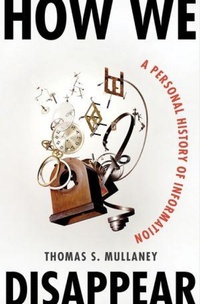
How We Disappear
A Personal History of Information
Will be published approx. on 23. June 2026
Book
Hardback
240 pages
978-1-324-02078-3 (ISBN)
Description
Our lives are collections of information-from mundane official documents, poignant family photos, and random artifacts to the cues embodied in our genes. Never is this more evident than in the wake of a parent's death. Yet from all these elusive, even evanescent, data points, history is written and a future is made. This information is stored on clay tablets and wood pulp; in vinyl grooves, compact discs and magnetic patterns; and relayed over undersea cables and satellite cell networks. But all information decays. Everything that we put "in formation" eventually collapses into randomness.
In this wide-ranging examination of the micro and macro, world-renowned scholar Thomas S. Mullaney reflects on the deaths of his parents, and on how human lives "disappear". Lyrical and poignant, his erudite, inspiring meditation offers eye-opening insight on the miracle of existence, and on what it means to forge meaning from a chaotic universe.
In this wide-ranging examination of the micro and macro, world-renowned scholar Thomas S. Mullaney reflects on the deaths of his parents, and on how human lives "disappear". Lyrical and poignant, his erudite, inspiring meditation offers eye-opening insight on the miracle of existence, and on what it means to forge meaning from a chaotic universe.
More details
Language
English
Place of publication
New York
United States
Illustrations
1 illustration
Dimensions
Height: 218 mm
Width: 147 mm
Thickness: 20 mm
Weight
302 gr
ISBN-13
978-1-324-02078-3 (9781324020783)
Copyright in bibliographic data and cover images is held by Nielsen Book Services Limited or by the publishers or by their respective licensors: all rights reserved.
Schweitzer Classification