

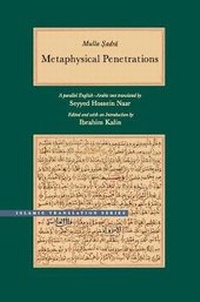
Metaphysical Penetrations
A Parallel English-Arabic Text
Will be published approx. on 15. June 2014
Book
Hardback
320 pages
978-0-8425-2839-9 (ISBN)
Description
Mulla Sadra (ca. 1572-1640) is one of the most prominent figures of post-Avicennan Islamic philosophy and among the most important philosophers of Safavid Persia. He was a prolific writer whose work advanced the fields of intellectual and religious science in Islamic philosophy, but arguably his most important contribution to Islamic philosophy is in the study of existence (wujud) and its application to such areas as cosmology, epistemology, psychology, and eschatology. Sadra represents a paradigm shift from the Aristotelian metaphysics of fixed substances, which had dominated Islamic philosophy, to an analysis of existence as the ultimate ground and dynamic source of things. He posits that all beings derive their reality and truth from their wujud and that a proper philosophical analysis must therefore start and eventually end with it. The present work's focus on Sadra's gradational ontology provides a strong foundation for the reader to understand Sadra's other works and later texts by philosophers working in the same field. This edition contains parallel English-Arabic texts and a new translation by preeminent scholar of Islamic philosophy Seyyed Hossein Nasr.
More details
Series
Language
English
Place of publication
Utah
United States
Target group
College/higher education
Dimensions
Height: 24 mm
Width: 16 mm
Thickness: 2 mm
Weight
567 gr
ISBN-13
978-0-8425-2839-9 (9780842528399)
Copyright in bibliographic data and cover images is held by Nielsen Book Services Limited or by the publishers or by their respective licensors: all rights reserved.
Schweitzer Classification
Persons
Seyyed Hossein Nasr is the University Professor of Islamic Studies at George Washington University. Ibrahim Kalin currently serves as chief advisor to the prime minister of Turkey and is a fellow at the Prince Alwaleed Bin Talal Center for Muslim-Christian Understanding, Georgetown University.