

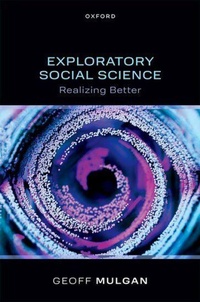
Exploratory Social Science
Realizing Better
Will be published approx. on 4. December 2026
Book
Hardback
232 pages
978-0-19-786193-6 (ISBN)
Description
At a time when the public badly want better public services, trustworthy politics, and a healthy biosphere, the social sciences have prioritized analysis and critique over design. Ours is a golden age of diagnosis but a dark age of prescription, which contributes to a widening gap between extraordinary technological dynamism and social stagnation. Exploratory Social Science shows how the social sciences can return to their best traditions and define pathways and options for the future: helping to change the world, rather than just interpreting it. The first use of the phrase "social science" came in a book two centuries ago which analysed social problems, including stark inequality, and proposed how they could be tackled. Mulgan argues we need similar combinations of analysis and prescription for current issues such as living with AI, declining birthrates, rampant disinformation, and rising global temperatures.
Exploratory Social Science investigates how to make the most of the many resources available to social science, from history to data analytics, studies of systems and complexity to methods from design and the arts. These can be used to shape options for tasks such as reinventing democracy and care or designing new public institutions Most social scientists want to use their knowledge to serve their societies, but in recent years have been discouraged from design by trends leaning towards narrow empiricism and away from creative imagination. Many younger social scientists think it career-threatening to move from analysis to prescription. This book shows how to harness their intellects and energy for the greater good.
Exploratory Social Science investigates how to make the most of the many resources available to social science, from history to data analytics, studies of systems and complexity to methods from design and the arts. These can be used to shape options for tasks such as reinventing democracy and care or designing new public institutions Most social scientists want to use their knowledge to serve their societies, but in recent years have been discouraged from design by trends leaning towards narrow empiricism and away from creative imagination. Many younger social scientists think it career-threatening to move from analysis to prescription. This book shows how to harness their intellects and energy for the greater good.
More details
Language
English
Place of publication
New York
United States
Product notice
sewn/stitched
Cloth over boards
Dimensions
Height: 210 mm
Width: 140 mm
ISBN-13
978-0-19-786193-6 (9780197861936)
Copyright in bibliographic data and cover images is held by Nielsen Book Services Limited or by the publishers or by their respective licensors: all rights reserved.
Schweitzer Classification
Other editions
Additional editions
Book
approx. 09/2026
Oxford University Press
€30.50
Not yet published
Person
Geoff Mulgan is a Professor at University College London. Formerly he has served as CEO of Nesta and the Young Foundation, Director of the UK Government's Strategy Unit, and head of policy in the Prime Minister's office. He has authored several books including Another World is Possible: How to Reignite Social and Political Imagination (2022) and When Science Meets Power (2024).
Content
- Introduction: Explore, envision and enact
- Part I. Why Explore?
- 1: The purpose of the social sciences: Agency in the world
- 2: Why exploration became hard: Dilemmas, mistakes and misdirection
- 3: How to better understand the possible future
- 4: What to build on: Existing methods for social design
- Part II. How to Explore
- 5: Methods for exploratory social sciences
- 6: The structures and spaces for exploratory social science
- Part III. Applications
- 7: Some fields for exploratory social science
- 8: Theorizing exploration
- 9: Falsifiability and exploratory social science
- Part IV. Educating for Exploration
- 10: Learning exploratory social science
- 11: Exploration as common sense: Realizing the possible