

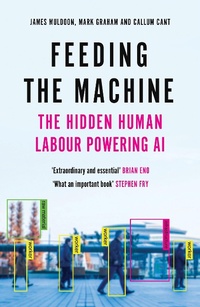
Feeding the Machine
The Hidden Human Labour Powering AI
Published on 18. July 2024
Book
Hardback
288 pages
978-1-83726-181-9 (ISBN)
Description
Big Tech has sold us the illusion that artificial intelligence is a frictionless technology that will bring wealth and prosperity to humanity. But hidden beneath this smooth surface lies the grim reality of a precarious global workforce of millions that labour under often appalling conditions to make AI possible. Feeding the Machine presents an urgent, riveting investigation of the intricate network of organisations that maintain this exploitative system, revealing the untold truth of AI.
Based on hundreds of interviews and thousands of hours of fieldwork over more than a decade, this book shows us the lives of the workers often deliberately concealed from view and the systems of power that determine their future. It shows how AI is an extraction machine that churns through ever-larger datasets and feeds off humanity's labour and collective intelligence to power its algorithms. Feeding the Machine is a call to arms against this exploitative system and details what we need to do, individually and collectively, to fight for a more just digital future.
Based on hundreds of interviews and thousands of hours of fieldwork over more than a decade, this book shows us the lives of the workers often deliberately concealed from view and the systems of power that determine their future. It shows how AI is an extraction machine that churns through ever-larger datasets and feeds off humanity's labour and collective intelligence to power its algorithms. Feeding the Machine is a call to arms against this exploitative system and details what we need to do, individually and collectively, to fight for a more just digital future.
Reviews / Votes
[A] call to arms to take control over our digital futures: build worker power, hold big tech accountable, and create a better understanding of how these systems work * * Financial Times * * Feeding the Machine may just be the most important book to be written in the current fever of AI publishing. It shines a light into the darkest corners of this 'revolution', revealing the enormous human cost behind the giant servers and grinding labour farms that exploit and abuse the human spirit in order to provide a technology that itself exploits and abuses the human spirit. I urge anyone who uses, harnesses or leverages AI to read this and consider. What an important book -- STEPHEN FRY I had no idea of the dark, tangled world of human exploitation and corporate greed that is fuelling the growth of AI. Here we meet people working impossible hours for pitiful wages - just so we can get our orders a couple of hours earlier, while some billionaire gets richer. If you think - as I once did - that the internet is a kind of 'free lunch' you need to read this extraordinary and essential book -- BRIAN ENO The darker side of the shiny AI era is the subject of Feeding the Machine . . . The authors delve into seven archetypal jobs in the AI supply chain * * Economist * *More details
Edition
Main
Language
English
Place of publication
Edinburgh
United Kingdom
Product notice
With dust jacket
Dimensions
Height: 244 mm
Width: 159 mm
Thickness: 32 mm
Weight
486 gr
ISBN-13
978-1-83726-181-9 (9781837261819)
Copyright in bibliographic data and cover images is held by Nielsen Book Services Limited or by the publishers or by their respective licensors: all rights reserved.
Schweitzer Classification
Persons
James Muldoon, Mark Graham and Callum Cant work together at Fairwork, a project established to highlight the best and worst examples of how new technologies are being used in the workplace.
James Muldoon is a Reader in Management at the University of Essex, a Research Associate at the University of Oxford and the Head of Digital Research at the Autonomy think tank. His research examines how modern technologies such as artificial intelligence and digital platforms can create public value and serve the common good.
Mark Graham is Director of Fairwork and Professor at the Oxford Internet Institute, University of Oxford. As an internet geographer, Mark studied the growth of a global digital labour market since the first arrival of submarine internet cables in Kenya in 2009. He has also written for publications including Wired and the Guardian.
Callum Cant is a Senior Lecturer at the University of Essex Business School, where his research focuses on work, technology, and the crises of the 21st century. He has written for publications including the New Internationalist and Vice News. He edits Notes from Below, a journal of worker writing.
James Muldoon is a Reader in Management at the University of Essex, a Research Associate at the University of Oxford and the Head of Digital Research at the Autonomy think tank. His research examines how modern technologies such as artificial intelligence and digital platforms can create public value and serve the common good.
Mark Graham is Director of Fairwork and Professor at the Oxford Internet Institute, University of Oxford. As an internet geographer, Mark studied the growth of a global digital labour market since the first arrival of submarine internet cables in Kenya in 2009. He has also written for publications including Wired and the Guardian.
Callum Cant is a Senior Lecturer at the University of Essex Business School, where his research focuses on work, technology, and the crises of the 21st century. He has written for publications including the New Internationalist and Vice News. He edits Notes from Below, a journal of worker writing.