

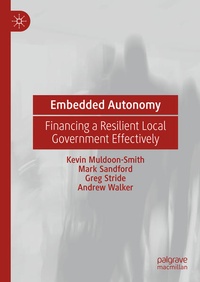
Embedded Autonomy
Description
This book addresses the sustained failure to properly fund local government in England. While there has been plenty of rhetoric and policy initiatives around devolution of power to local authorities in recent decades, continuing recently with the English Devolution Bill, there has been far less attention paid to how these endeavours will be practically delivered and, most importantly, funded. In this context, the motivation in this book is to consider how local government in England could be funded differently. How can the continual hand to mouth existence of local authorities, and those that work to support them, be improved? Drawing on a system-based analysis of international local government practice, the authors develop a new theory of embedded autonomy to help understand and frame how local government can be funded effectively in England.
Reviews / Votes
"Embedded Autonomy offers a new perspective that unites the often fragmented and competing concerns around local democracy and devolution of power with financial stability and resilience. Drawing fascinating insights from local government systems around the world it provides a holistic framework that moves beyond negative and partial tropes of local government insolvency, mismanagement, and debt towards considering a sustainable future for local democracy." (Dr Jonathan Carr-West, Chief Executive of Local Government Information Unit)
"Embedded Autonomy provides a meaningful and timely conceptual innovation to support thinking about balances in relations of power and money between central and local government. Through detailed empirical analysis, Muldoon Smith et al. demonstrate that learning and adapting from international experience and practice can help address the fundamental questions of what local government is for and how it can be funded in England." (Andy Pike, Henry Daysh Professor of Regional Development Studies, Centre for Urban and Regional Development Studies (CURDS), Newcastle University, UK)
"This book is a long overdue authoritative systematic analysis of an important and much misunderstood critical part of the state: local government and its finance system. The authors' calm and logical approach lays bare years of neglect by central government of an increasingly fragile sector, exposed to austerity and badly thought-out piecemeal change, coping with ever rising needs locally. The authors' concept of embedded autonomy, their central concept for reform, underpinned by international comparisons sets out a clear roadmap for reform and says once and for all that the current system has exhausted the available options for financial survival and needs a dynamic and thoughtful solution." (Aileen Murphie, former National Audit Office Director and Honorary Professor, University of Durham)
"The UK state, particularly in England, has long been strongly centralised. It has limited space for the devolution of power, and even less for decentralisation of local government finance. At a time when reforms are under consideration, the authors have provided a timely study of how a culture of centralisation shapes England's local government finance system. The book shows how different views of the state shape other countries' systems in very different ways, with valuable lessons for England." (John Denham, former Secretary of State for Communities and Local Government and Professor, at Southhampton University)
More details
Other editions
Additional editions
Persons
Kevin Muldoon-Smith is an Associate Professor in Strategic Public Sector Finance and Urban Adaptation at Northumbria University, UK. He is an established author and policy advisor investigating local government finance systems, regularly via international comparison and intersecting issues of governance, taxation, land, and property markets.
Mark Sandford is an Honorary Professor at the University of Bristol where he specialises in local government, devolution, local government finance and territorial identity. He has also been a research fellow at the Constitution Unit, University College London, and head of research at the Electoral Commission.
Greg Stride is a Researcher at the Local Democracy Research Centre at the Local Government Information Unit (LGIU) where he has led projects on local government finance and electoral administration. Before joining the LGIU, Greg completed a PhD at the University of Exeter on electoral administration in England.
Andrew Walker is the Head of Research at the Local Democracy Research Centre at the Local Government Information Unit (LGIU). Andrew leads LGIU's research programme and directs the activity of the Local Democracy Research Centre.
Content
Introduction.- Time for system thinking: a system wide perspective of local government finance.- Applying a systems perspective to local government finance.- Local government in England.- Local government in Germany.- Local Government in Italy.- Local government in Japan.- Reform in England: what if local government was funded differently in England.- Conclusion: redefining the magic money tree.