

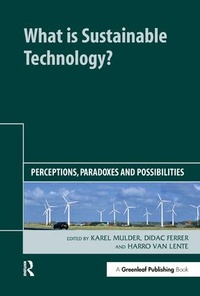
What is Sustainable Technology?
Perceptions, Paradoxes and Possibilities
1st Edition
Published on 1. September 2011
Book
Hardback
264 pages
978-1-906093-50-1 (ISBN)
Description
Designers of technology have a major responsibility in the current age. Their designs can have tremendous effects on society, in both the short and the long term. In fact, sustainable development itself has all the characteristics of a design project, albeit a vast one. But a failed product design here will be not just be unsuccessful in the market - it will have far-reaching consequences. It is our common responsibility to make the project successful.
Technology has played an important role in creating the problems that we now face; but it will also play an important role in solving them. But this does not mean the technological fix will be easy. How do we allocate resources and attention when there are myriad issues under the umbrella of "sustainable development" currently in competition with one another? How do we arrive at precise specifications for the sustainable technologies that are to be developed and, furthermore, reach consensus on these specifications? What if our sustainable technological solutions aggravate other problems or create new ones? And, because sustainable development is all about the long-term consequences of our actions, how do we assess the effects of modifying existing landscapes, infrastructures and patterns of life?How could we be sure in advance that the changes that new technologies bring will make our society more sustainable? These dilemmas and paradoxes are the subject of this provocative book.
Sometimes the claim that a technology is sustainable is made in order to make the technology acceptable in the political process, as in the case of nuclear energy production, where the claims of "sustainability" refer to the absence of CO2 emissions. In the case of biofuels, claims of sustainability have led to a "fuel or food" debate, showing that sustainability has counteracting articulations. And the well-known rebound effect is observed when increased resource efficiency can create a stimulus for consumption. What is Sustainable Technology? illustrates that the sustainability impact of a technology is often much more complicated and ambivalent than one might expect. Making improvements to existing designs is not the technological challenge that will lead to real solutions. We mustn't look to change a part of a machine, but rather the machine as a whole - or even the whole system in which it functions. It is these system innovations that have the potential to make a genuine contribution to sustainable development. What is Sustainable Technology? will help all those involved in designing more sustainable technologies in determining their strategies. It does so by presenting case studies of different technologies in contrasting contexts. Each case asks:
1. What articulations of sustainability played a role in the design process?
2. What sustainability effects did this technology lead to?
3. Who was affected, where, and when?
4. Could the designer have foreseen these consequences?
5. How did the designer anticipate them?
6. How was societal interaction dealt with during the design process?
Finally, the authors reflect on future options for the sustainable technology designer. They argue that an important first step is an awareness of the multitude of sustainable development challenges that play a role in production, use, recycling and end-of-life disposal. What is Sustainable Technology? will be essential reading for product designers, engineers, material scientists and others involved in the development of sustainable technologies, as well as a wide academic audience interested in the complexities of the sustainable design process.
Technology has played an important role in creating the problems that we now face; but it will also play an important role in solving them. But this does not mean the technological fix will be easy. How do we allocate resources and attention when there are myriad issues under the umbrella of "sustainable development" currently in competition with one another? How do we arrive at precise specifications for the sustainable technologies that are to be developed and, furthermore, reach consensus on these specifications? What if our sustainable technological solutions aggravate other problems or create new ones? And, because sustainable development is all about the long-term consequences of our actions, how do we assess the effects of modifying existing landscapes, infrastructures and patterns of life?How could we be sure in advance that the changes that new technologies bring will make our society more sustainable? These dilemmas and paradoxes are the subject of this provocative book.
Sometimes the claim that a technology is sustainable is made in order to make the technology acceptable in the political process, as in the case of nuclear energy production, where the claims of "sustainability" refer to the absence of CO2 emissions. In the case of biofuels, claims of sustainability have led to a "fuel or food" debate, showing that sustainability has counteracting articulations. And the well-known rebound effect is observed when increased resource efficiency can create a stimulus for consumption. What is Sustainable Technology? illustrates that the sustainability impact of a technology is often much more complicated and ambivalent than one might expect. Making improvements to existing designs is not the technological challenge that will lead to real solutions. We mustn't look to change a part of a machine, but rather the machine as a whole - or even the whole system in which it functions. It is these system innovations that have the potential to make a genuine contribution to sustainable development. What is Sustainable Technology? will help all those involved in designing more sustainable technologies in determining their strategies. It does so by presenting case studies of different technologies in contrasting contexts. Each case asks:
1. What articulations of sustainability played a role in the design process?
2. What sustainability effects did this technology lead to?
3. Who was affected, where, and when?
4. Could the designer have foreseen these consequences?
5. How did the designer anticipate them?
6. How was societal interaction dealt with during the design process?
Finally, the authors reflect on future options for the sustainable technology designer. They argue that an important first step is an awareness of the multitude of sustainable development challenges that play a role in production, use, recycling and end-of-life disposal. What is Sustainable Technology? will be essential reading for product designers, engineers, material scientists and others involved in the development of sustainable technologies, as well as a wide academic audience interested in the complexities of the sustainable design process.
Reviews / Votes
What is Sustainable Technology? Perceptions, Paradoxes and PossibilitiesHistorically, improving the quality of life has been the main driver for the advent of technology. But the long term effects of new technologies are more often than not unforeseen. And when unwanted side effects of new technologies cause critical damage to our environment, the natural impulse is to turn to other technological developments to replace or reverse the effect of the old ones. Far from being a straightforward process, making technology more sustainable brings to the surface entire sets of problems and paradoxes.
Presented in the form of an academic communication session, the bulk of this book comprises a series of case studies all aimed at improving the economic, environmental or social performance of technologies and resource management. An introductory study and a chapter on conclusions frame the eleven studies looking at materials and energy, urbanisation, transport and water management.
Acknowledging both the Bruntland Commission definition of sustainability and the vagueness of the term, this volume investigates the complex ways in which different manifestations - or articulations - of sustainability conflict with each other and the way technology is intertwined with economic interests, policy-making, cultural habits or social goals. Can applying the same technology yield completely different and sometimes opposite results? Is it possible that the very process of recycling is damaging to the environment? How long until the end of oil, or the beginning of the hydrogen-fuelled society? These are only a few of the huge number of puzzling questions that scientists and researchers are trying to answer.
With its extensive biography and wide range of topics, the book is an excellent introductory read for anyone trying to get the grips of how sustainability works and how technological developments relate to it -- Leonard Bacica, CSR International
More details
Language
English
Place of publication
Saltaire
United Kingdom
Publishing group
Taylor & Francis Ltd
Target group
College/higher education
Professional and scholarly
Postgraduate and Professional Practice & Development
Dimensions
Height: 234 mm
Width: 156 mm
Weight
521 gr
ISBN-13
978-1-906093-50-1 (9781906093501)
Copyright in bibliographic data and cover images is held by Nielsen Book Services Limited or by the publishers or by their respective licensors: all rights reserved.
Schweitzer Classification
Other editions
Additional editions
Karel Mulder | Didac Ferrer | Harro van Lente
What is Sustainable Technology?
Perceptions, Paradoxes and Possibilities
E-Book
09/2017
Routledge
€86.99
Available for download
Karel Mulder | Didac Ferrer | Harro van Lente
What is Sustainable Technology?
Perceptions, Paradoxes and Possibilities
E-Book
09/2017
Routledge
€86.99
Available for download
Persons
Mulder, Karel; Ferrer, Didac; Lente, Harro van
Content
1. What is sustainable technology?2. Perceptions of Technology: An historical overview3. Chlorofluorocarbons: Drivers of their emergence and substitution4. Vehicles of Sustainability in the Field of Nanocoatings Harro van Lente, Innovation Studies, Copernicus Institute for Sustainable Development, University of Utrecht, The Netherlands and Jon van Til, Technopolis Group, Amsterdam, The Netherlands 5. Articulations of sustainability in the development of wind power in the Netherlands Linda M. Kamp, Faculty of Technology, Policy and Management, TU Delft, The Netherlands 6. Environmental technology in a new urban neighbourhood: Stockholm's Hammarby Sjoestad Ronald Wennersten and Anna Spitsyna, Department of Industrial Ecology, Royal Institute of Technology, Stockholm, Sweden 7. Trade-offs in the district heat distribution system Magdalena Svanstroem, Associate Professor in Chemical Environmental Science and Director of Chalmers Learning Centre, Department of Chemical and Biological Engineering, Chalmers University of Technology, Goeteborg, Sweden and Morgan Froeling, Associate Pro 8. Municipal solid waste: Treatment, management and prevention Chantal Block and Carlo Vandecasteele, Department of Chemical Engineering, University of Leuven, Belgium 9. What is a sustainable transport system? Dilemmas regarding transport solutions in Sweden Ronald Wennersten and Anna Spitsyna, Department of Industrial Ecology, Royal Institute of Technology, Stockholm, Sweden 10. Reducing material use in passenger cars 1920-2020: Balancing energy, waste and safety Erik Tempelman, Faculty of Industrial Design Engineering, TU Delft, The Netherlands 11. Hydrogen: A stack of competing visions Sjoerd Bakker, Innovation Studies Group, University of Utrecht, The Netherlands 12. Sustainable technologies for water treatment Jordi Morato, Alex Pires Carneiro and Angeles Ortiz, Sustainable Water Management Group, UNESCO Chair of Sustainability, Polytechnic University of Catalonia, Spain 13. Dilemmas in water systems development in China Xingqiang Song, Department of Industrial Ecology, Royal Institute of Technology, Sweden and Xingqiang Song and Wim Ravesteijn, Faculty of Technology, Policy and Management, TU Delft, The Netherlands 14. Conclusions: perceptions, paradoxes and possibilities Karel Mulder, Technology Dynamics and Sustainable Development, TU Delft, Netherlands; Didac Ferrer, Universitat Politecnica de Catalunya, Barcelona; Harro van Lente, Department of Innovation and Environmental Studies, University of Utrecht, Netherlands