

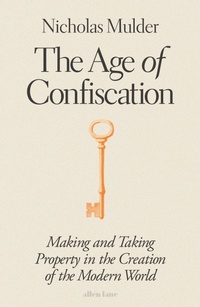
The Age of Confiscation
Making and Taking Property in the Creation of the Modern World
Will be published approx. on 29. October 2026
Book
Hardback
800 pages
978-0-241-58271-8 (ISBN)
Description
A sweeping, resonant, revelatory history of how the expropriation of property made the modern world, by a brilliant young historian
Expropriation - the forced transfer of property rights - is usually associated with dictators, unstable countries, and violent revolution. But in fact, it has been integral to the political and economic history of the West, enabling everything from the abolition of serfdom and slavery to decolonization, Allied victory in two world wars and the birth of the modern welfare state. For better and for worse, much of our modern world was built through coercive acquisition of property.
In this groundbreaking international history of expropriation, Nicholas Mulder charts a gripping course from the eighteenth century to the present, ranging from the French Revolution to the Russo-Ukrainian War, from colonial companies to railway empires, from sales of church land to oil nationalizations, and from the confiscation of patents to asset freezing in the Eurodollar market. He shows how all kinds of political movements - liberal and nationalist, socialist and fascist, imperialist and anticolonial - both dissolved and redistributed property rights. Successful state-building did not depend on extinguishing the confiscatory state, but on capitalists mastering its powers and redeploying them for their own purposes.
Drawing on a vast range of sources and data across history, politics, and economics, Mulder unfolds a bold revisionist history of how property was made and unmade, transferred and converted, stolen and restored. The Age of Confiscation reveals how much expropriation has been part of our recent past, and how amid rising geopolitical competition, growing inequality, and climate change, it will mark our future.
Expropriation - the forced transfer of property rights - is usually associated with dictators, unstable countries, and violent revolution. But in fact, it has been integral to the political and economic history of the West, enabling everything from the abolition of serfdom and slavery to decolonization, Allied victory in two world wars and the birth of the modern welfare state. For better and for worse, much of our modern world was built through coercive acquisition of property.
In this groundbreaking international history of expropriation, Nicholas Mulder charts a gripping course from the eighteenth century to the present, ranging from the French Revolution to the Russo-Ukrainian War, from colonial companies to railway empires, from sales of church land to oil nationalizations, and from the confiscation of patents to asset freezing in the Eurodollar market. He shows how all kinds of political movements - liberal and nationalist, socialist and fascist, imperialist and anticolonial - both dissolved and redistributed property rights. Successful state-building did not depend on extinguishing the confiscatory state, but on capitalists mastering its powers and redeploying them for their own purposes.
Drawing on a vast range of sources and data across history, politics, and economics, Mulder unfolds a bold revisionist history of how property was made and unmade, transferred and converted, stolen and restored. The Age of Confiscation reveals how much expropriation has been part of our recent past, and how amid rising geopolitical competition, growing inequality, and climate change, it will mark our future.
More details
Language
English
Place of publication
London
United Kingdom
Publishing group
Penguin Books Ltd
Target group
College/higher education
Professional and scholarly
Dimensions
Height: 240 mm
Width: 156 mm
Thickness: 40 mm
Weight
750 gr
ISBN-13
978-0-241-58271-8 (9780241582718)
Copyright in bibliographic data and cover images is held by Nielsen Book Services Limited or by the publishers or by their respective licensors: all rights reserved.
Schweitzer Classification
Other editions
Additional editions
Nicholas Mulder
The Age of Confiscation
Making and Taking Property in the Creation of the Modern World
E-Book
approx. 10/2026
Penguin
€14.99
Not yet available
Person
Nicholas Mulder is assistant professor of history and Milstein Faculty Fellow at Cornell University. He specializes in the history of geoeconomics and is the author of The Economic Weapon: The Rise of Sanctions as a Tool of Modern War (Yale, 2022), which received the Paul Birdsall Prize from the American Historical Association and the Stuart Bernath Prize of the Society for Historians of American Foreign Relations. His writing has appeared in The New York Times, The Wall Street Journal, Financial Times, Foreign Affairs, The Guardian, and elsewhere.