

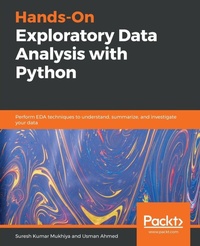
Hands-On Exploratory Data Analysis with Python
Perform EDA techniques to understand, summarize, and investigate your data
Published on 27. March 2020
Book
Paperback/Softback
352 pages
978-1-78953-725-3 (ISBN)
Description
Discover techniques to summarize the characteristics of your data using PyPlot, NumPy, SciPy, and pandas
Key Features
Understand the fundamental concepts of exploratory data analysis using Python
Find missing values in your data and identify the correlation between different variables
Practice graphical exploratory analysis techniques using Matplotlib and the Seaborn Python package
Book DescriptionExploratory Data Analysis (EDA) is an approach to data analysis that involves the application of diverse techniques to gain insights into a dataset. This book will help you gain practical knowledge of the main pillars of EDA - data cleaning, data preparation, data exploration, and data visualization.
You'll start by performing EDA using open source datasets and perform simple to advanced analyses to turn data into meaningful insights. You'll then learn various descriptive statistical techniques to describe the basic characteristics of data and progress to performing EDA on time-series data. As you advance, you'll learn how to implement EDA techniques for model development and evaluation and build predictive models to visualize results. Using Python for data analysis, you'll work with real-world datasets, understand data, summarize its characteristics, and visualize it for business intelligence.
By the end of this EDA book, you'll have developed the skills required to carry out a preliminary investigation on any dataset, yield insights into data, present your results with visual aids, and build a model that correctly predicts future outcomes.What you will learn
Import, clean, and explore data to perform preliminary analysis using powerful Python packages
Identify and transform erroneous data using different data wrangling techniques
Explore the use of multiple regression to describe non-linear relationships
Discover hypothesis testing and explore techniques of time-series analysis
Understand and interpret results obtained from graphical analysis
Build, train, and optimize predictive models to estimate results
Perform complex EDA techniques on open source datasets
Who this book is forThis EDA book is for anyone interested in data analysis, especially students, statisticians, data analysts, and data scientists. The practical concepts presented in this book can be applied in various disciplines to enhance decision-making processes with data analysis and synthesis. Fundamental knowledge of Python programming and statistical concepts is all you need to get started with this book.
Key Features
Understand the fundamental concepts of exploratory data analysis using Python
Find missing values in your data and identify the correlation between different variables
Practice graphical exploratory analysis techniques using Matplotlib and the Seaborn Python package
Book DescriptionExploratory Data Analysis (EDA) is an approach to data analysis that involves the application of diverse techniques to gain insights into a dataset. This book will help you gain practical knowledge of the main pillars of EDA - data cleaning, data preparation, data exploration, and data visualization.
You'll start by performing EDA using open source datasets and perform simple to advanced analyses to turn data into meaningful insights. You'll then learn various descriptive statistical techniques to describe the basic characteristics of data and progress to performing EDA on time-series data. As you advance, you'll learn how to implement EDA techniques for model development and evaluation and build predictive models to visualize results. Using Python for data analysis, you'll work with real-world datasets, understand data, summarize its characteristics, and visualize it for business intelligence.
By the end of this EDA book, you'll have developed the skills required to carry out a preliminary investigation on any dataset, yield insights into data, present your results with visual aids, and build a model that correctly predicts future outcomes.What you will learn
Import, clean, and explore data to perform preliminary analysis using powerful Python packages
Identify and transform erroneous data using different data wrangling techniques
Explore the use of multiple regression to describe non-linear relationships
Discover hypothesis testing and explore techniques of time-series analysis
Understand and interpret results obtained from graphical analysis
Build, train, and optimize predictive models to estimate results
Perform complex EDA techniques on open source datasets
Who this book is forThis EDA book is for anyone interested in data analysis, especially students, statisticians, data analysts, and data scientists. The practical concepts presented in this book can be applied in various disciplines to enhance decision-making processes with data analysis and synthesis. Fundamental knowledge of Python programming and statistical concepts is all you need to get started with this book.
More details
Language
English
Place of publication
Birmingham
United Kingdom
Target group
Professional and scholarly
US School Grade: College Graduate Student
Dimensions
Height: 235 mm
Width: 191 mm
Thickness: 20 mm
Weight
658 gr
ISBN-13
978-1-78953-725-3 (9781789537253)
Copyright in bibliographic data and cover images is held by Nielsen Book Services Limited or by the publishers or by their respective licensors: all rights reserved.
Schweitzer Classification
Other editions
Additional editions
Suresh Kumar Mukhiya | Usman Ahmed
Hands-On Exploratory Data Analysis with Python
Perform EDA techniques to understand, summarize, and investigate your data
E-Book
09/2024
Packt Publishing
€25.99
Available for download
Persons
Suresh Kumar Mukhiya is a PhD candidate, currently affiliated to the Western Norway University of Applied Sciences (HVL). He is a big data enthusiast, specializing in Information Systems, Model-Driven Software Engineering, Big Data Analysis, Artificial Intelligence and Frontend development. He has completed a Masters in Information Systems from the Norwegian University of Science and Technology (NTNU, Norway) along with a thesis in processing mining. He also holds a bachelor's degree in computer science and information technology (BSc.CSIT) from Tribhuvan University, Nepal, where he was decorated with the Vice-Chancellor's Award for obtaining the highest score. He is a passionate photographer and a resilient traveler. Usman Ahmed is a data scientist and Ph.D. candidate at Western Norway University of Applied Science (HVL). He has rich experience in building and scaling high-performance systems based on data mining, natural language processing, and machine learning. Usman's research interests are sequential data mining, heterogeneous computing, natural language processing, a recommendation system, and machine learning. He has completed a Master's of Science in computer science from Capital University of Science and Technology, Islamabad, Pakistan. Usman Ahmed was awarded Gold Medal in Bachelor of Computer Science from Heavy Industries Taxila Education City.
Content
Table of Contents
Exploratory Data Analysis Fundamentals
Visual Aids for EDA
EDA with Personal Email
Data Transformation
Descriptive Statistics
Grouping Dataset
Correlation
Time Series Analysis
Hypothesis Testing and Regression
Model Development and Evaluation
EDA on Wine Quality Data Analysis
Appendix
Exploratory Data Analysis Fundamentals
Visual Aids for EDA
EDA with Personal Email
Data Transformation
Descriptive Statistics
Grouping Dataset
Correlation
Time Series Analysis
Hypothesis Testing and Regression
Model Development and Evaluation
EDA on Wine Quality Data Analysis
Appendix