

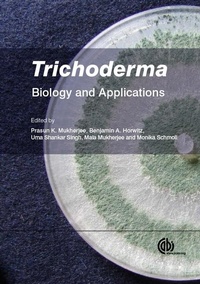
Trichoderma
Biology and Applications
Published on 16. September 2013
Book
Hardback
344 pages
978-1-78064-247-5 (ISBN)
Description
Trichoderma spp. are biotechnologically significant fungi, being widely used both in agriculture and industry. These microbes are also a potential drug source of clinical importance. In recent years, driven by advances in genetics and genomics, research on these fungi have opened new avenues for its varied applications. Divided into three sections, covering taxonomy and physiology, interactions with plants and applications and significance, this book also discusses topics that have seen rapid developments in the recent years. Various aspects of Trichoderma like molecular taxonomy, sexual and asexual developments, secondary metabolism, beneficial interactions with plants, applications as cell factories and harmful interactions with humans are discussed. This book, thus, hopes to be an essential ready reference for researchers, students and people form industry as well.
More details
Language
English
Place of publication
Wallingford
United Kingdom
Target group
College/higher education
Product notice
sewn/stitched
Cloth over boards
Dimensions
Height: 246 mm
Width: 173 mm
Thickness: 25 mm
Weight
862 gr
ISBN-13
978-1-78064-247-5 (9781780642475)
Copyright in bibliographic data and cover images is held by Nielsen Book Services Limited or by the publishers or by their respective licensors: all rights reserved.
Schweitzer Classification
Other editions
Additional editions
E-Book
09/2013
CABI Publishing
€222.99
Available for download
Persons
Prof. Dr. Prasun K. Mukherjee, with over 30 years of engagement in Trichoderma research, has authored more than 90 research papers (h-index 38) and developed two commercial formulations. Elected as a fellow of the Indian National Science Academy, National Academy of Sciences, and National Academy of Agricultural Sciences, Prof. Mukherjee has received various national and international awards. Serving as a Visiting Scientist to the Israel Institute of Technology and Texas A&M University, he is also on the editorial board of three international journals and has edited three books for CABI and Springer Publishers. Prof. Dr. Irina S. Druzhinina is Senior Research Leader at the Royal Botanic Gardens Kew, UK, leading the Group of Fungal Diversity and Systematics. She has over 20 years of dedicated work in Trichoderma research and has authored more than 150 peer-reviewed publications and edited five books. Her mission is to integrate applied microbiology and biotechnology with fungal systematics and evolution for a comprehensive understanding of fungal biology, hazard prediction, and improved conservation of fungal diversity.
Irina's pioneering work includes the development of DNA barcoding for molecular identification and research on Trichoderma genomics, mycoparasitism, and surface-active proteins such as hydrophobins and cerato-platanins. With a background in classical mycology, she earned her master's and doctoral degrees at the University of Vienna. She has held tenured positions at Vienna University of Technology, Austria, and Nanjing Agricultural University, China. Prof. Dr. Prasun K. Mukherjee, with over 30 years of engagement in Trichoderma research, has authored more than 90 research papers (h-index 38) and developed two commercial formulations. Elected as a fellow of the Indian National Science Academy, National Academy of Sciences, and National Academy of Agricultural Sciences, Prof. Mukherjee has received various national and international awards. Serving as a Visiting Scientist to the Israel Institute of Technology and Texas A&M University, he is also on the editorial board of three international journals and has edited three books for CABI and Springer Publishers.
Irina's pioneering work includes the development of DNA barcoding for molecular identification and research on Trichoderma genomics, mycoparasitism, and surface-active proteins such as hydrophobins and cerato-platanins. With a background in classical mycology, she earned her master's and doctoral degrees at the University of Vienna. She has held tenured positions at Vienna University of Technology, Austria, and Nanjing Agricultural University, China. Prof. Dr. Prasun K. Mukherjee, with over 30 years of engagement in Trichoderma research, has authored more than 90 research papers (h-index 38) and developed two commercial formulations. Elected as a fellow of the Indian National Science Academy, National Academy of Sciences, and National Academy of Agricultural Sciences, Prof. Mukherjee has received various national and international awards. Serving as a Visiting Scientist to the Israel Institute of Technology and Texas A&M University, he is also on the editorial board of three international journals and has edited three books for CABI and Springer Publishers.
Content
I: Preface 1: Trichoderma in Agriculture, Industry and Medicine: An Overview PART I: TAXONOMY AND PHYSIOLOGY 2: Two Hundred Trichoderma Species Recognized on the Basis of Molecular Phylogeny 3: The Influence of Light on the Biology of Trichoderma 4: Sexual Development in Trichoderma - Scrutinizing the Aspired Phenomenon 5: Asexual Development in Trichoderma: From Conidia to Chlamydospores 6: Volatile Organic Metabolites of Trichoderma spp.: Biosynthesis, Biology and Analytics 7: Molecular Tools in Trichoderma Genetic Studies PART II: INTERACTIONS WITH PLANTS 8: Trichoderma in the Rhizosphere: Looking for Sugar? 9: The Endophytic Trichoderma 10: Promotion of Plant Growth and the Induction of Systemic Defence by Trichoderma: Physiology, Genetics and Gene Expression 11: Trichoderma Genomes: A Vast Reservoir of Potential Elicitor Proteins 12: The Use of Metabolomic Approaches to Study Trichoderma-Plant Interactions PART III: APPLICATIONS AND SIGNIFICANCE 13: Trichoderma and the Biorefinery: From Plant Health to Enzymes to Biofuel Production 14: Trichoderma in Plant Health Management 15: Marine-derived Trichoderma: A Source of New Bioactive Metabolites 16: Trichoderma as Cell Factories 17: Trichoderma as a Human Pathogen