

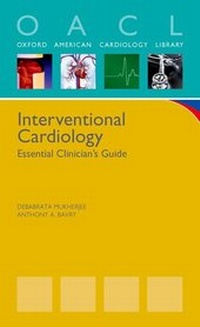
Interventional Cardiology
1st Edition
Published on 17. February 2011
Book
Paperback/Softback
304 pages
978-0-19-973260-9 (ISBN)
Description
Interventional cardiology refers to catheter-based treatment of cardiovascular diseases. This dynamic new field is one of the fastest growing fields in medicine. In the United States, more than a million percutaneous coronary interventions (PCI) are performed annually; moreover, the number of procedures performed will likely continue to increase. The field of interventional cardiology has evolved dramatically over the past decade with the availability of embolic protection devices, drug eluting stents, mechanical thrombectomy catheters, etc. Interventional cardiology represents a rapidly moving target for the cardiologist who seeks to integrate recent advances into their clinical practice. The advent of newer technology presents both an opportunity as well as numerous challenges for the cardiologist to treat patients optimally.
Interventional Cardiology: Essential Clinicians Guide (Oxford American Cardiology Library) aims to provide clinicians with concise, easily accessible guidance on the pre-procedural, procedural and post procedural aspects of PCI in general situations and in various specific clinical settings. The volume features evidence-based discussion on patient selection, vascular access, general principles of PCI, and various specific settings and optimal post procedure management of these patients. This handbook focuses on tailoring stent type to the individual patient, taking into account specific risk factors and comorbidities, appropriate use of embolic protection and thrombectomy catheters. Highly practical in format, content and style, Interventional Cardiology: Essential Clinician's Guide serves as a succinct, yet comprehensive, easily accessible point-of-care reference for busy practitioners. Useful tools, such as treatment algorithms, charts, tables and illustrations assist in making this volume a practical reference tool.
Interventional Cardiology: Essential Clinicians Guide (Oxford American Cardiology Library) aims to provide clinicians with concise, easily accessible guidance on the pre-procedural, procedural and post procedural aspects of PCI in general situations and in various specific clinical settings. The volume features evidence-based discussion on patient selection, vascular access, general principles of PCI, and various specific settings and optimal post procedure management of these patients. This handbook focuses on tailoring stent type to the individual patient, taking into account specific risk factors and comorbidities, appropriate use of embolic protection and thrombectomy catheters. Highly practical in format, content and style, Interventional Cardiology: Essential Clinician's Guide serves as a succinct, yet comprehensive, easily accessible point-of-care reference for busy practitioners. Useful tools, such as treatment algorithms, charts, tables and illustrations assist in making this volume a practical reference tool.
More details
Series
Language
English
Place of publication
New York
United States
Target group
Professional and scholarly
Clinicians: General Practitioners, Cardiologists
Dimensions
Height: 127 mm
Width: 203 mm
Thickness: 18 mm
Weight
318 gr
ISBN-13
978-0-19-973260-9 (9780199732609)
Copyright in bibliographic data and cover images is held by Nielsen Book Services Limited or by the publishers or by their respective licensors: all rights reserved.
Schweitzer Classification
Other editions
Additional editions
Debabrata Mukherjee | Anthony Bavry
Interventional Cardiology
E-Book
01/2011
1st Edition
OUP eBook
€35.49
Available for download
Persons
Debabrata Mukherjee, MD
Gill Heart Foundation Professor of Interventional Cardiology
Director of Cardiac Catheterization Laboratories
Gill Heart Institute, Division of Cardiovascular Medicine
University of Kentucky
900 S. Limestone, 326 Wethington Building
Lexington, KY
Anthony Bavry, MD
Division of Cardiovascular Medicine
Associate Professor of Medicine
University of Florida
1600 SW Archer Road/Box 100277
Gainesville, FL 32610-0277
Gill Heart Foundation Professor of Interventional Cardiology
Director of Cardiac Catheterization Laboratories
Gill Heart Institute, Division of Cardiovascular Medicine
University of Kentucky
900 S. Limestone, 326 Wethington Building
Lexington, KY
Anthony Bavry, MD
Division of Cardiovascular Medicine
Associate Professor of Medicine
University of Florida
1600 SW Archer Road/Box 100277
Gainesville, FL 32610-0277
Content
1. Basic Radiation Principles, Contrast material
2. Antiplatelet agents, antithrombotics, vasopressors and vasodilators
3. Vascular Access (femoral, brachial, radial), use of micropuncture techniques
4. Guiding Catheters, Wires, balloon catheters, cutting balloons
5. Coronary Artery Stenting (BMS, DES)
6. CFR, FFR, IVUS and optical coherence tomography
7. Special settings/subsets
a. STEMI
b. Cardiogenic Shock (PCI, IABP, Tandem Heart, Impella)
c. Saphenous Vein Graft Intervention
d. Chronic total occlusion
e. Calcified lesions
f. Bifurcation lesions
g. LIMA graft lesions
h. Left main interventions
8. Emboli protection devices, Rotational atherectomy, mechanical thrombectomy devices, etc
9. Complications of PCI (stent loss and retrieval, perforation, access site hematoma, AV fistula, radial artery access complications)
10. Optimal long term therapy of the patient after PCI
11. Non coronary interventions
a. Renal and Mesenteric artery interventions
b. Carotid artery interventions
c. Lower extremity arterial interventions
12. Structural heart disease
a. ASD/PFO
b. Ethanol Septal ablation
2. Antiplatelet agents, antithrombotics, vasopressors and vasodilators
3. Vascular Access (femoral, brachial, radial), use of micropuncture techniques
4. Guiding Catheters, Wires, balloon catheters, cutting balloons
5. Coronary Artery Stenting (BMS, DES)
6. CFR, FFR, IVUS and optical coherence tomography
7. Special settings/subsets
a. STEMI
b. Cardiogenic Shock (PCI, IABP, Tandem Heart, Impella)
c. Saphenous Vein Graft Intervention
d. Chronic total occlusion
e. Calcified lesions
f. Bifurcation lesions
g. LIMA graft lesions
h. Left main interventions
8. Emboli protection devices, Rotational atherectomy, mechanical thrombectomy devices, etc
9. Complications of PCI (stent loss and retrieval, perforation, access site hematoma, AV fistula, radial artery access complications)
10. Optimal long term therapy of the patient after PCI
11. Non coronary interventions
a. Renal and Mesenteric artery interventions
b. Carotid artery interventions
c. Lower extremity arterial interventions
12. Structural heart disease
a. ASD/PFO
b. Ethanol Septal ablation