

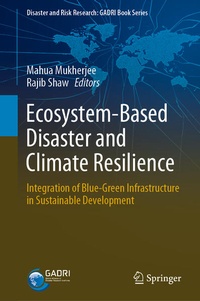
Ecosystem-Based Disaster and Climate Resilience
Description
More details
Other editions
Additional editions
Persons
Rajib Shaw is a professor in the Graduate School of Media and Governance in Keio University, Japan. He is also Senior Fellow of the Institute of Global Environmental Strategies (IGES) Japan and Chairperson of the Sustainable Environment and Ecological Development Society (SEEDS) Asia and the Church World Service (CWS) Japan, two Japanese NGOs. Earlier, he was the executive director of Integrated Research on Disaster Risk (IRDR) and was a professor at Kyoto University. His expertise includes disaster governance, community-based disaster risk management, climate change adaptation, urban risk management, and disaster and environmental education. Professor Shaw is the chair of the United Nations Science Technology Advisory Group (STAG) for disaster risk reduction and the co-chair of the Asia Science Technology Academic Advisory Group (ASTAAG). He is also the coordinating lead author for the Asia chapter of IPCC's 6th Assessment Report. He is the editor-in-chief of the Elsevier journal Progress in Disaster Science and the series editor of the Springer book series on disaster risk reduction. Prof. Shaw has published 51 books and over 300 academic papers and book chapters.
Content
Chapter 1. Uncertainties in Urbanizing World and Nature-based resilience building
Chapter 2. Ecosystem-based Adaptation (EbA) in the Hindu Kush Himalayas: Status, progress and challenges
Chapter 3. Evaluation of Ecosystem based approaches for disaster and climate risk resilience and policy perspectives in Pakistan
Chapter 4. Ecosystem-based approaches and policy perspectives in Nepal
Chapter 5. Ecosystem-based approaches and policy perspective from India
Chapter 6. Ecosystem-based approaches and policy perspectives: Towards integrated blue-green solutions in Vietnam
Chapter 7. Turning blue, green and gray: opportunities for blue-green infrastructure in the Philippines
Chapter 8. Making resilience a reality: The contribution of Peri-urban ecosystem services (BGI) to Urban resilience
Chapter 9. Innovations to Reduce Disaster Risks of Water Challenges
Chapter 10. Future heat risk in South Asia and the need for ecosystem mitigation
Chapter 11. Urban Risk Assessment Tools and Techniques for Ecosystem-based Solutions, India
Chapter 12. Scaling-up Nature based Solutions for mainstreaming urban resilience in Indian cities
Chapter 13. Incorporation of BIM based modeling in sustainable development of green building from stakeholders' perspective
Chapter 14. Planning for Climate Change Adaptation: Comprehensive Approach for Smart Urban Areas Management
Chapter 15. Path towards sustainable water management: A case study of Shimla, India
Chapter 16. Application of Remote Sensing Image in ECO-DRR for Dehradun City
Chapter 17. Ecosystem-based approaches for water stress management- lessons from Nagpur Metropolitan Area, India
Chapter 18. Challenges in decision-making for building resilience to climate risks
Chapter 19: A "Greener" alternative: The Sri Lankan experience of Eco-DRR
Chapter 20. the Watarase retarding basin-a historical example of ecosystem-based disaster risk reduction in Japan
Chapter 21: Self-efficacy for EbA and human health in a post-disaster recovery phase
Chapter 22: Freshwater biomonitoring: an ecosystem-based approach (EbA) for building climate resilience communities in Fiji
Chapter 23: Forward Looking Lens to Mainstream Blue-Green Infrastructure