

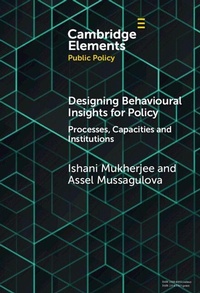
Designing Behavioural Insights for Policy
Processes, Capacities & Institutions
Published on 16. May 2024
Book
Hardback
84 pages
978-1-009-50036-4 (ISBN)
Description
The diversity of knowledge surrounding behavioural insights (BI) means in the policy sciences, although visible, remains under-theorized with scant comparative and generalizable explorations of the procedural prerequisites for their effective design, both as stand-alone tools and as part of dedicated policy 'toolkits'. While comparative analyses of the content of BI tools has proliferated, the knowledge gap about the procedural needs of BI policy design is growing recognizably, as the range of BI responses grows in practice necessitating specific capabilities, processes and institutional frameworks to be in place for their design. This Element draws on the literature on policy design and innovation adoption to explore the administrative, institutional and capacity endowments of governments for the successful and appropriate integration of BI in existing policy frameworks. Further, we present three illustrative cases with respect to their experience of essential procedural endowments facilitating for the effective integration of BI in policy design.
More details
Series
Language
English
Place of publication
Cambridge
United Kingdom
Product notice
sewn/stitched
Cloth over boards
Illustrations
Worked examples or Exercises
Dimensions
Height: 229 mm
Width: 152 mm
Thickness: 6 mm
Weight
286 gr
ISBN-13
978-1-009-50036-4 (9781009500364)
Copyright in bibliographic data and cover images is held by Nielsen Book Services Limited or by the publishers or by their respective licensors: all rights reserved.
Schweitzer Classification
Other editions
Additional editions
Ishani Mukherjee | Assel Mussagulova
Designing Behavioural Insights for Policy
Processes, Capacities & Institutions
E-Book
05/2024
Cambridge University Press
€20.99
Available for download
Persons
Content
1. Introduction; 2. Integrating BI into existing policy toolkits - design and capacity linkages; 3. Institutionalization of BI through innovation adoption; 4. Institutionalization of BI in policy -Australia, Netherlands and Singapore; 5. Towards a consistent framework for BI in policy design; References.