

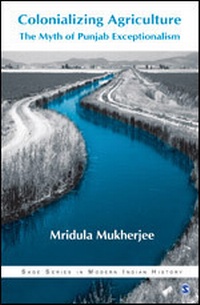
Colonializing Agriculture
The Myth of Punjab Exceptionalism
1st Edition
Published on 1. November 2006
Book
Hardback
240 pages
978-0-7619-3404-2 (ISBN)
Description
This book is the first comprehensive study of the impact of colonialism on the agriculture of this very important region which, apart from the Pakistani and Indian provinces of Punjab, included the present day Indian provinces of Haryana and Himachal Pradesh.
Making extensive use of data culled from government archives and private papers in India and Britain, as well as from village surveys, farm accounts and family budgets, the author argues that Punjab was by no means an idyllic land of prosperous peasant proprietors. She maintains that it was also the land of big feudal landlords, rack-rented tenants, and struggling small-holders, who were forced to enlist in the army or migrate to enable their families to pay government taxes and to repay debts. Comparing Punjab with its supposed polar-opposite, the eastern region of Bengal and Bihar, Mridula Mukherjee demonstrates that Punjab too had begun to exhibit features typical of colonial under-development, such as stagnation of productive forces, intensification of semi-feudal relations, forced commercialisation and lack of capital investment in agriculture. The green revolution therefore was not the result of a continuity but actually because of a break with the colonial past.
Making extensive use of data culled from government archives and private papers in India and Britain, as well as from village surveys, farm accounts and family budgets, the author argues that Punjab was by no means an idyllic land of prosperous peasant proprietors. She maintains that it was also the land of big feudal landlords, rack-rented tenants, and struggling small-holders, who were forced to enlist in the army or migrate to enable their families to pay government taxes and to repay debts. Comparing Punjab with its supposed polar-opposite, the eastern region of Bengal and Bihar, Mridula Mukherjee demonstrates that Punjab too had begun to exhibit features typical of colonial under-development, such as stagnation of productive forces, intensification of semi-feudal relations, forced commercialisation and lack of capital investment in agriculture. The green revolution therefore was not the result of a continuity but actually because of a break with the colonial past.
Reviews / Votes
Mukherjee's Colonizing Agriculture represents a significant contribution to an understanding of the transformation of the agrarian economy of Punjab under colonial rule... it seeks to arrive at some refreshing and original conclusions. -- Studies in History The present volume is a valuable one not only in terms of its being a comprehensive study of the colonial impact on an agriculturally very important region, but also as an example of a model of historical scholarship with its feet firm on the ground (of hard data) and withstanding temptations towards stratospheric musings. -- Development and Change Mukherjee has examined the evidence available in land records and other contemporary reports of the Punjab government. The bibliography is delightful as are the footnotes.... This book should be read by all reformer economists, even if it is not written by an economist. It provides insights that only historical records, not endless regressions, can provide. -- Business StandardMore details
Series
Edition
First Edition
Language
English
Place of publication
Thousand Oaks
United States
Target group
College/higher education
Professional and scholarly
Product notice
Cloth over boards
Dimensions
Height: 241 mm
Width: 159 mm
Weight
523 gr
ISBN-13
978-0-7619-3404-2 (9780761934042)
Copyright in bibliographic data and cover images is held by Nielsen Book Services Limited or by the publishers or by their respective licensors: all rights reserved.
Schweitzer Classification
Other editions
Additional editions
Book
11/2006
1st Edition
SAGE Publications Inc
€44.79
Shipment within 15-20 days
Person
Mridula Mukherjee is currently Professor of Modern Indian History and Chairperson of the Centre for Historical Studies, Jawaharlal Nehru University, New Delhi. Professor Mukherjee has been Visiting Scholar at Duke University, USA, and at the Institute of Oriental Culture, University of Tokyo. She has also been Chairperson of the Archives on Contemporary History at Jawaharlal Nehru University. She has published widely in the areas of agrarian history, peasant movements, social movements and the Indian national movement. Her publications include India's Struggle for Independence (1999) and India After Independence 1947-2000 (2000), both co-authored.
Content
Series Editors` Preface
Preface
Introduction
Peasants as Tax-Payers
Peasants as Debtors
Peasants in the Market
Peasants as Classes
Capital Accumulation and Investment
Punjab and Eastern India: Polar Opposites or Treading the Same Path
Bibliography
Index
Preface
Introduction
Peasants as Tax-Payers
Peasants as Debtors
Peasants in the Market
Peasants as Classes
Capital Accumulation and Investment
Punjab and Eastern India: Polar Opposites or Treading the Same Path
Bibliography
Index