

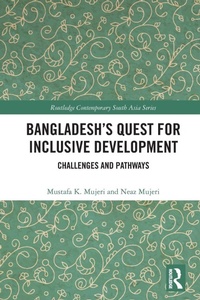
Bangladesh's Quest for Inclusive Development
Challenges and Pathways
1st Edition
Published on 26. August 2024
Book
Paperback/Softback
306 pages
978-1-032-30276-8 (ISBN)
Description
The book provides a comprehensive conceptual understanding covering major challenges and pathways to progressively promote inclusive development in Bangladesh.
Since independence in 1971, Bangladesh has achieved significant economic growth and social progress, but the benefits have not been shared equitably across all groups in society, and there is the demand that inclusive development should be at the core of the country's development agenda. Analysing inclusive development in Bangladesh, the authors present it as synonymous with improving the well-being of all individuals in a comprehensive manner along with upholding the principles of equity and justice. The book shows that the multidimensionality of inclusive development facilitates the participation of all in society in development through enhancing capabilities and ensuring equal opportunities. The analysis highlights social investments in specific concerns of the marginalised and disadvantaged groups and unequal structural forces that compel the state to remain biased towards the rich and consequent 'elite capture' of the state in Bangladesh. Arguing that Bangladesh has moved closer towards applying the inclusive development tenets in policy making, the book's findings show that the challenge is the absence of any generic formula to ensure that the country is moving towards a more inclusive development path.
A valuable contribution to the study of Bangladesh's changing dynamics of political, economic and social configurations and development economics, the book will be of interest to researchers in the fields of economics, Asian studies and development studies.
Since independence in 1971, Bangladesh has achieved significant economic growth and social progress, but the benefits have not been shared equitably across all groups in society, and there is the demand that inclusive development should be at the core of the country's development agenda. Analysing inclusive development in Bangladesh, the authors present it as synonymous with improving the well-being of all individuals in a comprehensive manner along with upholding the principles of equity and justice. The book shows that the multidimensionality of inclusive development facilitates the participation of all in society in development through enhancing capabilities and ensuring equal opportunities. The analysis highlights social investments in specific concerns of the marginalised and disadvantaged groups and unequal structural forces that compel the state to remain biased towards the rich and consequent 'elite capture' of the state in Bangladesh. Arguing that Bangladesh has moved closer towards applying the inclusive development tenets in policy making, the book's findings show that the challenge is the absence of any generic formula to ensure that the country is moving towards a more inclusive development path.
A valuable contribution to the study of Bangladesh's changing dynamics of political, economic and social configurations and development economics, the book will be of interest to researchers in the fields of economics, Asian studies and development studies.
More details
Series
Language
English
Place of publication
London
United Kingdom
Publishing group
Taylor & Francis Ltd
Target group
College/higher education
Professional and scholarly
Academic and Postgraduate
Illustrations
18 s/w Abbildungen, 17 s/w Photographien bzw. Rasterbilder, 1 s/w Zeichnung, 75 s/w Tabellen
75 Tables, black and white; 1 Line drawings, black and white; 17 Halftones, black and white; 18 Illustrations, black and white
Dimensions
Height: 234 mm
Width: 156 mm
Thickness: 18 mm
Weight
497 gr
ISBN-13
978-1-032-30276-8 (9781032302768)
Copyright in bibliographic data and cover images is held by Nielsen Book Services Limited or by the publishers or by their respective licensors: all rights reserved.
Schweitzer Classification
Other editions
Additional editions
Book
09/2022
1st Edition
Routledge
€207.00
Shipment within 10-20 days
E-Book
09/2022
1st Edition
Routledge
€55.49
Available for download
E-Book
09/2022
1st Edition
Routledge
€55.49
Available for download
Persons
Mustafa K. Mujeri is Executive Director at the Institute for Inclusive Finance and Development (InM), Dhaka, Bangladesh. He has co-authored two other books, Bangladesh at Fifty: Moving beyond Development Traps (2020) and Structural Transformation of Bangladesh Economy: A South Asian Perspective (2021) with Neaz Mujeri.
Neaz Mujeri is pursuing an M.Com in International Business at the UNSW Business School in Sydney, Australia. He is the Executive Director at the Center for Research Initiatives, Dhaka, Bangladesh. He has co-authored two other books, Bangladesh at Fifty: Moving beyond Development Traps (2020) and Structural Transformation of Bangladesh Economy: A South Asian Perspective (2021) with Mustafa K. Mujeri.
Neaz Mujeri is pursuing an M.Com in International Business at the UNSW Business School in Sydney, Australia. He is the Executive Director at the Center for Research Initiatives, Dhaka, Bangladesh. He has co-authored two other books, Bangladesh at Fifty: Moving beyond Development Traps (2020) and Structural Transformation of Bangladesh Economy: A South Asian Perspective (2021) with Mustafa K. Mujeri.
Content
Chapter 1: Introduction; Chapter 2: Inclusive Development: Conceptual and Operational Issues; Chapter 3: Bangladesh's Development: Patterns and Challenges; Chapter 4: Population Growth, Labour Supply and Employment; Chapter 5: The Labour Market: Recent Developments and Challenges; Chapter 6: Inclusive Development in Bangladesh: Future Perspectives; Chapter 7: Inequalities and Inclusive Development: The Policy Agenda; Chapter 8: Inclusive Development Strategies in Bangladesh; Chapter 9: Inclusive Development in Bangladesh: Future Pathway