

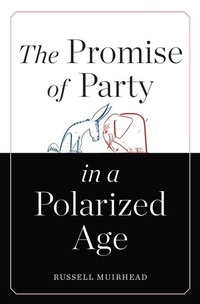
The Promise of Party in a Polarized Age
Published on 1. September 2014
Book
Hardback
336 pages
978-0-674-04683-2 (ISBN)
Description
At the root of America's broken politics is hyperbolic partisanship. It distorts perceptions, inflames disagreements, and poisons the democratic process. Citizens pine for a time when liberals and conservatives compromised with one another-or they yearn for a post-partisan future when the common good trumps ideology and self-interest. Russell Muirhead argues that better partisanship, not less partisanship, is the solution to America's political predicament. Instead of striving to overcome our differences, we should learn how to engage them.
The political conflicts that provide fodder for cable news shows are not simply manufactured from thin air. However sensationalized they become in the retelling, they originate in authentic disagreements over what constitutes the common welfare. Republicans vest responsibility in each citizen for dealing with bad decisions and bad luck, and want every individual and family to enjoy the benefits of good decisions and good luck. Democrats ask citizens to stand together to insure one another against the worst consequences of misfortune or poor judgment, and especially to insure children against some of the consequences of their parents' bad decisions or lack of opportunities. These are fundamental differences that fantasies of bipartisan consensus cannot dissolve.
Disagreement without parties is disempowering, Muirhead says. The remedy is not for citizens and elected officials to learn to "just get along" but for them to bring a skeptical sensibility even to their own convictions, and to learn to disagree as partisans and govern through compromise despite those disagreements.
The political conflicts that provide fodder for cable news shows are not simply manufactured from thin air. However sensationalized they become in the retelling, they originate in authentic disagreements over what constitutes the common welfare. Republicans vest responsibility in each citizen for dealing with bad decisions and bad luck, and want every individual and family to enjoy the benefits of good decisions and good luck. Democrats ask citizens to stand together to insure one another against the worst consequences of misfortune or poor judgment, and especially to insure children against some of the consequences of their parents' bad decisions or lack of opportunities. These are fundamental differences that fantasies of bipartisan consensus cannot dissolve.
Disagreement without parties is disempowering, Muirhead says. The remedy is not for citizens and elected officials to learn to "just get along" but for them to bring a skeptical sensibility even to their own convictions, and to learn to disagree as partisans and govern through compromise despite those disagreements.
Reviews / Votes
Muirhead combats the negative connotations of partisanship in the United States. Although he treasures his friends who agree with him on vital issues decided by legislatures, presidents and judges, the author also values his friends who disagree with him. Their thinking, he writes, provokes him to marshal his arguments and stimulate his mind to consider alternatives. To Muirhead, political disagreements should be resolved through dialogue and active discussion whenever practical. In this philosophical but clearly written book, the author examines how party loyalists can reach common ground, providing ample real-world examples of successful bipartisanship. * Kirkus Reviews * At a time of partisan gridlock, Russ Muirhead challenges conventional wisdom and offers a bold, compelling defense of 'party spirit.' The solution to the polarized politics of today is not bipartisan or post-partisan politics, he argues, but a better kind of partisanship. This illuminating account of the role party loyalties should play in democratic life will find its place among the classics of the field-Samuel Beer, E. E. Schattschneider, Woodrow Wilson, Edmund Burke. -- Michael J. Sandel, author of <i>What Money Can't Buy: The Moral Limits of Markets</i> Muirhead brings us a thoughtful consideration of partisanship in American politics, which by his lights 'encounters fewer limits' than in the past and 'threatens to render the government incapable of governing.' Party politics 'have lost their veneer of civility and mutual respect' and are less bridled by 'constitutional propriety.' The common good, he warns, is the loser in all this. Muirhead dissects the ambition of power seekers, mindset of moral purists, and unreason of zealots of all persuasions...This sensible, readable book deserves more than an academic audience. It might serve as remedial fare for elected officials and party leaders with a vested interest in self-promotional polarities. * Publishers Weekly *More details
Language
English
Place of publication
Cambridge, Mass
United States
Product notice
sewn/stitched
Cloth over boards
With dust jacket
Dimensions
Height: 216 mm
Width: 141 mm
Thickness: 32 mm
Weight
498 gr
ISBN-13
978-0-674-04683-2 (9780674046832)
Copyright in bibliographic data and cover images is held by Nielsen Book Services Limited or by the publishers or by their respective licensors: all rights reserved.
Schweitzer Classification
Other editions
Additional editions
Russell Muirhead
Promise of Party in a Polarized Age
E-Book
09/2014
1st Edition
Harvard University Press
€57.69
Available for download
Person
Russell Muirhead is Robert Clements Associate Professor of Democracy and Politics at Dartmouth College.