

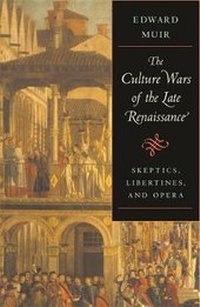
The Culture Wars of the Late Renaissance
Skeptics, Libertines, and Opera
Published on 1. May 2007
Book
Hardback
192 pages
978-0-674-02481-6 (ISBN)
Description
In the summer of 1591 students from the University of Padua attacked the local Jesuit college and successfully appealed to the Venetian Senate to intervene on behalf of the university. When the Jesuits were expelled from the Venetian dominion a few years later, religious censorship was virtually eliminated. The result was a remarkable era of cultural innovation that promoted free inquiry in the face of philosophical and theological orthodoxy, advocated libertine morals, critiqued the tyranny of aristocratic fathers over their daughters, and expanded the theatrical potential of grand opera.
In Padua a faction of university faculty, including Galileo Galilei and the philosopher Cesare Cremonini, pursued an open and free inquiry into astronomy and philosophy. In Venice some of Cremonini's students founded the Accademia degli Incogniti (Academy of the Unknowns), one of whose most notorious members was the brilliant polemicist Ferrante Pallavicino.
The execution of Pallavicino for his writings attacking Pope Urban VIII silenced the more outrageous members of the Incogniti, who soon turned to writing libretti for operas. The final phase of the Venetian culture wars pitted commercial opera, with its female performers and racy plot lines, against the decorous model of Jesuit theater. The libertine inclinations of the Incogniti suffuse many of the operas written in the 1640s, especially Monteverdi's masterpiece, L'Incoronazione di Poppea.
Edward Muir's exploration of an earlier age of anxiety reveals the distinguished past of today's culture wars, including debates about the place of women in society, the clash between science and faith, and the power of the arts to stir emotions.
In Padua a faction of university faculty, including Galileo Galilei and the philosopher Cesare Cremonini, pursued an open and free inquiry into astronomy and philosophy. In Venice some of Cremonini's students founded the Accademia degli Incogniti (Academy of the Unknowns), one of whose most notorious members was the brilliant polemicist Ferrante Pallavicino.
The execution of Pallavicino for his writings attacking Pope Urban VIII silenced the more outrageous members of the Incogniti, who soon turned to writing libretti for operas. The final phase of the Venetian culture wars pitted commercial opera, with its female performers and racy plot lines, against the decorous model of Jesuit theater. The libertine inclinations of the Incogniti suffuse many of the operas written in the 1640s, especially Monteverdi's masterpiece, L'Incoronazione di Poppea.
Edward Muir's exploration of an earlier age of anxiety reveals the distinguished past of today's culture wars, including debates about the place of women in society, the clash between science and faith, and the power of the arts to stir emotions.
Reviews / Votes
Finding the roots of opera in the history of science is a task that would daunt even a polymath of Renaissance stature. Yet in The Culture Wars of the Late Renaissance, Edward Muir plausibly explains how the skepticism taught by a professor at the University of Padua in the early 17th century fostered a musical revolution in neighboring Venice--and much else besides. -- Francis X. Rocca * Wall Street Journal * Muir's small book (hard-covered but paperback in dimensions) set me thinking. It's a remarkably readable, cross-disciplinary study. -- Clifford Bartlett * Journal of Japanese Studies *More details
Series
Language
English
Place of publication
Cambridge, Mass
United States
Target group
Professional and scholarly
Illustrations
11 halftones
Dimensions
Height: 203 mm
Width: 133 mm
ISBN-13
978-0-674-02481-6 (9780674024816)
Copyright in bibliographic data and cover images is held by Nielsen Book Services Limited or by the publishers or by their respective licensors: all rights reserved.
Schweitzer Classification
Other editions
Additional editions
E-Book
07/2009
Harvard University Press
€93.99
Available for download
Person
Edward Muir is Clarence L. Ver Steeg Professor in the Arts and Sciences at Northwestern University.