

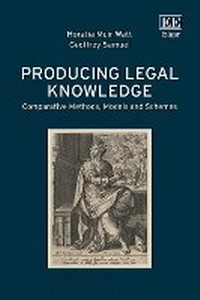
Producing Legal Knowledge
Comparative Methods, Models and Schemes
Published on 24. March 2026
Book
Hardback
266 pages
978-1-0353-1846-9 (ISBN)
Description
This thought-provoking book opens up a distinctive and original framework of analysis of the relationship between legal methodologies and the social and human sciences. Rich in implications both for comparative legal theory and for the understanding of legal reasoning in practice, it adopts a critical epistemological perspective by enlarging the focus of comparative legal studies and allowing for a much-needed decentering of conventional approaches to law across cultures and disciplines.
Using a novel lens, leading scholars Horatia Muir Watt and Geoffrey Samuel explore modes of knowledge, reasoning and veridiction that are usually taken for granted within the law. They investigate interdisciplinary insights from areas as diverse as algorithmic governance, symmetrical anthropology or cinema studies to suggest alternative knowledge frameworks better attuned to our culturally diverse world. Building on well known examples from Roman law, private international law and contemporary orientations in legal comparison, they highlight both the resistance of traditional legal epistemology to transformative moves in other fields as well as how other areas of knowledge incorporate in turn contributions from legal doctrines and juridical argument.
Producing Legal Knowledge is a beneficial read for scholars and students of comparative legal studies and legal epistemology, particularly those interested in legal research methods.
Using a novel lens, leading scholars Horatia Muir Watt and Geoffrey Samuel explore modes of knowledge, reasoning and veridiction that are usually taken for granted within the law. They investigate interdisciplinary insights from areas as diverse as algorithmic governance, symmetrical anthropology or cinema studies to suggest alternative knowledge frameworks better attuned to our culturally diverse world. Building on well known examples from Roman law, private international law and contemporary orientations in legal comparison, they highlight both the resistance of traditional legal epistemology to transformative moves in other fields as well as how other areas of knowledge incorporate in turn contributions from legal doctrines and juridical argument.
Producing Legal Knowledge is a beneficial read for scholars and students of comparative legal studies and legal epistemology, particularly those interested in legal research methods.
More details
Language
English
Place of publication
Cheltenham
United Kingdom
Target group
Professional and scholarly
College/higher education
Dimensions
Height: 234 mm
Width: 156 mm
ISBN-13
978-1-0353-1846-9 (9781035318469)
Copyright in bibliographic data and cover images is held by Nielsen Book Services Limited or by the publishers or by their respective licensors: all rights reserved.
Schweitzer Classification
Persons
Horatia Muir Watt, Professor of Law, SciencesPo, Paris, France and Geoffrey Samuel, Professor Emeritus, Kent Law School, UK
Content
Contents
Preface
1 Introduction: comparative legal methodology in context
PART I OVERVIEW
Introduction to Part I: Overview
2 Threshold epistemological conundra
3 Comparative law's conceptual language
4 Models of legal knowledge (1): the canon
5 Models of legal knowledge (2): further variations
PART II SCHEMES OF INTELLIGIBILITY
Introduction to Part II: schemes of intelligility
6 Causal scheme: an uncommon notion
7 Functional scheme: theory, heuristic, or just part of the
problem?
8 Structuralist scheme: preparing for the era of the 'post-
structuralist'?
9 Hermeneutical scheme: what (if anything) is beyond the 'text'?
10 Dialectical scheme: comparison, opposition and critique
11 Actionalist (and interactionalist) scheme: individuals, society,
actor-networks
12 Ontologies and open conclusions
Bibliography
Preface
1 Introduction: comparative legal methodology in context
PART I OVERVIEW
Introduction to Part I: Overview
2 Threshold epistemological conundra
3 Comparative law's conceptual language
4 Models of legal knowledge (1): the canon
5 Models of legal knowledge (2): further variations
PART II SCHEMES OF INTELLIGIBILITY
Introduction to Part II: schemes of intelligility
6 Causal scheme: an uncommon notion
7 Functional scheme: theory, heuristic, or just part of the
problem?
8 Structuralist scheme: preparing for the era of the 'post-
structuralist'?
9 Hermeneutical scheme: what (if anything) is beyond the 'text'?
10 Dialectical scheme: comparison, opposition and critique
11 Actionalist (and interactionalist) scheme: individuals, society,
actor-networks
12 Ontologies and open conclusions
Bibliography