

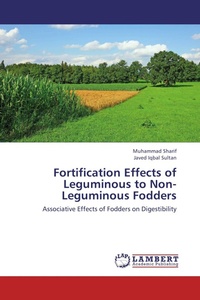
Fortification Effects of Leguminous to Non-Leguminous Fodders
Associative Effects of Fodders on Digestibility
Published on 22. August 2013
Book
Paperback/Softback
92 pages
978-3-659-44867-6 (ISBN)
Description
The book deals with associative effects of leguminous and non-leguminous fodders. Non-leguminous fodders are mainly used to meet the dietary requirements of ruminant animals. However, these grasses are low in crude protein and non-structural carbohydrates but rich source of structural carbohydrates. This need can be partially met through the use of leguminous fodders which are rich in crude protein and non-structural carbohydrates. Feeding leguminous and non-leguminous fodders in combination provides better feed for the animals. It results in improved forage intake as the level of legume in the basal diet is increased up to a level. Thus optimum benefits may be obtained by using leguminous fodders at particular level with non-leguminous fodders due to their optimum positive associative effect at the level.
More details
Language
English
Product notice
Paperback (trade)
Unsewn / adhesive bound
Dimensions
Height: 220 mm
Width: 150 mm
Thickness: 7 mm
Weight
155 gr
ISBN-13
978-3-659-44867-6 (9783659448676)
Copyright in bibliographic data and cover images is held by Nielsen Book Services Limited or by the publishers or by their respective licensors: all rights reserved.
Schweitzer Classification
Persons
Dr. Muhammad Sharif has been working as Assistant Professor at University of Agriculture, Faisalabad. He is interested in providing balanced ration to ruminant animals through the use of leguminous and non-leguminous fodders and provision of minerals. He has published 25 research/review manuscripts and a book on Mineral Nutrition in Buffaloes.