

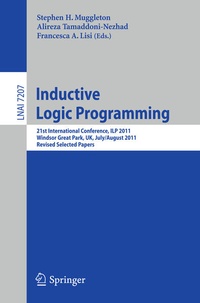
Inductive Logic Programming
21st International Conference, ILP 2011, Windsor Great Park, UK, July 31 -- August 3, 2011, Revised Selected Papers
Published on 27. July 2012
Book
Paperback/Softback
XI, 406 pages
978-3-642-31950-1 (ISBN)
Description
This book constitutes the thoroughly refereed post-proceedings of the 21st International Conference on Inductive Logic Programming, ILP 2011, held in Windsor Great Park, UK, in July/August 2011. The 24 revised full papers were carefully reviewed and selected from 66 submissions. Also included are five extended abstracts and three invited talks. The papers represent the diversity and vitality in present ILP research including ILP theory, implementations, probabilistic ILP, biological applications, sub-group discovery, grammatical inference, relational kernels, learning of Petri nets, spatial learning, graph-based learning, and learning of action models.
More details
Series
Edition
2012 ed.
Language
English
Place of publication
Berlin
Germany
Publishing group
Springer Berlin
Target group
Professional and scholarly
Research
Illustrations
130 s/w Abbildungen
XI, 406 p. 130 illus.
Dimensions
Height: 235 mm
Width: 155 mm
Thickness: 23 mm
Weight
633 gr
ISBN-13
978-3-642-31950-1 (9783642319501)
DOI
10.1007/978-3-642-31951-8
Schweitzer Classification
Other editions
Additional editions
Stephen Muggleton | Alireza Tamaddoni-Nezhad | Francesca A. Lisi
Inductive Logic Programming
21st International Conference, ILP 2011, Windsor Great Park, UK, July 31 -- August 3, 2011, Revised Selected Papers
E-Book
07/2012
Springer
€53.49
Available for download
Content
Inference and Learning.- Beyond Reward: The Problem of Knowledge and Data.- Exploiting Constraints.- Online Bayesian Inference for the Parameters of PRISM Programs.- Learning Compact Markov Logic Networks with Decision Trees.- Relational Networks of Conditional Preferences.- k-Optimal: A Novel Approximate Inference Algorithm for ProbLog.- Learning Directed Relational Models with Recursive Dependencies.- Integrating Model Checking and Inductive Logic Programming.- Inductive Logic Programming in Answer Set Programming.- Graph-Based Relational Learning with a Polynomial Time Projection Algorithm.- Interleaved Inductive-Abductive Reasoning for Learning Complex Event Models.- Conceptual Clustering of Multi-Relational Data.- Expressive Power of Safe First-Order Logical Decision Trees.- Relational Learning for Spatial Relation Extraction from Natural