

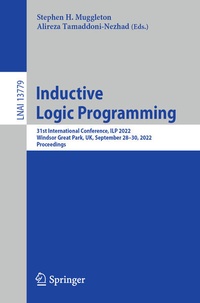
Inductive Logic Programming
31st International Conference, ILP 2022, Windsor Great Park, UK, September 28-30, 2022, Proceedings
Published on 20. March 2024
Book
Paperback/Softback
X, 157 pages
978-3-031-55629-6 (ISBN)
Description
This book constitutes the refereed proceedings of the 31st International Conference on Inductive Logic Programming, ILP 2022, held during September 28-30, 2022.
The 11 regular papers presented in this book were carefully reviewed and selected from 26 submissions
The papers in these proceedings represent the diversity and vitality in present ILP research, including statistical relational learning, transfer learning, scientific reasoning, learning temporal models, synthesis and planning, and argumentation and language.
More details
Series
Edition
2024 ed.
Language
English
Place of publication
Cham
Switzerland
Publishing group
Springer International Publishing
Target group
Professional and scholarly
Illustrations
15 s/w Abbildungen, 20 farbige Abbildungen
X, 157 p. 35 illus., 20 illus. in color.
Dimensions
Height: 235 mm
Width: 155 mm
Thickness: 10 mm
Weight
265 gr
ISBN-13
978-3-031-55629-6 (9783031556296)
DOI
10.1007/978-3-031-55630-2
Schweitzer Classification
Other editions
Additional editions
Stephen H. Muggleton | Alireza Tamaddoni-Nezhad
Inductive Logic Programming
31st International Conference, ILP 2022, Windsor Great Park, UK, September 28-30, 2022, Proceedings
E-Book
03/2024
Springer
€58.84
Available for download
Content
Learning the Parameters of Probabilistic Answer Set Programs.- Navigable atom-rule interactions in PSL models enhanced by rule verbalizations, with an application to etymological inference.- A Program-Synthesis Challenge for ARC-like Tasks.- Explaining with Attribute-based and Relational Near Misses: An Interpretable Approach to Distinguishing Facial Expressions of Pain and Disgust.- Learning Automata-Based Complex Event Patterns in Answer Set Programming.- Learning Hierarchical Problem Networks for Knowledge-Based Planning.- Combining word embeddings-based similarity measures for transfer learning across relational domains.- Learning Assumption-based Argumentation Frameworks.- Diagnosis of Event Sequences with LFIT.- Efficient Abductive Learning of Microbial Interactions using Meta Inverse Entailment.- Functional Lifted Bayesian Networks: Statistical Relational Learning and Reasoning with Relative Frequencies.