

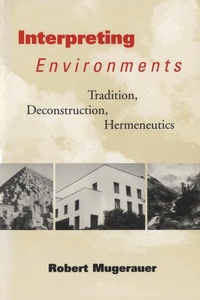
Interpreting Environments
Tradition, Deconstruction, Hermeneutics
Published on 1. January 1996
Book
Paperback/Softback
232 pages
978-0-292-75189-7 (ISBN)
Description
In this pioneering book, Robert Mugerauer seeks to make deconstruction and hermeneutics accessible to people in the environmental disciplines, including architecture, planning, urban studies, environmental studies, and cultural geography.
Mugerauer demonstrates each methodology through a case study. The first study uses the traditional approach to recover the meaning of Jung's and Wittgenstein's houses by analyzing their historical, intentional contexts. The second case study utilizes deconstruction to explore Egyptian, French neoclassical, and postmodern attempts to use pyramids to constitute a sense of lasting presence. And the third case study employs hermeneutics to reveal how the American understanding of the natural landscape has evolved from religious to secular to ecological since the nineteenth century.
Mugerauer demonstrates each methodology through a case study. The first study uses the traditional approach to recover the meaning of Jung's and Wittgenstein's houses by analyzing their historical, intentional contexts. The second case study utilizes deconstruction to explore Egyptian, French neoclassical, and postmodern attempts to use pyramids to constitute a sense of lasting presence. And the third case study employs hermeneutics to reveal how the American understanding of the natural landscape has evolved from religious to secular to ecological since the nineteenth century.
More details
Language
English
Place of publication
Austin, TX
United States
Target group
Professional and scholarly
Product notice
Paperback (trade)
Dimensions
Height: 229 mm
Width: 152 mm
Thickness: 14 mm
Weight
387 gr
ISBN-13
978-0-292-75189-7 (9780292751897)
Copyright in bibliographic data and cover images is held by Nielsen Book Services Limited or by the publishers or by their respective licensors: all rights reserved.
Schweitzer Classification
Person
Robert Mugerauer is Professor of Urban Design and Planning at the University of Washington.
Content
Acknowledgments
Introduction
1. Traditional Approaches: Wittgenstein's and Jung's Lives, Work, and Houses
Facing Uncertain Meanings and Traditions
Wittgenstein's Restlessness
Jung's Quest for Wholeness
Alternatives for Contemporary Existence
2. Deconstruction: Pyramid as Posture and Strategy
Deconstructing Pyramids
Egyptian Pyramids
French Neoclassic Pyramids
Postmodern Pyramids
3. Hermeneutic Retrieval: American Nature as Paradise
America Religiously Understood
A Natural Paradise Already Given
Paradise Promised: Wilderness to Be Converted
Secular Echoes in Landscape Architecture and Environmental Attitudes
The Hidden and Disclosure
Postscript
Notes
Bibliography
Index
Introduction
1. Traditional Approaches: Wittgenstein's and Jung's Lives, Work, and Houses
Facing Uncertain Meanings and Traditions
Wittgenstein's Restlessness
Jung's Quest for Wholeness
Alternatives for Contemporary Existence
2. Deconstruction: Pyramid as Posture and Strategy
Deconstructing Pyramids
Egyptian Pyramids
French Neoclassic Pyramids
Postmodern Pyramids
3. Hermeneutic Retrieval: American Nature as Paradise
America Religiously Understood
A Natural Paradise Already Given
Paradise Promised: Wilderness to Be Converted
Secular Echoes in Landscape Architecture and Environmental Attitudes
The Hidden and Disclosure
Postscript
Notes
Bibliography
Index