

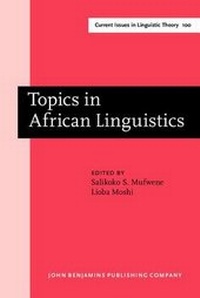
Topics in African Linguistics
Papers from the XXI Annual Conference on African Linguistics, University of Georgia, April 1990
Published on 7. October 1993
Book
Hardback
307 pages
978-1-55619-553-2 (ISBN)
Description
The 16 papers in this volume are revised versions of papers presented at the conference; they represent the state of the art in various subfields of African linguistics into which the book is organized: (1) morphosyntax, (2) semantics, (3) phonology, and (4) language contact. The last part covers topics such as code-switching and mixing, pidginization/creolization, and language planning.The papers in Part I: Morphosyntax focus particularly on the verb and verb phrase in a variety of Niger-Congo languages, discussing several aspects of the verb morphology. The specific languages discussed include Kinande, Kilega, Kinyarwanda (Larry Hyman), Kikongo-Kituba (M. Ngalasso), Duala (E. Bilao), Yoruba (S.A. Lawal), Ewe (A.S. Allen), and Gbaya 'Bodoe (P. Roulon-Doko). The papers in Part II: Semantics discuss foundational questions regarding the proper/common noun distinction in two geographically very distant African languages, Gborbo Krahn (Janet Bing) in the west and Luo (Ben G. Blount) in the east, which follow yet very similar principles. And, despite differences in the titles, the papers on Kivunjo (Lioba Moshi) and Emai (Schaefer and Egbokhare) address the question of the semantic basis for assigning property concepts to different lexical categories. There are two papers in Part III: Phonology, which are mostly on the prosodic features of Chiyao (Al Mtenje) and Manding (J. Tourville). In Part IV: Language Contact, Eyamba Bokamba's and C. Meyers-Scotton's papers discuss speech variation and mostly formal constraints associated with them, while Helma Pasch compares segmental features of Sango and Yakoma in the Central African Republic to determine whether the former is a creole. Edmun Richmond focuses on the choice of national official language in sub-Saharan Africa. Except for Pasch all of them cover several languages and geographical areas.
More details
Series
Language
English
Place of publication
Amsterdam/Philadelphia
United States
Target group
Professional and scholarly
Dimensions
Height: 245 mm
Width: 164 mm
Weight
540 gr
ISBN-13
978-1-55619-553-2 (9781556195532)
Copyright in bibliographic data and cover images is held by Nielsen Book Services Limited or by the publishers or by their respective licensors: all rights reserved.
Schweitzer Classification
Persons
Content
1. Editors' foreword; 2. I. Morphosyntax; 3. Conceptual issues in the comparative study of the Bantu verb stem (by Hyman, Larry M.); 4. Ewe verbs in derivation and in periphrastic constructions (by Allen, Andrew S.); 5. Les procedes repetitifs en kikongo: le redoublement et la reduplication (by Ngalasso, Mwatha Musanji); 6. Clitic climbing in BAntu (by Biloa, Edmond); 7. The Yoruba serial verb construction: a complex or simple sentence? (by Lawal, S. Adenike); 8. La negation en gbaya 'bodoe (by Roulon-Doko, Paulette); 9. II. Semantics; 10. Names and horofic pronouns in Gborbo Krahn (by Bing, Janet); 11. Luo names: reference and meaning (by Blount, Ben G.); 12. Time-stability: the case of adjectives in kiVunjo-Chaga (by Moshi, Lioba); 13. On the typological character of property concepts in Emai (by Schaefer, Ronald P.); 14. III. Phonology; 15. Verb structure and tone in Chiyao (by Mtenje, Al); 16. On the reduced nasal phoneme of manding (by Tourville, Jose); 17. IV. Language contact; 18. Language variation and change in pervasively multilingual societies: Bantu languages (by Bokamba, Eyamba G.); 19. Building the frame in codeswitching: evidence from Africa (by Myers-Scotton, Carol); 20. Phonological similarities between Sango and its base language: is Sango a pidgin/creole or a koine? (by Pasch, Helma); 21. Can language plannign work? Theory versus practice in Africa (by Richmond, Edmund B.); 22. Author index; 23. Language index