

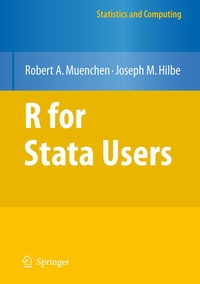
R for Stata Users
Description
Stata is the most flexible and extensible data analysis package available from a commercial vendor. R is a similarly flexible free and open source package for data analysis, with over 3,000 add-on packages available. This book shows you how to extend the power of Stata through the use of R. It introduces R using Stata terminology with which you are already familiar. It steps through more than 30 programs written in both languages, comparing and contrasting the two packages' different approaches. When finished, you will be able to use R in conjunction with Stata, or separately, to import data, manage and transform it, create publication quality graphics, and perform basic statistical analyses.
A glossary defines over 50 R terms using Stata jargon and again using more formal R terminology. The table of contents and index allow you to find equivalent R functions by looking up Stata commands and vice versa. The example programs and practice datasets for both R and Stata are available for download.
Reviews / Votes
From the reviews:
"The goal of the authors 'is to help you translate what you know about Stata into a working knowledge of R as quickly and easily as possible' . . the book is apparently aimed at someone who wishes to switch from Stata to R. . many chapters include Stata code and R code to do exactly the same thing (particularly in the data manipulation chapters) and these are helpful." (Richard Goldstein, Technometrics, Vol. 53 (4), November, 2011)More details
Other editions
Additional editions
Persons
Joseph M. Hilbe is Solar System Ambassador with NASA/Jet Propulsion Laboratory, California Institute of Technology, an adjunct professor of statistics at Arizona State, and emeritus professor at the University of Hawaii. He is a Fellow of the American Statistical Association and elected member of the International Statistical Institute. Hilbe was the first editor of the Stata Technical Bulletin, (later named the Stata Journal) and is author of a number of textbooks, including Logistic Regression Models and Negative Binomial Regression.