

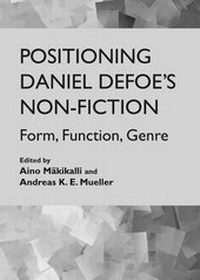
Positioning Daniel Defoe's Non-Fiction
Form, Function, Genre
Published on 17. June 2011
Book
Hardback
210 pages
978-1-4438-3005-8 (ISBN)
Description
This volume analyses the form, structure and genre of a selection of non-fictional works by Daniel Defoe. Directing our scholarly gaze away from the much studied novels, the essays explore the rhetorical strategies and generic inventiveness on display in Defoe's better known non-fictional texts, such as The Shortest Way with the Dissenters and A Tour through the Whole Island of Great Britain, and some of his lesser known publications, such as his Complete English Tradesman and An Essay on the History and Reality of Apparitions. What emerges from the collection is the picture of an author who responded to early eighteenth-century debates and events with outstanding authorial skill and energy, and to whom matters of form and style were of great importance.
Reviews / Votes
'I finished Positioning Daniel Defoe's Non-Fiction convinced of the argument made in its introduction: that Defoe innovated formally in his non-fiction in orderto engage, persuade, and move his reader. The collection does an excellent job of showing us how and of tracing patterns across some of the many genres in which Defoe wrote. It will be required reading for Defoe scholars, and it will be of interest to many students with a more general interest in the popular writing of the early eighteenth century.', Jess Edwards, Manchester Metropolitan University, in Digital Defoe: Studies in Defoe & His Contemporaries 4, no. 1 (fall 2012), pp. 83-87, p. 87."The nine essays in this book accurately analyze not only the contexts of Defoe's writing on topics as diverse as England's union with Scotland, the present and future growth of London, Jacobite threats, religious bigotry, convergence of masculine and feminine psychology in the conduct of tradesmen, the devastation wrought by a fierce storm in 1703, and what he took to be the oddly constituted reality of ghosts. Even more importantly, these essays explain the large repertoire of genres and rhetorical strategies Defoe had mastered for use as he thought different occasions demanded. What results is better understanding of his great skill as a professional writer on matters of fact or speculation, and therefore better appreciation of an author whose strange, surprising leap of genius to Robinson Crusoe and Moll Flanders can neither be chalked off to lucky amateur accident nor, even in retrospect, viewed as a predictable, inevitable progress from capable journalism to innovative artistry."-Paul K. Alkon, Bing Professor Emeritus of English and American Literature, University of Southern California, Los Angeles, USAMore details
Edition
Unabridged edition
Language
English
Place of publication
Newcastle upon Tyne
United Kingdom
Target group
Professional and scholarly
Edition type
Unabridged edition
Product notice
With dust jacket
Dimensions
Height: 212 mm
Width: 148 mm
ISBN-13
978-1-4438-3005-8 (9781443830058)
Copyright in bibliographic data and cover images is held by Nielsen Book Services Limited or by the publishers or by their respective licensors: all rights reserved.
Schweitzer Classification
Other editions
Additional editions
Unknown | Aino Maekikalli | Andreas K. E. Mueller
Positioning Daniel Defoe's Non-Fiction
Form, Function, Genre
E-Book
05/2020
1st Edition
Cambridge Scholars Publishing
€139.99
Available for download
Persons
Dr Aino Maekikalli is a Research Fellow in Comparative Literature at the University of Turku, Finland. Her publications include From Eternity to Time: Conceptions of Time in Daniel Defoe's Novels (2007).Dr Andreas K. E. Mueller is a Senior Lecturer in English Literature at the University of Worcester, UK. His publications include A Critical Study of Daniel Defoe's Verse (2010).