

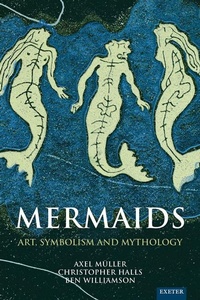
Mermaids
Art, Symbolism and Mythology
Published on 26. April 2022
Book
Hardback
168 pages
978-1-80413-003-2 (ISBN)
Description
Women with fish tails are among the oldest and still most popular of mythological creatures, possessing a powerful allure and compelling ambiguity. They dwell right in the uncanniest valley of the sea: so similar to humans, yet profoundly other. Mermaids: Art, Symbolism and Mythology presents a comprehensive, interdisciplinary and beautifully illustrated study of mermaids and their influence on Western culture. The roots of mermaid mythology and its metamorphosis through the centuries are discussed with examples from visual art, literature, music and architecture-from 600 BCE right up to the present day.
Our story starts in Mesopotamia, source of the earliest preserved illustrations of half-human, half-fish creatures. The myths and legends of the Mesopotamians were incorporated and adopted by ancient Greek, Etruscan and Roman cultures. Then, during the early medieval period, ancient mythological creatures such as mermaids were confused, transformed and reinterpreted by Christian tradition to begin a new strand in mermaid lore. Along the way, all manner of stunning-and sometimes bizarre or unsettling-depictions of mermaids emerged. Written in an accessible and entertaining style, this book challenges conventional views of mermaid mythology, discusses mermaids in the light of evolutionary theory and aims to inspire future studies of these most curious of imaginary creatures.
Our story starts in Mesopotamia, source of the earliest preserved illustrations of half-human, half-fish creatures. The myths and legends of the Mesopotamians were incorporated and adopted by ancient Greek, Etruscan and Roman cultures. Then, during the early medieval period, ancient mythological creatures such as mermaids were confused, transformed and reinterpreted by Christian tradition to begin a new strand in mermaid lore. Along the way, all manner of stunning-and sometimes bizarre or unsettling-depictions of mermaids emerged. Written in an accessible and entertaining style, this book challenges conventional views of mermaid mythology, discusses mermaids in the light of evolutionary theory and aims to inspire future studies of these most curious of imaginary creatures.
Reviews / Votes
The authors have written a wonderfully in-depth (pun intended) book about virtually every aspect of merpeople. There is as much information as most people could ever wish for about the subject. -- Trevor Pyne, Magonia ReviewMore details
Language
English
Place of publication
Exeter
United Kingdom
Target group
Professional and scholarly
Illustrations
5 s/w Tabellen, 4 Karten, 5 s/w Abbildungen, 80 farbige Abbildungen, 5 s/w Zeichnungen
4 Maps; 5 Tables, black and white; 5 Illustrations, black and white; 5 Line drawings, black and white; 80 Illustrations, color
Dimensions
Height: 250 mm
Width: 181 mm
Thickness: 22 mm
Weight
627 gr
ISBN-13
978-1-80413-003-2 (9781804130032)
DOI
10.47788/DIJI2771
Copyright in bibliographic data and cover images is held by Nielsen Book Services Limited or by the publishers or by their respective licensors: all rights reserved.
Schweitzer Classification
Other editions
Additional editions
E-Book
04/2022
University of Exeter Press
€59.99
Available for download
E-Book
04/2022
University of Exeter Press
€59.99
Available for download
Persons
Axel Mueller is Professor in Mineralogy and Petrology at the Natural History Museum of the University of Oslo in Norway. He has a strong interdisciplinary geoscience career and teaches economic geology. The late Christopher Halls was awarded a PhD in Geology in 1969 from University College London. He worked as a geologist in Canada and then as a lecturer at Imperial College, London. Following retirement he became a Scientific Associate of the Natural History Museum. Ben Williamson is an Associate Professor in Applied Mineralogy at University of Exeter. His research has focused on the nature and origin of granites and associated mineralisation, and the environmental impacts of mining. He is also dedicated to teaching and inspiring the next generation of geologists.
Content
Preface
Memorial note
1 Introduction: Why mermaids?
2 Mermaids conceived: hybrid goddesses and beasts in antiquity
3 Christian adaptations in the Romanesque to Baroque eras
4 Mermaid passions: obsessive fixation in nineteenth- and early twentieth-century art
5 Mermaids everywhere: postwar commercialization and trivialization
6 Mermaids rationalized: evolutionary theory confronts the fantastic
References
Acknowledgements
Index
Memorial note
1 Introduction: Why mermaids?
2 Mermaids conceived: hybrid goddesses and beasts in antiquity
3 Christian adaptations in the Romanesque to Baroque eras
4 Mermaid passions: obsessive fixation in nineteenth- and early twentieth-century art
5 Mermaids everywhere: postwar commercialization and trivialization
6 Mermaids rationalized: evolutionary theory confronts the fantastic
References
Acknowledgements
Index