

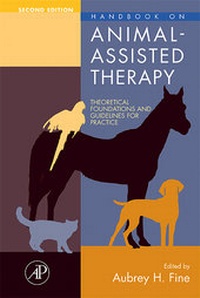
Handbook on Animal-Assisted Therapy
Theoretical Foundations and Guidelines for Practice
2nd Edition
Published on 27. September 2006
Book
Hardback
552 pages
978-0-12-369484-3 (ISBN)
Description
The original edition was the first book to provide a comprehensive overview of the ways in which animals can assist therapists with treatment of specific populations, and/or in specific settings. The second edition continues in this vein, with 7 new chapters plus substantial revisions of continuing chapters as the research in this field has grown. New coverage includes: Animals as social supports, Use of AAT with Special Needs students, the role of animals in the family- insights for clinicians, and measuring the animal-person bond.
More details
Edition
2nd edition
Language
English
Place of publication
San Diego
United States
Publishing group
Elsevier Science Publishing Co Inc
Target group
Professional and scholarly
Practicing Clinicians
Edition type
New edition
Dimensions
Height: 229 mm
Width: 152 mm
Weight
857 gr
ISBN-13
978-0-12-369484-3 (9780123694843)
Copyright in bibliographic data and cover images is held by Nielsen Book Services Limited or by the publishers or by their respective licensors: all rights reserved.
Schweitzer Classification
Other editions
New editions
Megan Mueller | Zenithson Ng | Taylor Chastain Griffin
Handbook on Animal-Assisted Therapy
Book
09/2024
6th Edition
Academic Press
€100.50
Shipment within 15-20 days
Aubrey H. Fine
Handbook on Animal-Assisted Therapy
Theoretical Foundations and Guidelines for Practice
Book
09/2010
3rd Edition
Academic Press
€68.08
Article exhausted; check for reprint
Additional editions
Megan Mueller Ph. D | Zenithson Ng | Taylor Chastain Griffin
Handbook on Animal-Assisted Therapy
Theoretical Foundations and Guidelines for Practice
E-Book
04/2011
2nd Edition
Academic Press
€62.95
Available for download
Previous edition
Aubrey H. Fine
Handbook on Animal Assisted Therapy
Theoretical Foundations and Guidelines for Practice
Book
10/1999
Academic Press
€60.60
Article exhausted; check for reprint
Persons
Dr. Megan K. Mueller, Ph.D. is an Associate Professor of Human-Animal interaction at the Cummings School of Veterinary Medicine at Tufts University within the Center for Animals and Public Policy. Dr. Mueller is Co-Director of the Tufts Initiative for Human-Animal Interaction and is a senior fellow at the Jonathan M. Tisch College of Civic Life at Tufts University. Dr. Mueller is a developmental psychologist, and her research program focuses on assessing the dynamic relationships between people and animals in families and communities. Her work focuses on the psychology of the human-animal bond, and how human-animal interaction can promote thriving for adolescents and their families. Her research has been published in numerous scientific journals and media outlets. Dr. Mueller is a board member of the International Society for Anthrozoology and serves on the Pet Partners Human-Animal Bond Advisory Board. Dr. Zenithson Ng is a clinical associate professor at the University of Tennessee. He earned his undergraduate degree in animal science from Rutgers University and his veterinary degree from Cornell University; then completed a small animal rotating internship at the ASPCA in NYC, followed by a canine/feline primary care residency combined with a master's degree in human-animal bond studies at Virginia Tech. His clinical interests include small animal behavior, dentistry, preventive medicine, and management of chronic disease. His research and teaching interests span all aspects of the human-animal bond including the effect of human-animal interaction on both humans and animals, the veterinary-client relationship, and stress reduction in both veterinary and animal-assisted intervention settings. Dr. Taylor Chastain Griffin?is the Executive Director of The Association of Animal-Assisted Intervention Professionals and is the National Director of Animal-Assisted Interventions (AAI) Advancement at Pet Partners. In these roles, she oversees the organizations' empirical research collaborations and works with other field leaders to motivate standardization and professionalization of the intervention. With a background as a dog trainer, therapy dog handler, and mental health counselor, Dr. Chastain Griffin came to her position with a variety of experiences that inform her work. Having completed her doctorate in research psychology with a focus on the human-animal bond, she works to formally integrate expertise in the field of human services with best practices while working with therapy animals. Psychologist Dr. Aubrey Fine is an internationally known expert with close to 50 years of experience in the field of Animal Assisted Therapy (AAT) and the Human Animal Bond. Dr. Fine is a Professor Emeritus at the California State Polytechnic University for over 42 years, during which time he has researched the value of AAT with children and the elderly. In addition, he has integrated the foundations of AAT into his clinical practice, which primarily focuses on the treatment of children with attention, behavioral, adjustment and developmental disorders.
Content
Abbreviated TOC
Dedication
Foreword
Preface
Acknowledgements
SECTION I The Conceptualization of the Animal-Human Bond: The Foundation for Understanding Animal-Assisted Therapy
SECTION II Animal-Assisted Therapy: Conceptual Model and Guidelines for Quality Assurance
SECTION III Best Practices in Animal-Assisted Therapy: Guidelines for Use of AAT with Special Populations
SECTION IV Special Topics and Concerns in Animal-Assisted Therapy
PART A The Role of Ethology in the Field of Human-Animal Relations and Animal-Assisted Therapy
PART B Human Animal Interactions in Health: Best Evidence and Where We Go From Here?
PART C The Role of AAT in Clinical Practice: The Importance of Demonstrating Empirically Oriented Psychotherapies
Dedication
Foreword
Preface
Acknowledgements
SECTION I The Conceptualization of the Animal-Human Bond: The Foundation for Understanding Animal-Assisted Therapy
SECTION II Animal-Assisted Therapy: Conceptual Model and Guidelines for Quality Assurance
SECTION III Best Practices in Animal-Assisted Therapy: Guidelines for Use of AAT with Special Populations
SECTION IV Special Topics and Concerns in Animal-Assisted Therapy
PART A The Role of Ethology in the Field of Human-Animal Relations and Animal-Assisted Therapy
PART B Human Animal Interactions in Health: Best Evidence and Where We Go From Here?
PART C The Role of AAT in Clinical Practice: The Importance of Demonstrating Empirically Oriented Psychotherapies