

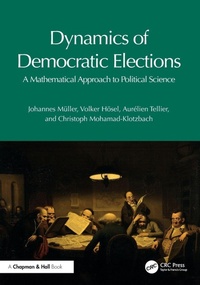
Dynamics of Democratic Elections
A Mathematical Approach to Political Science
1st Edition
Published on 14. November 2025
Book
Paperback/Softback
402 pages
978-1-032-79912-4 (ISBN)
Description
Dynamics of Democratic Elections explores modeling approaches to democratic elections and opinion dynamics at the intersection of mathematics, political science, and computational modeling. The book focuses on relatively simple models, their analysis, and how they perform in real-world applications. In order to make the book easy to navigate, the material is divided into three major parts concerning 'The Voter Model', 'Nonlinear Election Models', and 'Game Theoretical Models'. Although the material is unashamedly mathematical, the concepts are discussed in a way that should be accessible to anyone with a reasonably strong quantitative background and should prove interesting to a broad audience beyond mathematicians.
Features
Suitable for graduate students and researchers (mathematicians, physicists, social and political scientists with a strong theoretical background)
Step-by-step data preparation and analysis
Abundant exercises
Numerous color illustrations
Features
Suitable for graduate students and researchers (mathematicians, physicists, social and political scientists with a strong theoretical background)
Step-by-step data preparation and analysis
Abundant exercises
Numerous color illustrations
Reviews / Votes
"...[A]n extraordinary study and one that is exceptionally well organized and presented. An ideal textbook and tutorial on math modeling various aspects of the political process of campaigning, fund raising, policy development, and more..."-Midwest Book Review
More details
Language
English
Place of publication
United Kingdom
Publishing group
Taylor & Francis Ltd
Target group
College/higher education
Professional and scholarly
Academic and Postgraduate
Illustrations
87 farbige Abbildungen, 87 farbige Zeichnungen, 7 s/w Tabellen
7 Tables, black and white; 87 Line drawings, color; 87 Illustrations, color
Dimensions
Height: 254 mm
Width: 178 mm
Thickness: 23 mm
Weight
786 gr
ISBN-13
978-1-032-79912-4 (9781032799124)
Copyright in bibliographic data and cover images is held by Nielsen Book Services Limited or by the publishers or by their respective licensors: all rights reserved.
Schweitzer Classification
Other editions
Additional editions
Johannes Mueller | Volker Hoesel | Aurelien Tellier
Dynamics of Democratic Elections
A Mathematical Approach to Political Science
E-Book
11/2025
Chapman and Hall
€82.99
Available for download
Johannes Mueller | Volker Hoesel | Aurelien Tellier
Dynamics of Democratic Elections
A Mathematical Approach to Political Science
E-Book
11/2025
Chapman and Hall
€82.99
Available for download
Johannes Mueller | Volker Hoesel | Aurelien Tellier
Dynamics of Democratic Elections
A Mathematical Approach to Political Science
Book
11/2025
1st Edition
Chapman & Hall/CRC
€302.10
Shipment within 10-20 days
Persons
Johannes Mueller is an associate professor of mathematics at the Technische Universitaet Muenchen. His work bridges mathematics with the life and social sciences, focusing on dynamical systems and stochastic processes. Key areas of application include epidemiology - especially vaccination strategies and contact tracing - cell regulatory pathways with an emphasis on quorum sensing, and population genetics, including the role of quiescence. In the social sciences, his research explores elections, opinion dynamics, and social interaction models. Johannes studied in Karlsruhe and Tuebingen, where he completed his habilitation in 2001. Following stays in Utrecht and Cologne, he led a research group at the Helmholtz Center in Munich before joining TUM in 2004.
Volker Hoesel studied physics and mathematics at the University of Erlangen-Nuremberg, earning both degrees with distinction. He completed his Ph.D. in stochastic processes and habilitation in mathematics at the Technical University of Munich. His academic career includes research at the GSF Research Center for Environment and Health, a sabbatical at the University of North Carolina at Chapel Hill, and extensive teaching at the Technical University of Munich. Dr. Hoesel specializes in applied statistics, bioinformatics, and functional analysis. He lives and works in Munich, Germany.
Aurelien Tellier is a theoretical evolutionary biologist. Aurelien studied agronomy, plant biology, genetics, and statistics at ENITA (Bordeaux, France) and population genetics at AgroParisTech Paris, France). After obtaining his doctorate at the John Innes Centre (Norwich, UK) in 2007, he spent five years as a postdoctoral research fellow at LMU Munich. Since 2012, he has held the position of associate professor of population genetics at the Technical University of Munich. Aurelien's area of research is to develop population genetics theoretical models to comprehend genome evolution at the population or species level, aiming to bridge evolutionary and ecological time scales and processes. He also explores the evolutionary mechanisms of plant adaptation to their environment, considering aspects such as different climatic conditions and resistance against parasites (bacteria, fungi, insects). The primary focus of his research is the study of plant-parasite coevolution and long-term seed dormancy in the soil. Besides biology, Aurelien is interested in assessing the importance of random processes for disease epidemiology or human choices (for example in politics).
Christoph Mohamad-Klotzbach studied Political Science, Sociology, and History at the University of Wuerzburg. In his PhD thesis, he developed a new approach for measuring cleavage structures in democracies. He is currently a Post-Doctoral Researcher in Comparative Politics at the Institute of Political Science and Sociology at the University of Wuerzburg, Germany. His research areas are Political Culture, Democracy Studies, Stateness, Political Parties and Voting Behaviour. Between 2019 and 2023 he was the coordinator of the interdisciplinary DFG research group FOR2757 on "Local self-regulation in the context of weak statehood between antiquity and modernity (LoSAM)" and between 2018 and 2024 he was a speaker of the Working Group on Democracy Studies in the German Political Science Association (DVPW). He was a guest researcher at Canterbury Christ Church University in Kent, at the IESP-UERJ in Rio de Janeiro and at the UFRGS in Porto Alegre.
Volker Hoesel studied physics and mathematics at the University of Erlangen-Nuremberg, earning both degrees with distinction. He completed his Ph.D. in stochastic processes and habilitation in mathematics at the Technical University of Munich. His academic career includes research at the GSF Research Center for Environment and Health, a sabbatical at the University of North Carolina at Chapel Hill, and extensive teaching at the Technical University of Munich. Dr. Hoesel specializes in applied statistics, bioinformatics, and functional analysis. He lives and works in Munich, Germany.
Aurelien Tellier is a theoretical evolutionary biologist. Aurelien studied agronomy, plant biology, genetics, and statistics at ENITA (Bordeaux, France) and population genetics at AgroParisTech Paris, France). After obtaining his doctorate at the John Innes Centre (Norwich, UK) in 2007, he spent five years as a postdoctoral research fellow at LMU Munich. Since 2012, he has held the position of associate professor of population genetics at the Technical University of Munich. Aurelien's area of research is to develop population genetics theoretical models to comprehend genome evolution at the population or species level, aiming to bridge evolutionary and ecological time scales and processes. He also explores the evolutionary mechanisms of plant adaptation to their environment, considering aspects such as different climatic conditions and resistance against parasites (bacteria, fungi, insects). The primary focus of his research is the study of plant-parasite coevolution and long-term seed dormancy in the soil. Besides biology, Aurelien is interested in assessing the importance of random processes for disease epidemiology or human choices (for example in politics).
Christoph Mohamad-Klotzbach studied Political Science, Sociology, and History at the University of Wuerzburg. In his PhD thesis, he developed a new approach for measuring cleavage structures in democracies. He is currently a Post-Doctoral Researcher in Comparative Politics at the Institute of Political Science and Sociology at the University of Wuerzburg, Germany. His research areas are Political Culture, Democracy Studies, Stateness, Political Parties and Voting Behaviour. Between 2019 and 2023 he was the coordinator of the interdisciplinary DFG research group FOR2757 on "Local self-regulation in the context of weak statehood between antiquity and modernity (LoSAM)" and between 2018 and 2024 he was a speaker of the Working Group on Democracy Studies in the German Political Science Association (DVPW). He was a guest researcher at Canterbury Christ Church University in Kent, at the IESP-UERJ in Rio de Janeiro and at the UFRGS in Porto Alegre.
Content
Foreword Preface Section I The Voter Model and its extensions Chapter 1 Warm up: Votes per candidate Chapter 2 The voter model Chapter 3 The zealot Model Chapter 4 The Voter Model with Party Dynamics Section II Nonlinear election models Chapter 5 Elections and the Potts model Chapter 6 Reinforcement Model Chapter 7 Unifying ground of the Potts and the Voter model Chapter 8 Hierarchical models Section III Rational voting - Game theoretical models Chapter 9 Spatial valence model Chapter 10 Voting paradox Appendix A Dynamical systems in a nutshell Appendix B Stochastic models in a nutshell Appendix C Voter Model with Party Dynamics - details Appendix D Appendix: Tables for chapter 7 Bibliography Appendix E Data sources