

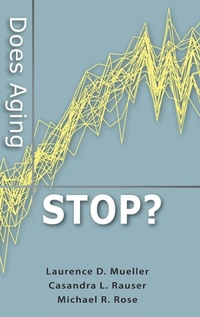
Does Aging Stop?
1st Edition
Published on 13. October 2011
Book
Hardback
224 pages
978-0-19-975422-9 (ISBN)
Description
Does Aging Stop? reveals the most paradoxical finding of recent aging research: the cessation of demographic aging. The authors show that aging stops at the level of the individual organism, and explain why evolution allows this. The implications of this counter-intuitive conclusion are profound, and aging research now needs to accept three uncomfortable truths. First, aging is not a cumulative physiological process. Second, the fundamental theory that is required to explain, manipulate, and probe the phenomena of aging comes from evolutionary biology. Third, strong-inference experimental strategies for aging must be founded in evolutionary research, not cell or molecular biology.
The result of fifteen years of research bringing together new applications of evolutionary theory, new models for demography, and massive experimentation, Does Aging Stop? advances an entirely new foundation for the scientific study of aging.
The result of fifteen years of research bringing together new applications of evolutionary theory, new models for demography, and massive experimentation, Does Aging Stop? advances an entirely new foundation for the scientific study of aging.
Reviews / Votes
"As an attempt to justify the existence of plateaus as direct outcomes of natural selection, the book is as good as it gets. The authors do a thorough job of presenting their ideas, along with the models and data they believe back these ideas up." -- Thomas B. L. Kirkwood, Institute for Ageing & Health, Newcastle University, Newcastle upon Tyne, United KingdomMore details
Language
English
Place of publication
New York
United States
Target group
Professional and scholarly
Biogerontologists; people engaged in scientific aging research. Additionally, scientists with interest in evolutionary biology or population genetics .
Illustrations
69 Zeichnungen
69 line art
Dimensions
Height: 240 mm
Width: 161 mm
Thickness: 17 mm
Weight
508 gr
ISBN-13
978-0-19-975422-9 (9780199754229)
Copyright in bibliographic data and cover images is held by Nielsen Book Services Limited or by the publishers or by their respective licensors: all rights reserved.
Schweitzer Classification
Other editions
Additional editions
Laurence D. Mueller | Casandra L. Rauser | Michael R. Rose
Does Aging Stop?
E-Book
07/2011
1st Edition
OUP eBook
€57.99
Available for download
Laurence D. Mueller | Casandra L. Rauser | Michael R. Rose
Does Aging Stop?
E-Book
07/2011
1st Edition
OUP eBook
€57.99
Available for download
Persons
Laurence Mueller is Professor of Ecology and Evolutionary Biology at the University of California, Irvine. His research interests are in life-history evolution, aging, and the population genetic aspects of forensic DNA typing. Dr. Mueller is the author of over 100 research papers in these fields as well as two books: Stability in Model Populations and Evolution and Ecology of the Organism.
Casandra Rauser is the Assistant Director of Research Development for the School of Biological Sciences at the University of California, Irvine.
Michael Rose is Professor of Biological Sciences at the University of California, Irvine. He is the author of Evolutionary Biology of Aging (OUP, 1991), and was awarded the Busse Research Prize by the World Congress of Gerontology in 1997.
Casandra Rauser is the Assistant Director of Research Development for the School of Biological Sciences at the University of California, Irvine.
Michael Rose is Professor of Biological Sciences at the University of California, Irvine. He is the author of Evolutionary Biology of Aging (OUP, 1991), and was awarded the Busse Research Prize by the World Congress of Gerontology in 1997.
Author
ProfessorProfessor, Department of Ecology and Evolutionary Biology, School of Biological Sciences, University of California, Irvine
Assistant Director of Research DevelopmentAssistant Director of Research Development, School of Biological Sciences, University of California, Irvine
ProfessorProfessor, Department of Ecology and Evolutionary Biology, School of Biological Sciences, University of California, Irvine
Content
Preface ; Acknowledgments ; 1. Introduction: A Third Phase of Life ; 2. Discovery of Late Life ; 3. Late Life is Predicted by Hamiltonian Evolutionary Theory ; 4. Late-Life Mortality and Fecundity Plateaus Evolve ; 5. Genetics of Late Life involve Antagonistic Pleiotropy ; 6. Demography of Late Life with Lifelong Heterogeneity ; 7. Evolution of Lifelong Heterogeneity ; 8. Experimental Tests of Lifelong Heterogeneity ; 9. Death Spirals ; 10. Physiology of Late Life ; 11. Late Life in Human Populations ; 12. Aging Stops: Late Life, Evolutionary Biology, and Gerontology ; Appendix ; References ; Index