

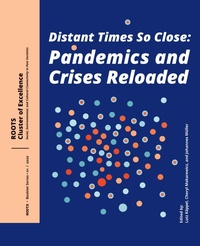
Distant Times So Close: Pandemics and Crises Reloaded
Distant Times So Close
1st Edition
Published on 24. September 2020
Book
Paperback/Softback
64 pages
978-90-8890-969-6 (ISBN)
Description
Archaeology is all about how the present came into existence. Thus, it contributes to the social understanding of crises, including present and potential future adversities. Even diseases, such as pandemics in past societies, were and are observed by archaeology. Some examples can be found in this booklet. The scientists of the Kiel Cluster of Excellence ROOTS describe human reactions in past societies that were organized quite differently from ours. This is precisely why it is possible to identify the basic features of human behaviour for the management of crises.
From the emergence of agriculture more than 10,000 years ago to the Russian colonisation of Siberia a few hundred years ago, a fundamental pattern is becoming apparent: crises, including those caused by disease, can only be managed by increasing diversity. Acceptance of diversity, the introduction of new technologies and socially responsible action have always led to the mastering of crises.
It is also clear that values can only be preserved or updated in crises through active involvement. For example, scientists describe that when people are passive, other social groups can easily bind power to themselves, whereas when people actively participate, more democratic structures can develop even in crisis scenarios.
This is the message that we take with us from the past: whether as a forager or as a simple farmer in earliest agricultural societies, in ancient Greece or in an early modern society - diversity and social commitment are the components that help us to overcome crises. Learning from the past for the present - that is the task of international archaeology.
From the emergence of agriculture more than 10,000 years ago to the Russian colonisation of Siberia a few hundred years ago, a fundamental pattern is becoming apparent: crises, including those caused by disease, can only be managed by increasing diversity. Acceptance of diversity, the introduction of new technologies and socially responsible action have always led to the mastering of crises.
It is also clear that values can only be preserved or updated in crises through active involvement. For example, scientists describe that when people are passive, other social groups can easily bind power to themselves, whereas when people actively participate, more democratic structures can develop even in crisis scenarios.
This is the message that we take with us from the past: whether as a forager or as a simple farmer in earliest agricultural societies, in ancient Greece or in an early modern society - diversity and social commitment are the components that help us to overcome crises. Learning from the past for the present - that is the task of international archaeology.
More details
Series
Edition
1. Auflage
Language
English
Place of publication
Leiden
Netherlands
Target group
Professional and scholarly
Illustrations
31fc/3bw
Dimensions
Height: 210 mm
Width: 170 mm
Thickness: 5 mm
Weight
157 gr
ISBN-13
978-90-8890-969-6 (9789088909696)
Copyright in bibliographic data and cover images is held by Nielsen Book Services Limited or by the publishers or by their respective licensors: all rights reserved.
Schweitzer Classification
Persons
Johannes Mueller (PhD, University of Freiburg, 1990) is a Professor and Director of the Institute for Prehistoric and Protohistoric Archaeology at Kiel University, Germany. He is the founding director of the Johanna Mestorf Academy, Speaker of the Collaborative Research Centre "Scales of Transformation: Human-environmental Interaction in Prehistoric and Archaic Societies" and of the Excellence Cluster "ROOTS - Social, Environmental, and Cultural Connectivity in Past Societies".
He conducts research on Neolithic and Bronze Age Europe, including the challenge of interlinking natural, social, life sciences, and the humanities within an anthropological approach of archaeology. Intensive fieldwork was and is carried out in international teams, e.g., on Tripolye mega-sites in Eastern Europa, the Late Neolithic tell site of Okoliste in Bosnia-Hercegovina, different Neolithic domestic and burial sites in Northern Germany, and Early Bronze Age sites in Greater Poland. Ethnoarchaeological fieldwork has been conducted, e.g., in India. Within the Kiel Graduate School "Human Development in Landscapes", now the Young Academy of ROOTS, and the Scandinavian Graduate School "Dialogues of the Past", Johannes Mueller promotes international PhD projects. Cheryl Makarewicz is professor at the Institute of Prehistoric and Protohistoric Archaeology at the Christian-Albrechts Univerity in Kiel. Studies of Classics in Tuebingen and Oxford, PhD 1990, Habilitation 1997, Professor of Classics, especially Greek Literature at the Christian-Albrechts-Universitaet zu Kiel 1999-, Ordinary Member of the German Archaeological Institute 2000-, Dean of the Faculty of Humanities 2006-2008, Co-Coordinator of the Kiel Graduate School 'Human Development in Landscapes' 2007-2016; Speaker of the University's Research Focus 'Social, Environmental, Cultural Change' 2007-.
He conducts research on Neolithic and Bronze Age Europe, including the challenge of interlinking natural, social, life sciences, and the humanities within an anthropological approach of archaeology. Intensive fieldwork was and is carried out in international teams, e.g., on Tripolye mega-sites in Eastern Europa, the Late Neolithic tell site of Okoliste in Bosnia-Hercegovina, different Neolithic domestic and burial sites in Northern Germany, and Early Bronze Age sites in Greater Poland. Ethnoarchaeological fieldwork has been conducted, e.g., in India. Within the Kiel Graduate School "Human Development in Landscapes", now the Young Academy of ROOTS, and the Scandinavian Graduate School "Dialogues of the Past", Johannes Mueller promotes international PhD projects. Cheryl Makarewicz is professor at the Institute of Prehistoric and Protohistoric Archaeology at the Christian-Albrechts Univerity in Kiel. Studies of Classics in Tuebingen and Oxford, PhD 1990, Habilitation 1997, Professor of Classics, especially Greek Literature at the Christian-Albrechts-Universitaet zu Kiel 1999-, Ordinary Member of the German Archaeological Institute 2000-, Dean of the Faculty of Humanities 2006-2008, Co-Coordinator of the Kiel Graduate School 'Human Development in Landscapes' 2007-2016; Speaker of the University's Research Focus 'Social, Environmental, Cultural Change' 2007-.
Content
Preface
Introduction. Pandemics, Crises and Solutions: The Past in the Future
Lutz Kaeppel, Cheryl Makarewicz, and Johannes Mueller
The Roots of Zoonoses
Cheryl Makarewicz
Epidemics, Mobility and Permafrost: Lessons from Siberia
Henny Piezonka
Social Diversity and the Sharing of Knowledge in European Prehistory: Lessons for the Pandemic Present?
Martin Furholt
Why Solidarity Is Needed: Neolithic Connectivity and the Chance of Epidemics
Tim Kerig
Population Agglomeration and the "Bubonic Plague": The Earliest European Cities around 3800 BCE
Johannes Mueller
Upheaval against Social Order. A Solution? Lessons from Neolithic and Iron Age Europe
Johannes Mueller
Pandemia and Holism: What Ancient Medicine Had to Say
Chiara Thumiger
The Epidemic as a Challenge: Homer, Iliad
Lutz Kaeppel
The Epidemic as a Challenge: Sophocles, Oedipus Rex
Lutz Kaeppel
Oedipus and the Attic Plague
Lutz Kaeppel
Tracing Past Pandemics through the Analysis of Ancient Pathogen Genomes
Ben Krause-Kyora and Almut Nebel
The Medieval Leprosy Pandemic and Its Impact on the Human Gene Pool
Ben Krause-Kyora and Almut Nebel
Politics of the Pandemic
Vesa Arponen
Consequences: Diversity and Personal Responsibility
Lutz Kaeppel, Cheryl Makarewicz, and Johannes Mueller
Introduction. Pandemics, Crises and Solutions: The Past in the Future
Lutz Kaeppel, Cheryl Makarewicz, and Johannes Mueller
The Roots of Zoonoses
Cheryl Makarewicz
Epidemics, Mobility and Permafrost: Lessons from Siberia
Henny Piezonka
Social Diversity and the Sharing of Knowledge in European Prehistory: Lessons for the Pandemic Present?
Martin Furholt
Why Solidarity Is Needed: Neolithic Connectivity and the Chance of Epidemics
Tim Kerig
Population Agglomeration and the "Bubonic Plague": The Earliest European Cities around 3800 BCE
Johannes Mueller
Upheaval against Social Order. A Solution? Lessons from Neolithic and Iron Age Europe
Johannes Mueller
Pandemia and Holism: What Ancient Medicine Had to Say
Chiara Thumiger
The Epidemic as a Challenge: Homer, Iliad
Lutz Kaeppel
The Epidemic as a Challenge: Sophocles, Oedipus Rex
Lutz Kaeppel
Oedipus and the Attic Plague
Lutz Kaeppel
Tracing Past Pandemics through the Analysis of Ancient Pathogen Genomes
Ben Krause-Kyora and Almut Nebel
The Medieval Leprosy Pandemic and Its Impact on the Human Gene Pool
Ben Krause-Kyora and Almut Nebel
Politics of the Pandemic
Vesa Arponen
Consequences: Diversity and Personal Responsibility
Lutz Kaeppel, Cheryl Makarewicz, and Johannes Mueller