

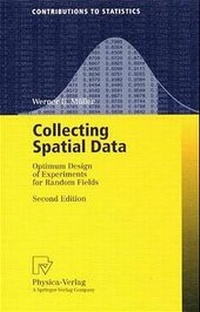
Collecting Spatial Data
Optimum Design of Experiments for Random Fields
2nd Edition
Published on 18. October 2000
Book
Paperback/Softback
XII, 196 pages
978-3-7908-1333-3 (ISBN)
Description
The book is concerned with the statistical theory for locating spatial sensors. It bridges the gap between spatial statistics and optimum design theory. After introductions to those two fields the topics of exploratory designs and designs for spatial trend and variogram estimation are treated. A new methodology, so-called approximate information matrices, are employed to cope with the problem of correlated observations. A great number of relevant references are collected and put into a common perspective. The theoretical investigations are accompanied by a practical example, the redesign of an Upper-Austrian air pollution monitoring network. A reader should be able to find respective theory and recommendations on how to efficiently plan a specific purpose spatial monitoring network. The revised edition contains additional material and exercises.
More details
Series
Edition
2nd rev. ed.
Language
English
Place of publication
Heidelberg
Germany
Target group
Professional and scholarly
Edition type
Revised edition
Illustrations
6
32 s/w Abbildungen, 6 s/w Tabellen
32 figures, 6 tables, indices
Dimensions
Height: 23.5 cm
Width: 15.5 cm
Weight
318 gr
ISBN-13
978-3-7908-1333-3 (9783790813333)
Schweitzer Classification
Other editions
New editions
Book
08/2007
3rd Edition
Springer
€106.99
Shipment within 10-15 days
Previous edition

Book
09/1998
Physica-Verlag GmbH & Co
€35.90
Article exhausted; check for reprint
Content
Introduction.- Fundamentals of Spatial Statistics.- Estimation of Spatial Trend. Universal Kriging. Local Regression. Variogram Fitting. Example. Exercises. References.- Fundamentals of Experimental Design.- Information Matrices. Design Criteria. Numerical Algorithms. Further Design Topics Useful in the Spatial Setting. Example. Exercises. References.- Exploratory Designs.- Deterministic and Random Sampling. Space Filling Designs. Designs for Local Regression. Model Discriminating Designs. Example. Exercises. References.- Designs for Spatial Trend Estimation.- Approximate Information Matrices. Replication-Free Designs. Designs for Correlated Fields. Designs for Spatial Prediction. Example. Exercises. References.- Multipurpose Designs Including Designs for Variogram Fitting.- Designs for Variogram Estimation. Augmenting Designs. Alternative Methods which Ignore Correlations. Combining Different Purpose Designs. Example. Exercises. References.- Appendix.- Data Sets. Proofs for Chapter 2. Proofs for Chapter 3. Proofs for Chapter 4. Proofs for Chapter 5. Proofs for Chapter 6. D2PT Description. References.- List of Figures.- Author Index.- Subject Index.