

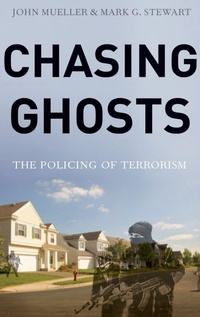
Chasing Ghosts
The Policing of Terrorism
Published on 7. January 2016
Book
Hardback
402 pages
978-0-19-023731-8 (ISBN)
Description
Since 2001, the United States has created or reorganized more than two counterterrorism organizations for every terrorist arrest or apprehension it has made of people plotting to do damage within the country. Central to this massive enterprise is 'ghost-chasing,' as less than one alarm in 10,000 is an actual threat-the rest all point to ghosts. And the vast majority of the leads deemed to be productive have led to terrorist enterprises that were either trivial or at most aspirational.
As John Mueller and Mark Stewart suggest in Chasing Ghosts, this is often an exercise in dueling delusions: a Muslim hothead has delusions about changing the world by blowing something up, and the authorities have delusions that he might actually be able to overcome his patent inadequacies to do so. Mueller and Stewart systematically examine this expensive, exhausting, bewildering, chaotic, and paranoia-inducing process. They evaluate the counterterrorism efforts of the FBI, the National Security Agency, the Department of Homeland Security, and local policing agencies. In addition, applying a new set of case studies, they appraise the capacities of the terrorist 'adversary' and discuss what they calls 'the myth of the mastermind.' They also assess public opinion, a key driving force for counterterrorism efforts. The yearly chance an American will be killed by a terrorist within the country is about one in four million under present conditions. However, polling data suggest that, although over a trillion dollars has been spent on domestic counterterrorism since 2001, Americans continue to be alarmed and say they do not feel safer. No defense of civil liberties is likely to be terribly effective as long as officials and the population at large continue to believe that the threat from terrorism is massive, even existential.
Mueller and Stewart do not argue that there is nothing for the ghost-chasers to find-the terrorist 'adversary' is real and does exist. The question that is central to the exercise, but one the ghost-chasers never really probe, is an important and rather straight-forward one to which standard evaluative procedures can be applied: is the chase worth the effort? Or is it excessive given a serious consideration of the danger that terrorism actually presents?
As John Mueller and Mark Stewart suggest in Chasing Ghosts, this is often an exercise in dueling delusions: a Muslim hothead has delusions about changing the world by blowing something up, and the authorities have delusions that he might actually be able to overcome his patent inadequacies to do so. Mueller and Stewart systematically examine this expensive, exhausting, bewildering, chaotic, and paranoia-inducing process. They evaluate the counterterrorism efforts of the FBI, the National Security Agency, the Department of Homeland Security, and local policing agencies. In addition, applying a new set of case studies, they appraise the capacities of the terrorist 'adversary' and discuss what they calls 'the myth of the mastermind.' They also assess public opinion, a key driving force for counterterrorism efforts. The yearly chance an American will be killed by a terrorist within the country is about one in four million under present conditions. However, polling data suggest that, although over a trillion dollars has been spent on domestic counterterrorism since 2001, Americans continue to be alarmed and say they do not feel safer. No defense of civil liberties is likely to be terribly effective as long as officials and the population at large continue to believe that the threat from terrorism is massive, even existential.
Mueller and Stewart do not argue that there is nothing for the ghost-chasers to find-the terrorist 'adversary' is real and does exist. The question that is central to the exercise, but one the ghost-chasers never really probe, is an important and rather straight-forward one to which standard evaluative procedures can be applied: is the chase worth the effort? Or is it excessive given a serious consideration of the danger that terrorism actually presents?
Reviews / Votes
"Does civilization face an existential threat of terrorism? Politicians and security bureaucrats have a vested interest in answering 'yes,' while blowing off the costs (in money, opportunities, and lives) of responding to their exaggerated and sometimes hallucinated threats. This evidence-based expose of the counterterrorism industry is witty and eye-opening, and offers a sound basis for intelligent policy and for our conception of the world we livein."-Steven Pinker, Johnstone Professor of Psychology, Harvard University, and author of The Better Angels of Our Nature and The Sense of Style
"In their provocative and well-informed book, Mueller and Stewart evaluate the policies and the politics of counterterrorism. Chasing Ghosts challenges the fundamental premises on which the post-9/11 counterterrorism framework is built, finding that the overall terrorism threat is limited, that many would-be terrorists are incompetent amateurs, and that much of the spending on counterterrorism is wasted."-Daniel Byman, Senior Fellow, Center for Middle East
Policy, Brookings Institution
"This terrific book is essential reading for anyone who wants to understand the U.S. War on Terror. Mueller and Stewart show that America's national security elites were so spooked by the events of 9/11 that they started seeing imaginary terrorists everywhere. To deal with these ghosts, the Bush and Obama administrations spent huge amounts of money and unnecessarily grew the national security state to the point where it is now a potential threat to our civil
liberties. When future historians look back someday at this period, Chasing Ghosts will stand out as a rare example of measured thinking about a threat that has been inflated to absurd proportions."-John
J. Mearsheimer, Professor of Political Science, University of Chicago
"This book comes as more and more evidence is emerging that the real 'terror' on our streets is being created by those who have been charged with eradicating it!"-Lowell Bergman, Distinguished Chair in Investigative Reporting, University of California, Berkeley
More details
Language
English
Place of publication
New York
United States
Target group
College/higher education
Professional and scholarly
Dimensions
Height: 240 mm
Width: 161 mm
Thickness: 26 mm
Weight
766 gr
ISBN-13
978-0-19-023731-8 (9780190237318)
Copyright in bibliographic data and cover images is held by Nielsen Book Services Limited or by the publishers or by their respective licensors: all rights reserved.
Schweitzer Classification
Other editions
Additional editions
E-Book
11/2015
1st Edition
OUP eBook
€17.99
Available for download
E-Book
11/2015
1st Edition
OUP eBook
€15.49
Available for download
Persons
John Mueller is a political scientist at Ohio State University and at the Cato Institute. He is the author, co-author, or editor of 18 books and hundreds of scholarly and popular articles. His research areas include international relations, security studies, risk analysis, public opinion, foreign policy, terrorism and counterterrorism, and dance history.
Mark G. Stewart is Professor of Civil Engineering at The University of Newcastle, Australia. He has more than 25 years of experience in probabilistic risk and vulnerability assessment of infrastructure and security systems. His expertise in risk assessment is applied to a wide range of threats and hazards most notably terrorism and climate change.
Mark G. Stewart is Professor of Civil Engineering at The University of Newcastle, Australia. He has more than 25 years of experience in probabilistic risk and vulnerability assessment of infrastructure and security systems. His expertise in risk assessment is applied to a wide range of threats and hazards most notably terrorism and climate change.
Author
Professor of Political ScienceProfessor of Political Science, Ohio State University
Professor of Civil Engineering and Director of the Centre for Infrastructure Performance and ReliabilityProfessor of Civil Engineering and Director of the Centre for Infrastructure Performance and Reliability, University of Newcastle (Australia)
Content
TK