

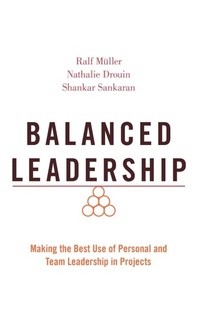
Balanced Leadership
Making the Best Use of Personal and Team Leadership in Projects
Published on 25. March 2022
Book
Hardback
230 pages
978-0-19-007612-2 (ISBN)
Description
A new theory of balanced leadership in projects
Leadership is not static. Instead, authority in projects shifts dynamically between project managers, individual team members, and sub-teams, depending on the situation. Leadership may be exercised through a vertical, horizontal, shared, or distributed leadership approach. However, balanced leadership ensures the best suitable approach is used in any given situation.
Based on an award-winning global program of research studies, Balanced Leadership is a thorough investigation of balanced leadership in projects. Ralf Mueller, Nathalie Drouin, and Shankar Sankaran present a project-specific leadership approach as well as a theory of balanced leadership, and the situations in which different strategies are required. They also outline the five building blocks that enable balanced leadership: nomination of team members, identification of potential leaders, selection and empowerment of leaders, empowered leadership and its governance, and leadership transition. The book explains the coordination of these building blocks through the socio-cognitive space shared by project manager and team. Using real-life case studies and clear examples, this book offers a new way of considering and utilizing dynamic leadership in project settings.
Leadership is not static. Instead, authority in projects shifts dynamically between project managers, individual team members, and sub-teams, depending on the situation. Leadership may be exercised through a vertical, horizontal, shared, or distributed leadership approach. However, balanced leadership ensures the best suitable approach is used in any given situation.
Based on an award-winning global program of research studies, Balanced Leadership is a thorough investigation of balanced leadership in projects. Ralf Mueller, Nathalie Drouin, and Shankar Sankaran present a project-specific leadership approach as well as a theory of balanced leadership, and the situations in which different strategies are required. They also outline the five building blocks that enable balanced leadership: nomination of team members, identification of potential leaders, selection and empowerment of leaders, empowered leadership and its governance, and leadership transition. The book explains the coordination of these building blocks through the socio-cognitive space shared by project manager and team. Using real-life case studies and clear examples, this book offers a new way of considering and utilizing dynamic leadership in project settings.
More details
Language
English
Place of publication
New York
United States
Target group
Professional and scholarly
Illustrations
23 b/w illustrations
Dimensions
Height: 240 mm
Width: 161 mm
Thickness: 17 mm
Weight
514 gr
ISBN-13
978-0-19-007612-2 (9780190076122)
Copyright in bibliographic data and cover images is held by Nielsen Book Services Limited or by the publishers or by their respective licensors: all rights reserved.
Schweitzer Classification
Other editions
Additional editions
Ralf Mueller | Nathalie Drouin | Shankar Sankaran
Balanced Leadership
Making the Best Use of Personal and Team Leadership in Projects
Book
03/2022
Oxford University Press Inc
€57.00
Shipment within 15-20 days
Ralf Müller | Nathalie Drouin | Shankar Sankaran
Balanced Leadership
Making the Best Use of Personal and Team Leadership in Projects
E-Book
11/2021
OUP eBook
€40.99
Available for download
Ralf Müller | Nathalie Drouin | Shankar Sankaran
Balanced Leadership
Making the Best Use of Personal and Team Leadership in Projects
E-Book
11/2021
OUP eBook
€40.99
Available for download
Persons
Ralf Mueller, DBA, MBA, PMP, is Professor of Project Management at BI Norwegian Business School, and Adjunct Professor at University of Technology Sydney, and Dalian University of Technology in China. He is Editor-in-Chief of the Project Management Journal and a Fellow of both the Project Management Institute (PMI (R)) and the Centre for Excellence in Project Management. Before joining academia, he spent 30 years in the industry consulting with large enterprises and governments in more than 50 different countries for better project management and governance. He also held related line management positions, such as the Worldwide Director of Project Management at NCR Corporation.
Nathalie Drouin, PhD, MBA, LL.B. is the Executive Director of KHEOPS, an International Research Consortium on the Governance of Large Infrastructure Projects, the Editor-in-Chief of the International Journal of Managing Projects in Business, a full professor at the Department of Management, Ecole des
Sciences de la gestion, Universite du Quebec a Montreal (ESG UQAM), Adjunct Professor at University of Technology Sydney (UTS), Australia, and Associate Researcher at Ecole nationale d'administration publique (ENAP), Canada. She teaches initiation and strategic management of projects in the Graduate Project Management Programs at ESG UQAM.
Shankar Sankaran, PhD, M., Eng., BSc, DMIT PMP (R), MIEAust, CPEng., is Professor of Organizational Project Management in the School of the Built Environment at the University of Technology Sydney, Australia where he is also a core researcher of the Centre of for Informatics Research and Innovation (CiRi). Shankar worked in industry for several years starting as an instrument engineer and moving on to become a project manager, operations manager, and director at Yokogawa Electric Asia in Singapore before entering academia. Shankar is the current Chair of the Global Accreditation Centre of the Project Management Institute, Past President of the International
Society for the Systems Sciences, and committee member of the College of Leadership and Management at Engineers Australia.
Nathalie Drouin, PhD, MBA, LL.B. is the Executive Director of KHEOPS, an International Research Consortium on the Governance of Large Infrastructure Projects, the Editor-in-Chief of the International Journal of Managing Projects in Business, a full professor at the Department of Management, Ecole des
Sciences de la gestion, Universite du Quebec a Montreal (ESG UQAM), Adjunct Professor at University of Technology Sydney (UTS), Australia, and Associate Researcher at Ecole nationale d'administration publique (ENAP), Canada. She teaches initiation and strategic management of projects in the Graduate Project Management Programs at ESG UQAM.
Shankar Sankaran, PhD, M., Eng., BSc, DMIT PMP (R), MIEAust, CPEng., is Professor of Organizational Project Management in the School of the Built Environment at the University of Technology Sydney, Australia where he is also a core researcher of the Centre of for Informatics Research and Innovation (CiRi). Shankar worked in industry for several years starting as an instrument engineer and moving on to become a project manager, operations manager, and director at Yokogawa Electric Asia in Singapore before entering academia. Shankar is the current Chair of the Global Accreditation Centre of the Project Management Institute, Past President of the International
Society for the Systems Sciences, and committee member of the College of Leadership and Management at Engineers Australia.
Author
Professor of Project ManagemenProfessor of Project Managemen, BI Norwegian Business School
Executive Director of KHEOPSExecutive Director of KHEOPS, International Research Consortium on the Governance of Large Infrastructure Projects
Professor of Organizational Project ManagementProfessor of Organizational Project Management, School of the Built Environment, University of Technology Sydney
Content
List of Figures
List of Tables
List of Boxes
Preface
Chapter 1: Introduction
Chapter 2: Horizontal Leadership and its Scenarios
Chapter 3: A Theory of Balanced Leadership
Chapter 4: Nomination
Chapter 5: Identification
Chapter 6: Selection and Empowerment
Chapter 7: Empowered Leadership and its Governance
Chapter 8: Leadership Transition
Chapter 9: Coordination Through the Socio-Cognitive Space
Chapter 10: Balanced Leadership Case Study: Transport for New South Wales, Australia
Chapter 11: Balanced Leadership Case Studies: Two Canadian Projects and Their Socio-Cognitive Space
Chapter 12: The Way Ahead
References
Index
List of Tables
List of Boxes
Preface
Chapter 1: Introduction
Chapter 2: Horizontal Leadership and its Scenarios
Chapter 3: A Theory of Balanced Leadership
Chapter 4: Nomination
Chapter 5: Identification
Chapter 6: Selection and Empowerment
Chapter 7: Empowered Leadership and its Governance
Chapter 8: Leadership Transition
Chapter 9: Coordination Through the Socio-Cognitive Space
Chapter 10: Balanced Leadership Case Study: Transport for New South Wales, Australia
Chapter 11: Balanced Leadership Case Studies: Two Canadian Projects and Their Socio-Cognitive Space
Chapter 12: The Way Ahead
References
Index