

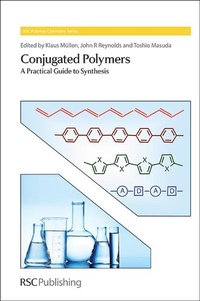
Conjugated Polymers
A Practical Guide to Synthesis
Published on 18. October 2013
Book
Hardback
480 pages
978-1-84973-799-9 (ISBN)
Description
Conjugated polymers are gaining a lot of interest due to their inherent functional properties and applications in plastic electronics. Their characteristic charge transporting and conducting properties produces features including coloration, photoluminescence, electroluminescence, photoconductivity, and electrochromism. In order to develop new functional polymers, researchers need the background information on the synthesis of the different polymer systems.
Conjugated Polymers focuses on the practical preparation of conjugated polymers with each chapter discussing a particular type of conjugated polymer including a general explanation of the polymer, experimental details for synthesis and characterization.
Edited by world leading experts in the field of conjugated polymer synthesis, the book serves as a convenient guide for advanced undergraduate level and above.
Conjugated Polymers focuses on the practical preparation of conjugated polymers with each chapter discussing a particular type of conjugated polymer including a general explanation of the polymer, experimental details for synthesis and characterization.
Edited by world leading experts in the field of conjugated polymer synthesis, the book serves as a convenient guide for advanced undergraduate level and above.
More details
Series
Language
English
Place of publication
Cambridge
United Kingdom
Target group
College/higher education
Product notice
Unsewn / adhesive bound
Dimensions
Height: 240 mm
Width: 163 mm
Thickness: 35 mm
Weight
948 gr
ISBN-13
978-1-84973-799-9 (9781849737999)
Copyright in bibliographic data and cover images is held by Nielsen Book Services Limited or by the publishers or by their respective licensors: all rights reserved.
Schweitzer Classification
Other editions
Additional editions
E-Book
10/2013
1st Edition
Royal Society of Chemistry
€222.99
Available for download
Persons
Toshio Masuda is currently Professor at the Fukui University of Technology and Professor Emeritus of Kyoto University. His research interests include substituted polyacetylenes, transition metal catalyzed polymerization, gas separation membranes, and polymeric functional materials. He is an associate editor of POLYMER published by Elsevier. He has published about 450 original papers and has received important awards including The Society of Polymer Science, Japan (SPSJ) Award for Outstanding Achievement in Polymer Science and Technology, 2008.
Prof. Dr. Klaus Muellen joined the Max Planck Society in 1989 as one of the directors of the Max Planck Institute for Polymer Research. He has published over 1,500 papers and received numerous awards. He has recently received the BASF-Award for Organic Electronics, Franco-German Award of the Societe Chimique de France and the Adolf-von-Baeyer-Medal, GDCh. His research interests include graphenes and carbon materials, new polymer-forming reactions including methods of organometallic chemistry and molecular materials with liquid crystalline properties for electronic and optoelectronic devices.
John R. Reynolds is currently Professor, Chemistry &?Biochemistry, Materials Science & Engineering at the Georgia Institute of Technology. His research encompasses the various aspects of the chemistry and materials science of electroactive and conducting polymers. He has published over 300 peer-reviewed scientific papers and served as co-editor of the Handbook of Conducting Polymers.
Prof. Dr. Klaus Muellen joined the Max Planck Society in 1989 as one of the directors of the Max Planck Institute for Polymer Research. He has published over 1,500 papers and received numerous awards. He has recently received the BASF-Award for Organic Electronics, Franco-German Award of the Societe Chimique de France and the Adolf-von-Baeyer-Medal, GDCh. His research interests include graphenes and carbon materials, new polymer-forming reactions including methods of organometallic chemistry and molecular materials with liquid crystalline properties for electronic and optoelectronic devices.
John R. Reynolds is currently Professor, Chemistry &?Biochemistry, Materials Science & Engineering at the Georgia Institute of Technology. His research encompasses the various aspects of the chemistry and materials science of electroactive and conducting polymers. He has published over 300 peer-reviewed scientific papers and served as co-editor of the Handbook of Conducting Polymers.
Content
General Introduction;
Polyacetylene;
Substituted Polyacetylenes;
Polyphenylenes;
Polyfluorenes;
Polycarbazolylenes;
Poly(phenylenevinylene)s;
Poly(phenyleneethynylene)s;
Polythiophenes;
Poly(oxythiophenes);
Polypyrroles;
Polyanilines;
Polysilanes;
Alternative Polyheterocycles;
D-A Alternating Copolymers;
Conjugated Polyelectrolytes;
Self-Doped Polymers;
Fused Heterocycle Polymers;
Direct Arylation Polycondensation;
Chain-Growth Synthesis;
Polyacetylene;
Substituted Polyacetylenes;
Polyphenylenes;
Polyfluorenes;
Polycarbazolylenes;
Poly(phenylenevinylene)s;
Poly(phenyleneethynylene)s;
Polythiophenes;
Poly(oxythiophenes);
Polypyrroles;
Polyanilines;
Polysilanes;
Alternative Polyheterocycles;
D-A Alternating Copolymers;
Conjugated Polyelectrolytes;
Self-Doped Polymers;
Fused Heterocycle Polymers;
Direct Arylation Polycondensation;
Chain-Growth Synthesis;