

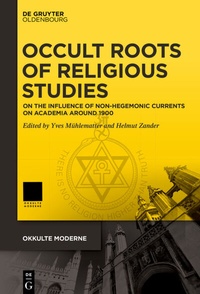
Occult Roots of Religious Studies
On the Influence of Non-Hegemonic Currents on Academia around 1900
1st Edition
Published on 3. April 2025
Book
Hardback
XII, 283 pages
978-3-11-066017-3 (ISBN)
Description
The historiographers of religious studies have written the history of this discipline primarily as a rationalization of ideological, most prominently theological and phenomenological ideas: first through the establishment of comparative, philological and sociological methods and secondly through the demand for intentional neutrality. This interpretation caused important roots in occult-esoteric traditions to be repressed.
This process of "purification" (Latour) is not to be equated with the origin of the academic studies. De facto, the elimination of idealistic theories took time and only happened later. One example concerning the early entanglement is Tibetology, where many researchers and respected chair holders were influenced by theosophical ideas or were even members of the Theosophical Society. Similarly, the emergence of comparatistics cannot be understood without taking into account perennialist ideas of esoteric provenance, which hold that all religions have a common origin.
In this perspective, it is not only the history of religious studies which must be revisited, but also the partial shaping of religious studies by these traditions, insofar as it saw itself as a counter-model to occult ideas.
This process of "purification" (Latour) is not to be equated with the origin of the academic studies. De facto, the elimination of idealistic theories took time and only happened later. One example concerning the early entanglement is Tibetology, where many researchers and respected chair holders were influenced by theosophical ideas or were even members of the Theosophical Society. Similarly, the emergence of comparatistics cannot be understood without taking into account perennialist ideas of esoteric provenance, which hold that all religions have a common origin.
In this perspective, it is not only the history of religious studies which must be revisited, but also the partial shaping of religious studies by these traditions, insofar as it saw itself as a counter-model to occult ideas.
Reviews / Votes
"This is a fine, and timely collection. The contributors add immensely to our understanding of the tensions among European scholars who pioneered in religious studies." W. Michael Ashcraft in: Reading Religion, https://readingreligion.org/9783110660173/, 30.08.2022More details
Series
Language
English
Place of publication
Berlin/München/Boston
Germany
Target group
Professional and scholarly
US School Grade: College Graduate Student
Illustrations
5 farbige Abbildungen, 1 s/w Zeichnung
4 col. ill., 1 b/w graphics
Dimensions
Height: 236 mm
Width: 160 mm
Thickness: 26 mm
Weight
650 gr
ISBN-13
978-3-11-066017-3 (9783110660173)
Schweitzer Classification
Other editions
Additional editions
Yves Mühlematter | Helmut Zander
Occult Roots of Religious Studies
On the Influence of Non-Hegemonic Currents on Academia around 1900
E-Book
06/2021
1st Edition
De Gruyter Oldenbourg
€0.00
Available for download
Yves Mühlematter | Helmut Zander
Occult Roots of Religious Studies
On the Influence of Non-Hegemonic Currents on Academia around 1900
E-Book
06/2021
1st Edition
De Gruyter Oldenbourg
€0.00
Available for download