

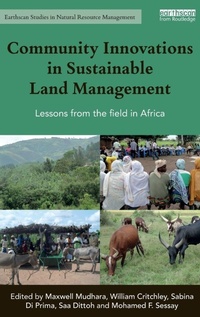
Community Innovations in Sustainable Land Management
Lessons from the field in Africa
1st Edition
Published on 11. August 2016
Book
Hardback
254 pages
978-1-138-19047-4 (ISBN)
Description
It is increasingly recognized that land can be managed most sustainably through involving local communities. This book highlights the potential of a new methodology of uncovering and stimulating community initiatives in sustainable land management in Africa.
Analyses of four contrasting African countries (Ghana, Morocco, South Africa and Uganda) show that as communities directly face the challenges of land degradation, they are likely to develop initiatives themselves in terms of sustainable land management. These initiatives (or 'innovations') may be more appropriate and sustainable than those emanating from research stations located far from the communities. The book describes the rationale of the approach used, the set of steps followed, how the project managed to engage the communities to understand the importance of the activities they were undertaking, and how they were stimulated to improve and extend their initiatives and innovativeness.
Examples covered include soil fertility, community forestry, afforestation, water, invasive species and grazing land management. Central to the book is the way communities, and scientists, interacted between the four countries and learnt from each other. The book also shows how the initiatives were outscaled locally.
Analyses of four contrasting African countries (Ghana, Morocco, South Africa and Uganda) show that as communities directly face the challenges of land degradation, they are likely to develop initiatives themselves in terms of sustainable land management. These initiatives (or 'innovations') may be more appropriate and sustainable than those emanating from research stations located far from the communities. The book describes the rationale of the approach used, the set of steps followed, how the project managed to engage the communities to understand the importance of the activities they were undertaking, and how they were stimulated to improve and extend their initiatives and innovativeness.
Examples covered include soil fertility, community forestry, afforestation, water, invasive species and grazing land management. Central to the book is the way communities, and scientists, interacted between the four countries and learnt from each other. The book also shows how the initiatives were outscaled locally.
Reviews / Votes
"This book serves as an important inventory and source of knowledge about the new approach needed to tackle some of the challenges facing human kind in the present era. The book will be relevant for a very long time as a lesson to scholars and a reference for policy makers." - from the foreword by Albert T. Modi, Dean and Head of School of Agricultural, Earth and Environmental Sciences, University of KwaZulu-Natal, South Africa."... to many people the concepts of 'community innovations' and 'indigenous knowledge' are vague and often confused. Few people understand what community innovation is and how it can be supported and expanded to promote sustainable initiatives. This book, which outlines the origin, theory behind, and practice of an approach termed Stimulating Community Initiatives in Sustainable Land Management (SCI-SLM) tackles this uncertainty head on and provides practical examples, tools and frameworks to support and expand such innovations... The case studies show that research on community innovations can be time-consuming, complicated and difficult as it often entails complex social, technical and political aspects. However, the lessons learnt and the experiences outlined by the project teams in the four countries (which are highlighted in the final chapter) can be used to help communities and researchers make innovations happen." - Terry Everson in African Journal of Range & Forage Science (2017).
More details
Series
Language
English
Place of publication
London
United Kingdom
Publishing group
Taylor & Francis Ltd
Target group
College/higher education
Professional and scholarly
Illustrations
71 s/w Abbildungen, 23 s/w Photographien bzw. Rasterbilder, 15 s/w Zeichnungen, 33 s/w Tabellen
33 Tables, black and white; 15 Line drawings, black and white; 23 Halftones, black and white; 71 Illustrations, black and white
Dimensions
Height: 240 mm
Width: 161 mm
Thickness: 18 mm
Weight
549 gr
ISBN-13
978-1-138-19047-4 (9781138190474)
Copyright in bibliographic data and cover images is held by Nielsen Book Services Limited or by the publishers or by their respective licensors: all rights reserved.
Schweitzer Classification
Other editions
Additional editions
Maxwell Mudhara | Saa Dittoh | Mohamed Sessay
Community Innovations in Sustainable Land Management
Lessons from the field in Africa
Book
01/2019
1st Edition
Routledge
€71.50
Shipment within 15-20 days
Maxwell Mudhara | Saa Dittoh | Mohamed Sessay
Community Innovations in Sustainable Land Management
Lessons from the field in Africa
E-Book
06/2016
Routledge
€64.49
Available for download
Maxwell Mudhara | Saa Dittoh | Mohamed Sessay
Community Innovations in Sustainable Land Management
Lessons from the field in Africa
E-Book
06/2016
Routledge
€64.49
Available for download
Persons
Maxwell Mudhara lectures at the School of Agricultural, Earth and Environmental Sciences and is Director of the Farmer Support Group, University of KwaZulu-Natal, South Africa.
William Critchley is a Director of Sustainable Land Management Associates Ltd, UK and former Senior Advisor at the Sustainable Land Management Thematic Unit, Centre for International Cooperation, Vrije Universiteit, Amsterdam, Netherlands.
Sabina Di Prima is a Sustainable Land Management Specialist at the Centre for International Cooperation, Vrije Universiteit, Amsterdam, Netherlands.
Saa Dittoh teaches in the Department of Climate Change and Food Security, University for Development Studies, Tamale, Ghana and was formerly Head of the University's Food and Nutrition Security Unit.
Mohamed F. Sessay is a Senior Programme Officer with the Biodiversity Unit of the Division of Environmental Policy Implementation (DEPI), United Nations Environment Programme (UNEP), Nairobi, Kenya. He was Chief of the Global Environment Facility (GEF) Biodiversity/Land Degradation/Biosafety Unit in DEPI, UNEP until his retirement in March 2015.
William Critchley is a Director of Sustainable Land Management Associates Ltd, UK and former Senior Advisor at the Sustainable Land Management Thematic Unit, Centre for International Cooperation, Vrije Universiteit, Amsterdam, Netherlands.
Sabina Di Prima is a Sustainable Land Management Specialist at the Centre for International Cooperation, Vrije Universiteit, Amsterdam, Netherlands.
Saa Dittoh teaches in the Department of Climate Change and Food Security, University for Development Studies, Tamale, Ghana and was formerly Head of the University's Food and Nutrition Security Unit.
Mohamed F. Sessay is a Senior Programme Officer with the Biodiversity Unit of the Division of Environmental Policy Implementation (DEPI), United Nations Environment Programme (UNEP), Nairobi, Kenya. He was Chief of the Global Environment Facility (GEF) Biodiversity/Land Degradation/Biosafety Unit in DEPI, UNEP until his retirement in March 2015.
Content
1. Stimulating Community Initiatives in Sustainable Land Management (SCI-SLM): An Introduction William Critchley, Maxwell Mudhara and Mohamed Sessay 2. Local Innovation: Theory, Experience and the Basis for SCI-SLM William Critchley and Sabina Di Prima 3. SCI-SLM Methodology: Origins of the Design Sabina Di Prima and William Critchley 4. SCI-SLM: Innovation Begins at Programme Level Maxwell Mudhara and Mohamed Sessay 5. Community Innovations in Sustainable Land Management: Lessons from Northern Ghana Saa Dittoh , Conrad A. Weobong, Margaret A. Akuriba and Cuthbert Kaba Nabilse 6. Community Initiatives for Sustainable Natural Resource Management in the High Atlas, Morocco M. Mahdi, Z. Tijani, M. Tami, and W. Tuyp 7. Stimulating Community Initiatives in Sustainable Land Management in South Africa Avrashka Sahadeva, Maxwell Mudhara Michael Malinga, and Zanele Shezi 8. Community Initiatives for Improving Degraded Ecosystems in Uganda Stephen Muwaya, Richard Molo, John Ssendawula, Swidiq Mugerwa, Alex Lwakuba and Sabina Di Prima 9. Cross-learning with Community Initiatives Wendelien Tuijp, Saa Dittoh, Mohamed Mahdi and Maxwell Mudhara 10. Contributing to Global Environmental Benefits Saa Dittoh, Maxwell Mudhara and Conrad Weobong with Stephen Muwaya and Mohammed Mahdi 11. SCI-SLM Methodology: Refinement of the Original Design Sabina Di Prima, William Critchley, and Eva van de Ven 12. Lessons Learned and Conclusions William Critchley, Sabina Di Prima, Maxwell Mudhara and Saa Dittoh