

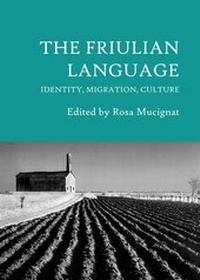
The Friulian Language
Identity, Migration, Culture
Published on 22. May 2014
Book
Hardback
217 pages
978-1-4438-5817-5 (ISBN)
Description
Are minor languages the lifeblood of cherished local identities or just passports with restricted validity, serving no purpose in today's transnational, global world? Italy's north-eastern region of Friuli is a case in point: in this area, around half a million people speak Friulian, a Romance language of the Rhaeto-Romance family, which is attested to in written texts since 1150 and acquired official minority language status in 1999. Geographically and politically off-centre, Friuli remained isolated for a long part of its history and developed a unique language that sustained a distinctive identity and culture. Starting from the nineteenth century, large-scale migration towards Northern Europe and the Americas brought Friulian into contact with other languages and contexts of use.The Friulian Language: Identity, Migration, Culture is the first comprehensive study in English of this little-known language to consider its history and the variety of its cultural manifestations from antiquity to the present day. The volume gathers together the work of ten contributors who are specialists in the fields of history (Fulvio Salimbeni), law (William Cisilino), linguistics (Paola Beninca, Franco Finco, Fabiana Fusco and Carla Marcato), literary studies (Rosa Mucignat and Rienzo Pellegrini), and migration (Javier P. Grossutti and Olga Zorzi Pugliese). The focus of the book is on Friulian, its varieties, its linguistic characteristics and its use in literature from fourteenth-century ballads to Pier Paolo Pasolini, and more recent poetry by Novella Cantarutti and others. Equal attention is given to the Friulians themselves, the social and political transformations of the region, and the experience of migration, in particular the case of high-skilled mosaic craftsmen from the Alpine foothills.Thanks to its multidisciplinary approach, the book sheds light on the questions of why Friulian has developed the way it has, what its significance as a minor language is, and how it can negotiate its relationship to other languages on a global scale.
Reviews / Votes
'The Friulian Language: Identity, Migration and Culture is a work that fits neatly into academic debates that analyse diasporic identity, linguistics, relations between dominant and minority languages and cultures, and migrant cultures. It is an indispensible book for scholars, students and lovers of Friuli, of Rhaeto-Romance languages and the languages and cultures of European minorities in general, and has the quality to offer the reader a local perspective as well as a global one.'-Simone Battiston, Swinburne University of Technology; Altreitalie, 50 (2014)'The Friulian Language deserves to be read, particularly by those interested in sociolinguistics, Romance languages, and dialectology. It has the merit of introducing to the English-speaking world a language and a culture that deserve to be better known, and its multidisciplinary approach ... will stand as a model for other studies devoted to minority languages.'-Tiberio Snaidero, Queens College, City University of New York; Italian American Review, 5.2 (2015)'This book brings together a collection of studies which relate in different ways to Friulian, a language of north-eastern Italy. It approaches the construction, expression, and maintenance of Friulian identity from the cross-disciplinary perspectives of social and political history, law, literature, and migration studies. It is the first such overview in English. Overall, this book opens an expansive vista into the historical and contemporary status of Friulian, and its chapters are drawn together with nuanced editing and an excellent editorial introduction. It will motivate many readers to discover more about this obscure and interesting minority language, its themes, expressions, and representations.'-H. William Amos, University of Liverpool; Journal of Multilingual and Multicultural Development, 2015'In conclusion, [...] this volume is undoubtedly a book that is pleasant to read. It represents a good starting point for the study of [the] Friulian language and the fields that are related to it. The contributions are well-written, [...] and the authors explain the topics in a stimulating way. The writing is often clear and accurate: this makes the reading easy. The chapters on the lexicon by Marcato and the two chapters on mosaic and terrazzo craftsmen's migrations by Grossutti and Zorzi Pugliese are particularly valuable. It should be emphasized that every chapter gives a complete list of bibliographic references that the reader could use to deepen his understanding of a topic. In conclusion, the book is really valuable, particularly for the multidisciplinary approach that is fundamental to [the] comprehension of the world that a language encapsulates.'-Simone Mattiola, Universita degli Studi di Bergamo; LINGUIST List 26.535'This book is a precious and unexpected homage to Friuli from England. [...] The title of the volume, The Friulian Language, shows that the main objective is to develop knowledge about the peculiar characteristics of the Friulian language, but the subtitle highlights the relevance of how language is manifested in the identity and culture of the Friulian community.'-Laura Vanelli, Ce Fastu: Rivista della Societa Filologica Friulana, 91: 1-2 (2015)'Focusing its attention on one of Italy's geographically and politically little known regions of Italy, this collection is a small gem and makes available to the English-speaking world, and the English-speaking descendants of emigrants, insights into Friuli Venezia Giulia's historical, cultural, and linguistic heritage. It is an important contribution to understanding the region not just from within Italy, but also from without, with evidence of the significant contributions of its considerable diaspora.'-Gabriella Colussi Arthur, York University; Annali d'italianistica, 34 (2016)More details
Edition
Unabridged edition
Language
English
Place of publication
Newcastle upon Tyne
United Kingdom
Target group
College/higher education
Professional and scholarly
Edition type
Unabridged edition
Product notice
With dust jacket
Dimensions
Height: 212 mm
Width: 148 mm
ISBN-13
978-1-4438-5817-5 (9781443858175)
Copyright in bibliographic data and cover images is held by Nielsen Book Services Limited or by the publishers or by their respective licensors: all rights reserved.
Schweitzer Classification
Other editions
Additional editions
E-Book
06/2014
1st Edition
Cambridge Scholars Publishing
€119.69
Available for download
Person
Rosa Mucignat is Lecturer in Comparative Literature at King's College London. She is the author of Realism and Space in the Novel, 1795-1869 (Aldershot: Ashgate, 2013). She works and publishes on space and place in literature, on representations of Italy in Romantic literature and thought, and on literature in minor languages, with a focus on Pier Paolo Pasolini's Friulian works.