

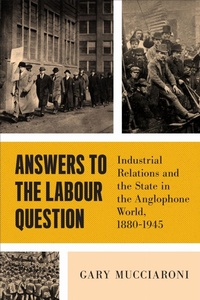
Answers to the Labour Question
Industrial Relations and the State in the Anglophone World, 1880-1945
Published on 13. February 2024
Book
Hardback
322 pages
978-1-4875-5149-0 (ISBN)
Description
Since the mid-nineteenth century, public officials, reformers, journalists, and other elites have referred to "the labour question." The labour question was rooted in the system of wage labour that spread throughout much of Europe and its colonies and produced contending classes as industrialization unfolded. Answers to the Labour Question explores how the liberal state responded to workers' demands that employers recognize trade unions as their legitimate representatives in their struggle for compensation and control over the workplace.
Gary Mucciaroni examines five Anglophone nations - Australia, Canada, Great Britain, New Zealand, and the United States - whose differences are often overlooked in the literature on political economy, which lumps them together as liberal, "market-led" economies. Despite their many shared characteristics and common historical origins, these nations' responses to the labour question diverged dramatically. Mucciaroni identifies the factors that explain why these nations developed such different industrial relations regimes and how the paths each nation took to the adoption of its regime reflected a different logic of institutional change. Drawing on newspaper accounts, parliamentary debates, and personal memoirs, among other sources, Answers to the Labour Question aims to understand the variety of state responses to industrial unrest and institutional change beyond the domain of industrial relations.
Gary Mucciaroni examines five Anglophone nations - Australia, Canada, Great Britain, New Zealand, and the United States - whose differences are often overlooked in the literature on political economy, which lumps them together as liberal, "market-led" economies. Despite their many shared characteristics and common historical origins, these nations' responses to the labour question diverged dramatically. Mucciaroni identifies the factors that explain why these nations developed such different industrial relations regimes and how the paths each nation took to the adoption of its regime reflected a different logic of institutional change. Drawing on newspaper accounts, parliamentary debates, and personal memoirs, among other sources, Answers to the Labour Question aims to understand the variety of state responses to industrial unrest and institutional change beyond the domain of industrial relations.
More details
Series
Language
English
Place of publication
Toronto
Canada
Target group
College/higher education
Professional and scholarly
Product notice
sewn/stitched
Cloth over boards
Illustrations
1 b&w figures, 2 b&w tables
Dimensions
Height: 229 mm
Width: 152 mm
Thickness: 22 mm
Weight
644 gr
ISBN-13
978-1-4875-5149-0 (9781487551490)
Copyright in bibliographic data and cover images is held by Nielsen Book Services Limited or by the publishers or by their respective licensors: all rights reserved.
Schweitzer Classification
Person
Gary Mucciaroni is a professor of political science and director of Master of Public Policy Program at Temple University.
Content
1. Answers to the Labour Question
2. Why the Anglophone Nations Diverged
3. How the Regimes Emerged
4. The Statist Answer: Australasia
5. The Voluntarist Answer: Great Britain
6. Elusive Answers: The United States before the 1930s
7. The Legalist Answer: The United States
8. Limited Statism: Canada's First Answer
9. Canada Capitulates to Legalism
10. Conclusions
Appendix
Notes
Works Cited
Index
2. Why the Anglophone Nations Diverged
3. How the Regimes Emerged
4. The Statist Answer: Australasia
5. The Voluntarist Answer: Great Britain
6. Elusive Answers: The United States before the 1930s
7. The Legalist Answer: The United States
8. Limited Statism: Canada's First Answer
9. Canada Capitulates to Legalism
10. Conclusions
Appendix
Notes
Works Cited
Index