

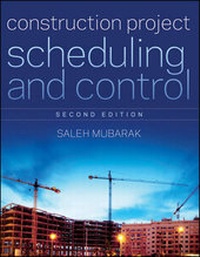
Construction Project Scheduling and Control
2nd Edition
Published on 13. July 2010
Book
Hardback
480 pages
978-0-470-50533-5 (ISBN)
Description
Written by a career construction professional, this text about scheduling and project lays out all steps clearly with solved and unsolved exercises that cover each subject. Computer software programs for construction are included for each chapter, along with examination of precedence networks as the realistic solution to scheduling. Also explored are new concepts in CPM scheduling such as the author's own Dynamic Minimum Lag technique. Addressing the average student, Construction Project Scheduling and Control skillfully guides readers through every aspect of a construction project, no matter what the size.
More details
Edition
2nd Revised edition
Language
English
Place of publication
Chichester
United Kingdom
Publishing group
John Wiley and Sons Ltd
Target group
Professional and scholarly
Edition type
Revised edition
Illustrations
Illustrations
Dimensions
Height: 242 mm
Width: 191 mm
Thickness: 30 mm
Weight
976 gr
ISBN-13
978-0-470-50533-5 (9780470505335)
Copyright in bibliographic data and cover images is held by Nielsen Book Services Limited or by the publishers or by their respective licensors: all rights reserved.
Schweitzer Classification
Other editions
New editions
Saleh A. Mubarak
Construction Project Scheduling and Control
Book
04/2015
3rd Edition
Wiley
€135.00
Article exhausted; check for reprint
Person
Saleh Mubarak, PhD, is Training Manager at the Qatar Project Management (QPM) Company in Doha, Qatar. A member of PMI and the PMI College of Scheduling, he served on the committee that created the PMI COS professional scheduler certification exam and is a former project controls manager with the Public Works Department of Hillsborough County in Tampa, Florida.
Content
Preface. Preface to the First Edition. Chapter 1 Introduction. Planning and Scheduling. Project Control. Why Schedule Projects? The Scheduler. Scheduling and Project Management. Chapter 1 Exercises. Chapter 2 Bar (Gantt) Charts. Definition and Introduction. Advantages of Bar Charts. Disadvantages of Bar Charts. Chapter 2 Exercises. Chapter 3 Basic Networks. Definition and Introduction. Arrow Networks. Node Networks. Comparison of Arrow and Node Networks. Networks versus Bar Charts. Time-Scaled Logic Diagrams. Chapter 3 Exercises. Chapter 4 The Critical Path Method (CPM). Introduction. Steps Required to Schedule a Project. Supplemental Steps. Resource Allocation and Leveling. Beginning-of-Day or End-of-Day Convention. The CPM Explained through Examples. Logic and Constraints. Chapter 4 Exercises. Chapter 5 Precedence Networks. Definition and Introduction. The Four Types of Relationships. The Percent Complete Approach. Fast-Track Projects. A Parallel Predecessor? CPM Calculations for Precedence Diagrams. Final Discussion. Chapter 5 Exercises. Chapter 6 Resource Allocation and Resource Leveling. Introduction. The Three Categories of Resources. What Is Resource Allocation? Resource Leveling. Materials Management. Chapter 6 Exercises. Chapter 7 Schedule Updating and Project Control. Introduction. The Need for Schedule Updating. Project Control Defined. Schedule Updating. Project Control. Chapter 7 Exercises. Chapter 8 Schedule Compression and Time-Cost Trade-Off. Introduction. Setting Priorities. Accelerating a Project. Direct and Indirect Costs. Recovery Schedules. Accelerating Projects Using Computers. Potential Issues with Uncoordinated Project Acceleration. Optimum Project Scheduling. Chapter 8 Exercises. Chapter 9 Reports and Presentations. Introduction. The Difference between Reports and Presentations. Skills Necessary for Giving Good Presentations. The Power of Presentation. Reviewing Reports before and after Printing. General Tips on Printing Reports. Summary Reports. Paper or Electronic Reports? E-Reports. Communications in the International Environment. Chapter 9 Exercises. Chapter 10 Scheduling as Part of the Project Management Effort. Introduction. Scheduling and Estimating. Estimating and Accounting. Scheduling and Accounting. Scheduling and Change Orders. Paperless Project Management. Procurement Management. Management of Submittals. The Master Schedule and Subschedules. Multiproject Management. Time Contingency and Management Options. Chapter 10 Exercises. Chapter 11 Other Scheduling Methods. Introduction. Program Evaluation and Review Technique (PERT). Graphical Evaluation and Review Technique (GERT). Linear Scheduling Method (LSM). Chapter 11 Exercises. Chapter 12 Dynamic Minimum Lag Relationship. Introduction. Why DML? Similarity of DML Concept with Linear Scheduling Method (LSM). How Does the DML Work? DML Relationship in the CPM calculations. Can the Lag in the DML Relationship Be a Percentage? Conclusion. Chapter 12 Exercises. Chapter 13 Construction Delay and Other Claims. Methods of Schedule Analysis. Chapter 13 Exercises. Chapter 14 Schedule Risk Management. Introduction. Types of Risk in Construction Projects. Schedule Risk Types. Definition of Risk Terms. Importance of Good Planning for Risk Management. Importance of Good CPM Scheduling Practices for Risk Assessment. Risk Shifting in Contracts. Schedule Risk Management Steps. Expected Value. Application in Scheduling. Examples of Risk Adjustment. Conclusion. Chapter 14 Exercises. Appendix A Computer Project. General Guidelines. Cost Loading. Updating the Project. Change Order. Resource Leveling. Schedule Compression. Schedule Compression 2. Delay Claim 1: Unforeseen Conditions. Delay Claim 2: Change in Owner's Requirements. Appendix B Sample Reports. Tabular Reports. Graphic Reports. Abbreviations. Glossary. References. Bibliography. Index.